











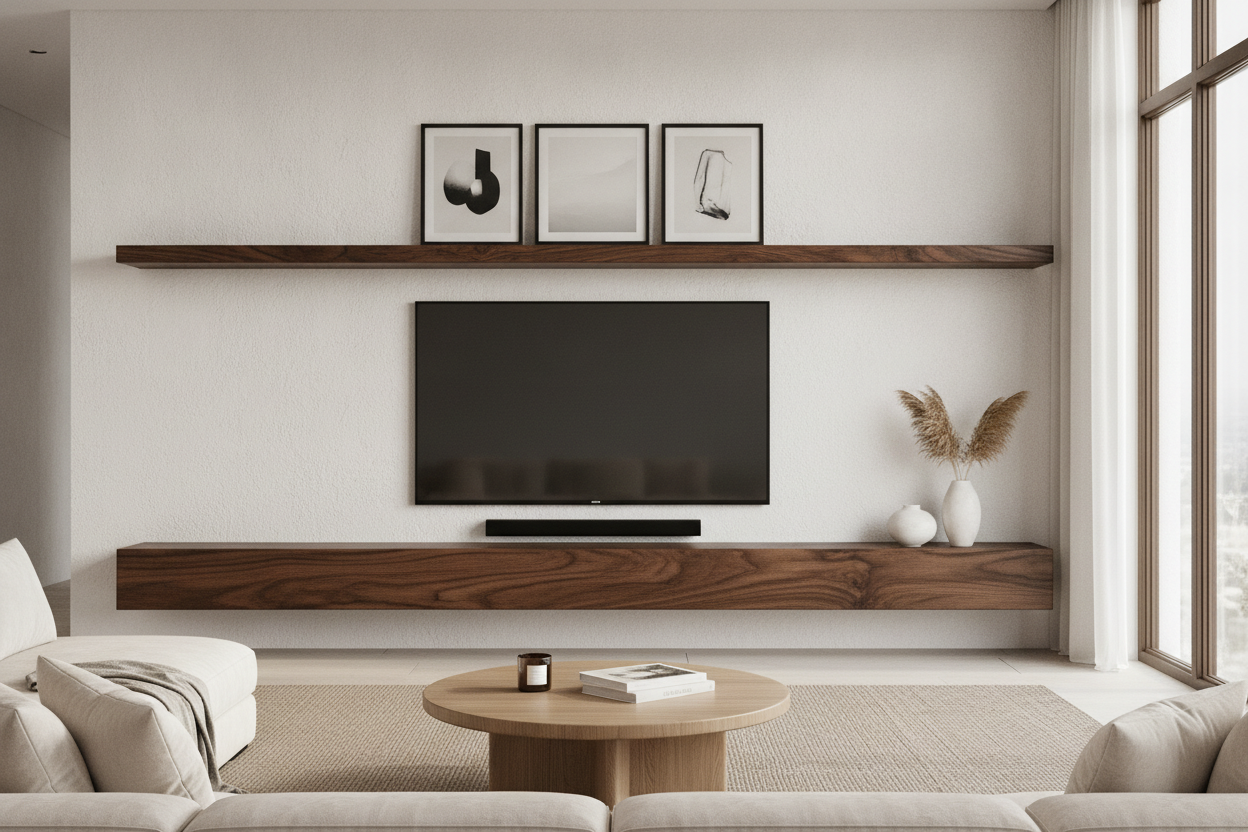
I spent three years staring at a tangle of black HDMI cables dangling from my wall-mounted TV like a bad science experiment. I tried one of those cheap, hollow-core floating shelves from a big-box store, and within six months, it was bowing in the middle like a tired hammock. If you want your living room to look like a grown-up actually lived there, you need a wooden wall shelf for tv that has some actual backbone.
- Real timber handles weight; MDF sags under the pressure of a soundbar.
- Thickness is the secret—aim for at least 2 inches to balance the screen size.
- Natural wood grain softens the harsh, clinical look of tech electronics.
- Heavy-duty brackets and stud-mounting are mandatory for solid wood.
The Problem With Most Under-TV Ledges
Most floating shelves you find online are essentially glorified cardboard with a wood-look sticker slapped on top. They look fine for a single picture frame or a small succulent, but the second you put a soundbar or a gaming console on them, they start to tilt. This is the 'dorm room effect'—that sagging, flimsy look that screams temporary housing rather than a designed home.
I finally replaced my bulky console because I wanted a cleaner, more airy living room. But I learned the hard way that 'lightweight' usually just means 'cheap.' If you want that high-end, custom-built look, you need a material that doesn't buckle under the weight of a single remote control. MDF is just sawdust and glue; it doesn't have the structural integrity to stay level over time, especially in humid environments where the core starts to swell and crumble.
Why Real Wood Changes the Entire Vibe
A television is just a giant, cold, black rectangle. It is clinical and, frankly, a bit of an eyesore when it is powered off. By swapping glossy media centers for wood, you are introducing texture and warmth that balances out all that glass and plastic. Wooden wall shelves for tv bring an organic element that makes the screen look like a part of your home’s design rather than just an appliance you slapped on the wall.
Natural grain patterns break up the flat, sterile surfaces of a modern room. Whether it is the tight, consistent grain of maple or the dramatic, chocolatey swirls of walnut, real wood has a depth that laminate can't replicate. It catches the light differently and feels substantial. When you pair a high-tech OLED screen with a piece of kiln-dried timber, you create a contrast that feels intentional and expensive.
Visual Weight Anchors the Room
If your shelf is less than 2 inches thick, it is going to look 'off' under a 55-inch or 65-inch TV. You need mass to counter the scale of the screen. A chunky, 3-inch thick slab of timber anchors the TV to the wall, creating a visual foundation so the screen doesn't look like it is just floating in space. Without that thickness, the shelf looks like an afterthought rather than a deliberate design choice.
Sourcing the Right Wooden Wall Shelves for TV
When you are shopping for wooden wall shelves for tv, walnut is the gold standard for that mid-century modern look, while white oak feels more modern and Scandinavian. Avoid 'pine' unless it is specifically reclaimed and thick, as cheap pine is soft and prone to denting if you happen to drop a controller on it. You want a hardwood that can take a bit of a beating.
Just remember: solid wood is heavy. If you are looking for adjustable shelf storage as an alternative for taller AV receivers or a growing collection of media, that is a great path for flexibility. But for a main ledge, go fixed and go heavy-duty. Use toggle bolts or, better yet, hit the studs directly. I once bought a 'live edge' shelf that was so warped I could not get a level on it; I spent four hours shimming the brackets just to keep my soundbar from sliding off. Buy kiln-dried wood to avoid that headache.
Styling Your New Wood Ledge (Without the Clutter)
The goal for a floating ledge is 'curated,' not 'cluttered.' Keep it simple. A stack of two coffee table books and maybe one matte ceramic vase is plenty. If you have a vintage wood bookcase nearby, try to match the stain or at least the undertone. If your bookcase is a cool-toned oak, don't put a cherry-red shelf right next to it.
Matching your wood tones makes the whole room feel cohesive and expensive. It ties the floating element back into the rest of your furniture, making it look like a custom architectural feature rather than something you bought on a whim. It is the difference between a room that looks 'furnished' and a room that looks 'designed.'
FAQ
How high should I mount the shelf?
I usually aim for 4 to 6 inches below the bottom of the TV. This is enough space to fit a soundbar without leaving a massive gap that exposes all your wires, but enough room to let the wood grain breathe.
Can it hold a heavy AV receiver?
Only if the brackets are rated for the weight and you are screwed directly into at least two wall studs. Solid wood is heavy on its own; adding a 25-pound receiver requires serious hardware, not just drywall anchors.
How do I hide the wires?
The cleanest way is to run them behind the drywall using an in-wall cable kit. If you are renting and can't do that, use a paintable cord cover that matches your wall color exactly. It becomes much less distracting when it blends into the background.

Dejar un comentario
Este sitio está protegido por hCaptcha y se aplican la Política de privacidad de hCaptcha y los Términos del servicio.