










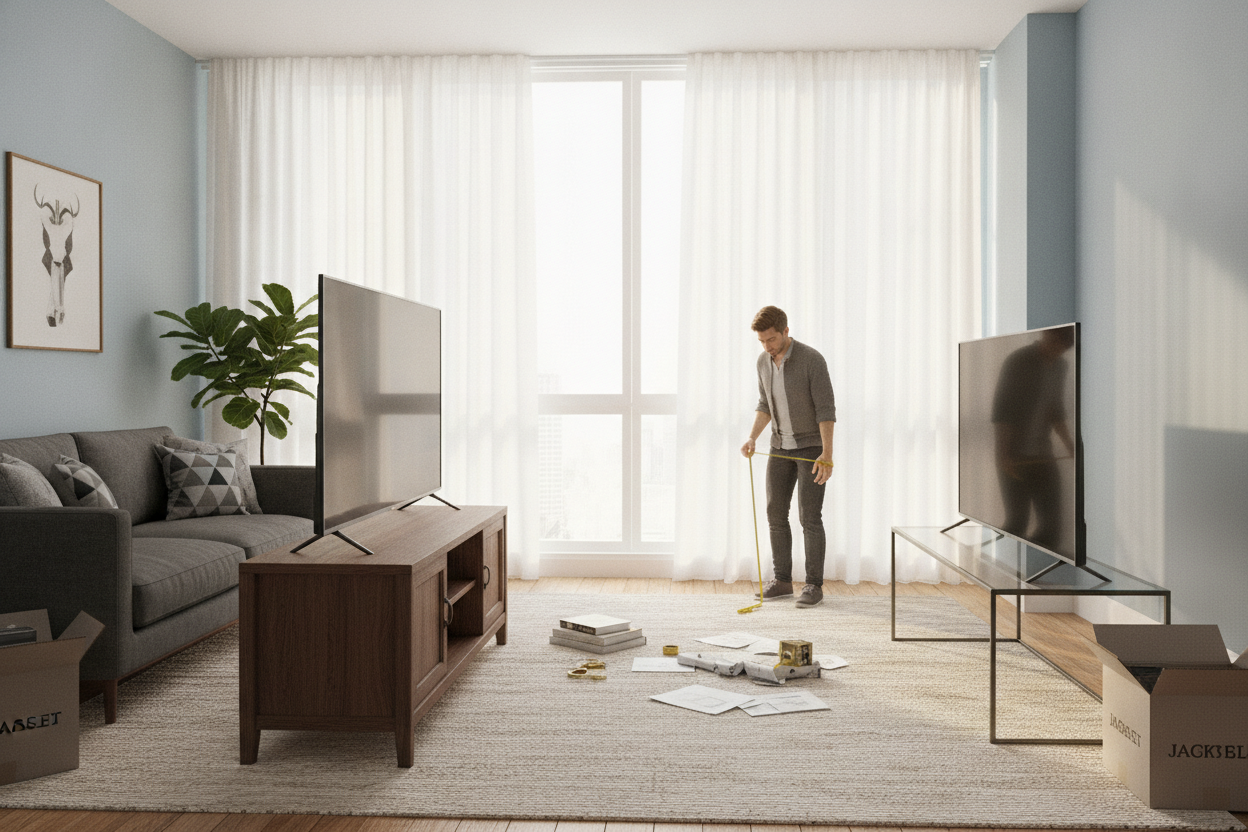
I spent three hours last Tuesday staring at a 40-inch screen sitting on a stack of moving boxes in my guest room. It felt like a crime against interior design. The problem is that most modern furniture is built for the 'bigger is better' era, leaving those of us with modest screens stuck in a weird middle ground. If you buy a massive console, your TV looks like a postage stamp; if you buy a tiny plastic cart, your room looks like a freshman dorm room.
Finding the right tv stands 40 inch flat screen setups is actually a lesson in geometry. A 40-inch TV is usually about 35 inches wide. To make it look like a deliberate design choice rather than a temporary fix, you need a stand that offers enough 'breathing room' on the sides without swallowing the screen whole. I’ve lived through the trial and error of wobbly MDF boards and oversized monstrosities, and I’m here to tell you there’s a better way.
Quick Takeaways
- Aim for a stand between 42 and 50 inches wide to balance the 35-inch screen width.
- Prioritize solid wood or heavy-duty metal over flimsy wire shelving.
- Look for 'sideboards' or 'entryway tables' if the TV section feels too bulky.
- Closed storage is non-negotiable for hiding the rat’s nest of HDMI cables.
The Awkward Proportion Problem We Need to Talk About
The visual weight of a 40-inch screen is tricky. It’s large enough to be a focal point but small enough to look pathetic if the furniture around it is too 'loud.' When shopping for tv stands for 40 inch flat screen setups, the golden rule is the 'two-inch overhang' minimum. You want at least two to five inches of surface area on either side of the TV feet. Anything less and the setup looks precarious; anything more than ten inches and the TV looks like it’s shrinking.
I’ve seen people drop a 40-inch screen on a 72-inch media console, and it’s a disaster. The empty space on the sides becomes a magnet for clutter—mail, half-empty coffee mugs, and random keys. You want a piece of furniture that frames the screen. Think of it like a well-tailored suit. If it’s too big, you look like a kid playing dress-up. If it’s too small, it’s just uncomfortable.
Stop Settling for Flimsy Metal Carts
We’ve all seen those wire rolling carts that claim to be 'utility stands.' Please, for the love of your floor plan, stop buying them. They vibrate when the speakers kick in, they show every single cable, and they scream 'I just moved in and haven’t unpacked yet.' Investing in a real tv cabinet for 40 inch tv screens—something with actual density—grounds the entire room. I prefer kiln-dried oak or even high-quality birch plywood over that hollow-core honeycomb stuff that bows under the weight of a single soundbar.
If you’re tired of the 'dorm room' aesthetic, I suggest browsing standard TV stands that lean into mid-century modern or industrial styles. A solid base doesn't just hold the TV; it absorbs the visual chaos of the room. I once bought a $40 metal rack for my bedroom setup and regretted it within a week because the wheels scratched my hardwood and the whole thing swayed every time I walked past it. A heavy, stationary cabinet is always the better play.
Storage First: Making the Most of a Compact Footprint
In a small apartment, every square inch has to pay rent. If you’re getting an entertainment center for 40 inch tv models, it needs to do more than just hold a screen. I look for units with at least two closed cabinets. Why? Because routers, gaming consoles, and power strips are ugly. You want to tuck those away so the only thing people see is your curated book collection or a nice ceramic vase.
Don't be afraid to go vertical, either. Sometimes a taller cabinet is the best stand for smaller screens because it brings the display up to eye level while providing three tiers of storage below. I use a 30-inch high sideboard for my 40-inch screen, which allows me to store my entire board game collection and a printer underneath. It turns a 'TV corner' into a functional storage hub.
The Sneaky Trick for Hiding Your Screen Entirely
Let’s be honest: even a well-proportioned TV is still a big black rectangle that sucks the soul out of a room when it’s turned off. If you’re a minimalist or you’re trying to maintain a specific 'vibe' in a small studio, you might want to hide the tech altogether. This is where the 'stealth' furniture comes in.
You can actually find specialized furniture with a hidden mechanism TV cabinet that allows the screen to disappear into the unit with the press of a button. It sounds like something out of a Bond movie, but for a 40-inch screen, it’s a total space-saver. During the day, you have a beautiful wooden console; at night, you have a movie theater. It’s the ultimate way to reclaim your aesthetic without giving up Netflix.
Navigating Showrooms When Everything Is Oversized
If you go looking for a tv stand for 40 inch tv nearby at a big-box retailer, you’re going to be frustrated. Most showrooms are designed to sell 75-inch monsters, so their 'small' section is usually an afterthought of cheap particle board. My pro tip? Stop looking in the TV section. Head over to the 'Entryway' or 'Dining' departments.
A sturdy entryway console or a dining room buffet is often the perfect height (30-34 inches) and width (42-48 inches) for a 40-inch flat screen. These pieces are usually built with better materials because they're meant to hold heavy dishes or survive high-traffic foyers. I found my current stand in the 'office' section—it was technically a lateral file cabinet, but the dimensions were spot-on and the build quality was ten times better than the actual TV stands sitting three aisles over.
Frequently Asked Questions
Can I put a 40-inch TV on a 40-inch wide stand?
Technically yes, but it will look cramped. The feet of the TV might be right at the edge, which is a tipping hazard. Aim for a stand at least 44 inches wide for a much cleaner look.
Is a wall mount better for a 40-inch TV?
Wall mounting saves floor space, but you still have the 'cable dangle' problem. If you don't want to cut into your drywall to hide wires, a slim console is usually the more practical choice.
What is the best height for a TV stand?
For a 40-inch screen, you want the center of the TV to be at eye level when you're sitting. Usually, a stand height of 24 to 30 inches is the sweet spot for most standard sofas.

Dejar un comentario
Este sitio está protegido por hCaptcha y se aplican la Política de privacidad de hCaptcha y los Términos del servicio.