










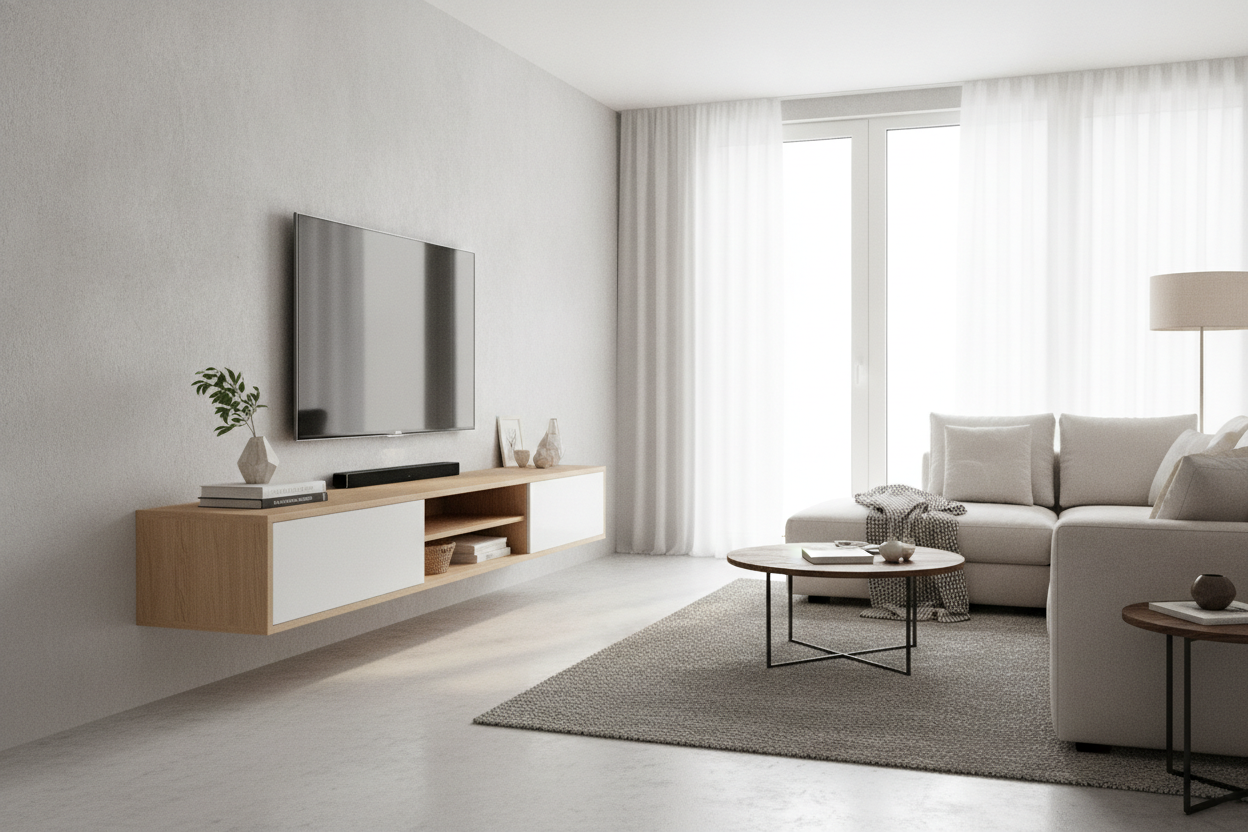
I spent three hours staring at my living room wall last Saturday, a level in one hand and a stud finder in the other. I was terrified that my new modern tv stand floating design would rip a massive hole in the drywall and take my 65-inch OLED down with it. But after five years of living in apartments where every square inch of floor is a premium, I’ve realized that legs are often just visual clutter we can't afford to keep.
There is something about seeing the floor extend all the way to the baseboard that makes a 300-square-foot studio feel like a loft. It’s a design trick that works every time, but the execution is where most people panic. If you’re tired of vacuuming around spindly legs and want that clean, gallery-like look, you have to get over the fear of the drill.
Quick Takeaways
- Always mount into at least two wooden studs; drywall anchors are for pictures, not furniture.
- Check the weight capacity of your wall bracket—most are rated for 50-75 lbs.
- Use a cord management channel or 'smurf tube' inside the wall to hide the spaghetti of wires.
- Leave at least 8 to 10 inches of clearance from the floor for the best visual effect.
The 'Will It Fall?' Anxiety is Completely Valid
Let’s be real: hanging a 40-pound box made of MDF and glass onto a vertical sheet of gypsum board feels like a bad idea. I’ve been there. I once bought a cheap unit that felt like it was made of balsa wood, and every time I put a coffee table book on it, I heard a faint 'creak' that kept me up at night. That anxiety is your brain telling you that physics is real.
But here is why you should do it anyway. A floor-based console is a dust magnet. It traps pet hair and crumbs in a No Man’s Land that no Roomba can reach. Beyond the hygiene, it’s about the 'visual weight.' When a piece of furniture sits on the floor, it anchors the room and makes it feel smaller. When you lift that modern floating tv console just a few inches up, the room breathes. It’s the difference between a cramped basement and a curated showroom.
The trick to sleeping at night is over-engineering the mount. If the manual says you need four screws, use six. If it comes with those flimsy plastic ribbed anchors, throw them in the trash immediately. We are playing for keeps here.
How to Choose a Modern Floating TV Console (That Won't Break Your Wall)
Before you start drilling, you need to pick a unit that isn't destined to sag. I’ve seen enough 'budget' units bow in the middle after three months to know that material thickness matters. Look for units that use at least 18mm thick panels. If you see 12mm or 15mm, run. It might look okay in the stock photo, but once you add a soundbar and a gaming console, it’s going to look like a frown.
When you start browsing Tv Stands, pay attention to the mounting hardware. You want a 'French Cleat' system or a full-length steel bracket. Avoid units that only have two small 'keyhole' hangers at the corners. Those are fine for a mirror, but they’ll fail under the weight of a media center. I also highly recommend reading up on a Mid Century Modern Floating Tv Stand What Stores Wont Tell You to understand how certain vintage-style veneers can hide low-quality cores that don't hold screws well.
Weight distribution is your best friend. A longer console is actually better because it allows you to hit more studs. A 60-inch unit will likely span three studs (spaced 16 inches apart), which gives you three points of contact. That is significantly more secure than a tiny 30-inch box hanging on a single stud.
The Stud-Finder Math You Cannot Ignore
You cannot guess where your studs are. I don’t care if you’ve done the 'knock test' and think you hear a solid thud. Buy a magnetic stud finder or a high-end electronic one. In most North American homes, studs are 16 inches apart on center. Once you find one, mark it, then measure 16 inches over to find the next. If your console doesn't align perfectly with your studs, you have to use a mounting board or heavy-duty toggle bolts, but I always advocate for moving the console an inch or two just to hit the wood.
If you are a renter, don't panic. Four 2.5-inch lag bolts into studs leave holes no bigger than a standard curtain rod bracket. When you move out, a $5 tub of spackle and a tiny bit of touch-up paint will make those holes disappear. It is much easier to fix a small hole than it is to explain to a landlord why your TV fell and took a chunk of the wall with it because you used the wrong anchors.
Styling a Contemporary Floating Entertainment Center
Once the unit is up, the biggest mistake people make is leaving it as a lonely island on a big blank wall. You need to anchor it visually. I like to use a Stylish Black Tv Stand Entertainment Center Modern Design With Ample Storage Space to create a high-contrast focal point. The black finish hides the 'eye' of the TV when it’s off, making the whole setup look like a deliberate design choice rather than just a place to watch Netflix.
To make a contemporary floating entertainment center look integrated, follow the rule of thirds. Put a tall vase or a stack of books on one side to break up the long horizontal line. Don't over-clutter the top; the whole point of a floating unit is minimalism. If you have a soundbar, mount it to the wall or the TV itself so it also 'floats' above the console. This creates a layered look that feels expensive and architectural.
What to Do With That Awkward Space Underneath
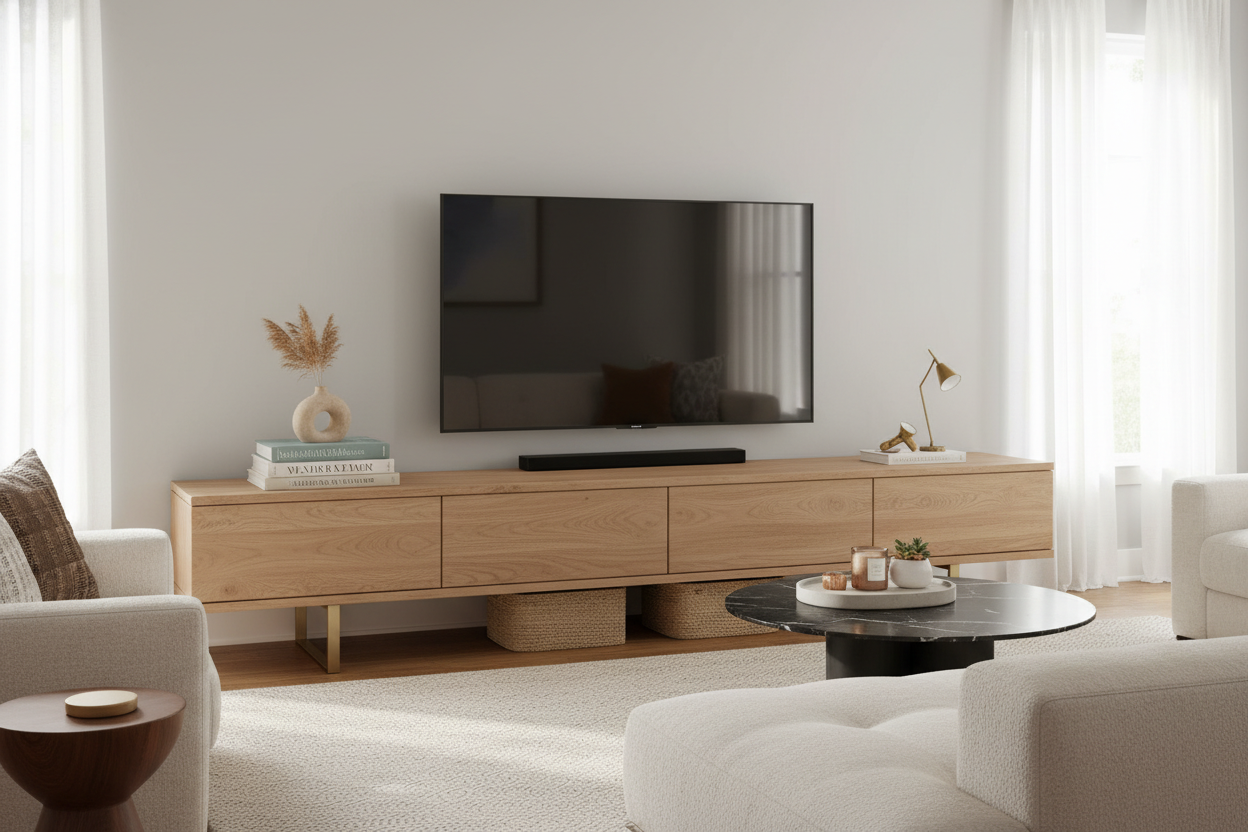
The space between the floor and your console is prime real estate. If you leave it empty, it can look a bit clinical. I usually slide two low-profile woven baskets underneath. They are great for hiding extra blankets or dog toys, and they add a bit of texture to balance out the hard lines of a modern unit.
If you’re a plant person, this is the perfect spot for low-light favorites like a Snake Plant or a ZZ Plant. Just make sure the pots have saucers so you aren't getting water on your floors. The goal is to make the 'float' look intentional. By filling that negative space with soft textures or greenery, you emphasize the fact that the floor is clear, which is the ultimate small-space flex.
My Honest Experience
I once tried to mount an 80-inch console by myself. It was a disaster. I thought I could hold it with one shoulder while driving the first screw. I ended up stripping the screw, scratching the paint, and nearly breaking my toe. Please, get a friend to help you hold the unit while you level it. Also, I once used 1.5-inch screws instead of 2.5-inch ones because that’s all I had in the drawer. The unit stayed up for a week before I noticed it pulling away from the wall. Don't cut corners on hardware. Spend the $8 on the right bolts.
Frequently Asked Questions
Can I mount a floating TV stand on a plaster wall?
Yes, but you have to be careful. Plaster and lath are more brittle than drywall. Use a masonry bit to drill your pilot holes so you don't crack the plaster, and definitely ensure you are hitting the structural studs behind the lath.
How high should a floating TV stand be?
Usually, the bottom of the unit should be 8 to 12 inches off the floor. However, the more important measurement is your TV height. Your eyes should be level with the middle of the screen when you are sitting on your sofa.
Will a floating console hold a heavy soundbar?
If it is mounted into studs, yes. Most modern consoles can handle 50+ pounds easily. Just check the specs of the specific unit you bought, as some decorative shelves are only rated for 20 pounds.

Dejar un comentario
Este sitio está protegido por hCaptcha y se aplican la Política de privacidad de hCaptcha y los Términos del servicio.