










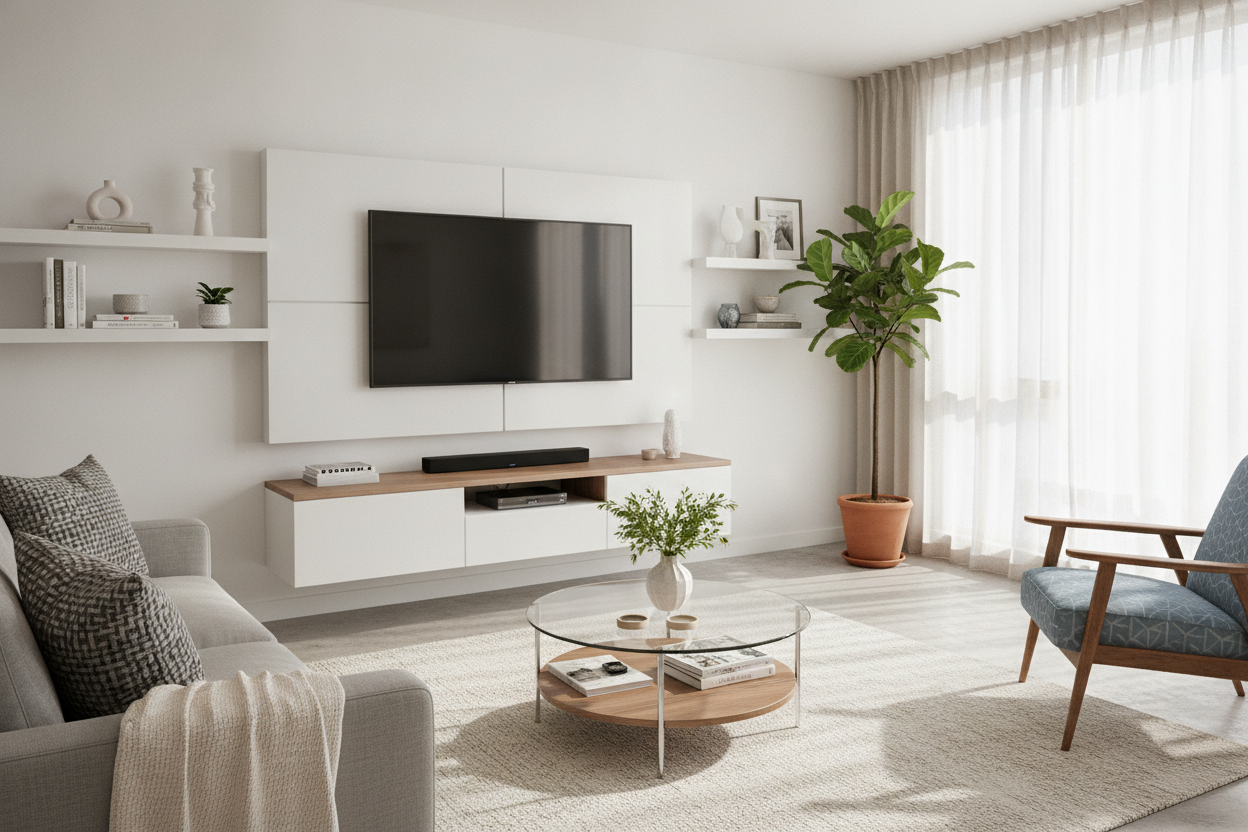
I remember staring at my lease agreement, specifically the part about 'no structural modifications,' while clutching a brand new 65-inch OLED. My apartment walls are basically made of old crackers and hope. I wanted that sleek, hovering look you see in architecture magazines, but my security deposit was on the line. That's when I realized a television stand with floater mount was the only way to get the look without the liability.
I’ve spent too many nights scrolling through furniture sites trying to find a piece that doesn't look like a bulky dresser from 2004. Most traditional consoles sit way too low, forcing you to look down at the screen, which is a one-way ticket to neck strain. By choosing a hybrid setup, I finally got my screen at eye level while keeping my landlord happy.
Quick Takeaways
- Achieve a wall-mounted look with zero holes in the drywall.
- Integrated cable management hides the 'spaghetti' of HDMI and power cords.
- Adjustable height settings let you find the perfect viewing angle.
- Significantly more stable than cheap tripod stands or flimsy legs.
The 'I Want It Mounted But I Rent' Dilemma
Renting is a constant battle between wanting a home that feels like yours and knowing you might have to pack it all into a U-Haul in twelve months. Most landlords act like a single toggle bolt is a structural sin. Even if you have permission, apartment walls are notoriously unreliable. I Used A Tv Stand With Mount Because My Wall Studs Betrayed Me in my last place, where the studs were spaced at some mystery interval that defied all logic. Putting a heavy TV on a wall you don't trust is a recipe for a 3 AM disaster.
A tv stand with floater mount solves the trust issues. It’s a self-contained unit. The weight isn't pulling on your drywall; it’s being distributed down a steel spine into a heavy, stable base. You get the height, you get the 'floating' effect, and you get to keep your deposit when you move out.
Enter the Television Stand With Floater Mount
This isn't just a regular console with a pole stuck on the back. A proper floater mount is engineered to act as a cantilever. The bracket holds the screen several inches above the surface of the stand, creating a gap that mimics the look of a professional wall installation. Because the spine is usually made of heavy-gauge steel, it can support those massive 75-inch screens that would make a standard piece of particle-board furniture bow in the middle.
The beauty of this setup is the footprint. You can have a very slim, minimalist base that doesn't eat up your floor space, while the TV sits securely above it. It's the ultimate 'fake it till you make it' for home theater enthusiasts who are tired of the bulky look of traditional media centers.
Wait, what exactly is a floater mount?
Think of it as a hybrid between a wall mount and a floor stand. A standard stand just gives you a flat surface to put the TV's included legs on. A floater mount uses a VESA-compatible bracket—the same kind you'd use on a wall—but attaches it to a vertical pillar integrated into the furniture. This allows for swivel and tilt adjustments that you just can't get with the plastic 'chicken feet' legs that come in the TV box.
Faking the Built-In Aesthetic (Without the Handyman Bill)
If you want people to walk in and think your TV is actually on the wall, you have to style it right. The trick is to push the base of the stand as close to the wall as possible. Since most of these units have a slim profile, they can sit almost flush against your baseboards. Why I Swapped My Console For A Tv Stand With Mount And Shelves was largely about this visual trickery; by clearing the surface of the stand, you create a sense of openness that makes the whole room feel larger.
I personally like to place a few taller decor items—like a ceramic vase or a stack of oversized coffee table books—just slightly to the side of the support pillar. It breaks up the vertical line and draws the eye to the 'floating' screen instead of the hardware holding it up. If you choose a unit with a dark spine, it virtually disappears against a dark accent wall or in low-light movie settings.
The Cord Management Actually Makes Sense
We've all seen those 'wall-mounted' TVs where a thick black bundle of cords dangles down to the outlet like an ugly tail. It ruins the whole vibe. The best part of a floater mount is the hollow spine. It’s a secret tunnel for your tech. You run the power and HDMI through the top of the pillar and they pop out at the bottom, right behind your components.
When you use a Mid Century Modern Tv Stand With Slatted Doors Open Shelves And Cable Management, you can tuck your PS5 and Apple TV inside the cabinets and have a completely wireless look. It’s a much cleaner solution than those plastic cord-hider strips that never quite stick to the paint and always look like an afterthought. I’ve found that taking ten minutes to zip-tie everything inside the pillar makes a world of difference.
My Personal Experience
I’ll be honest: I once bought a super cheap floater stand that claimed it could hold 100 pounds. It couldn't. The metal was so thin that my TV had a permanent 5-degree 'sad tilt' to the left. I learned the hard way that you want a base with some actual heft—look for tempered glass or solid wood bases that weigh at least 40-50 pounds on their own. Now that I have a sturdy one, I’ll never go back to a basic tabletop setup.
FAQ
Is a floater mount safe for heavy TVs?
Yes, as long as you check the weight capacity. Most high-quality mounts are rated for 80 to 110 pounds, which covers almost any modern 65 or 75-inch LED. Just make sure the VESA pattern on your TV matches the bracket.
Can I swivel the TV with this stand?
Most floater mounts offer about 15 to 30 degrees of swivel in either direction. It’s perfect for open-concept apartments where you might want to turn the screen toward the kitchen while you're cooking dinner.
Will it work with a soundbar?
Absolutely. You can either sit the soundbar on the console surface directly below the TV or use 'soundbar brackets' that attach to the floater mount itself, keeping the speaker floating right along with the screen.

Dejar un comentario
Este sitio está protegido por hCaptcha y se aplican la Política de privacidad de hCaptcha y los Términos del servicio.