










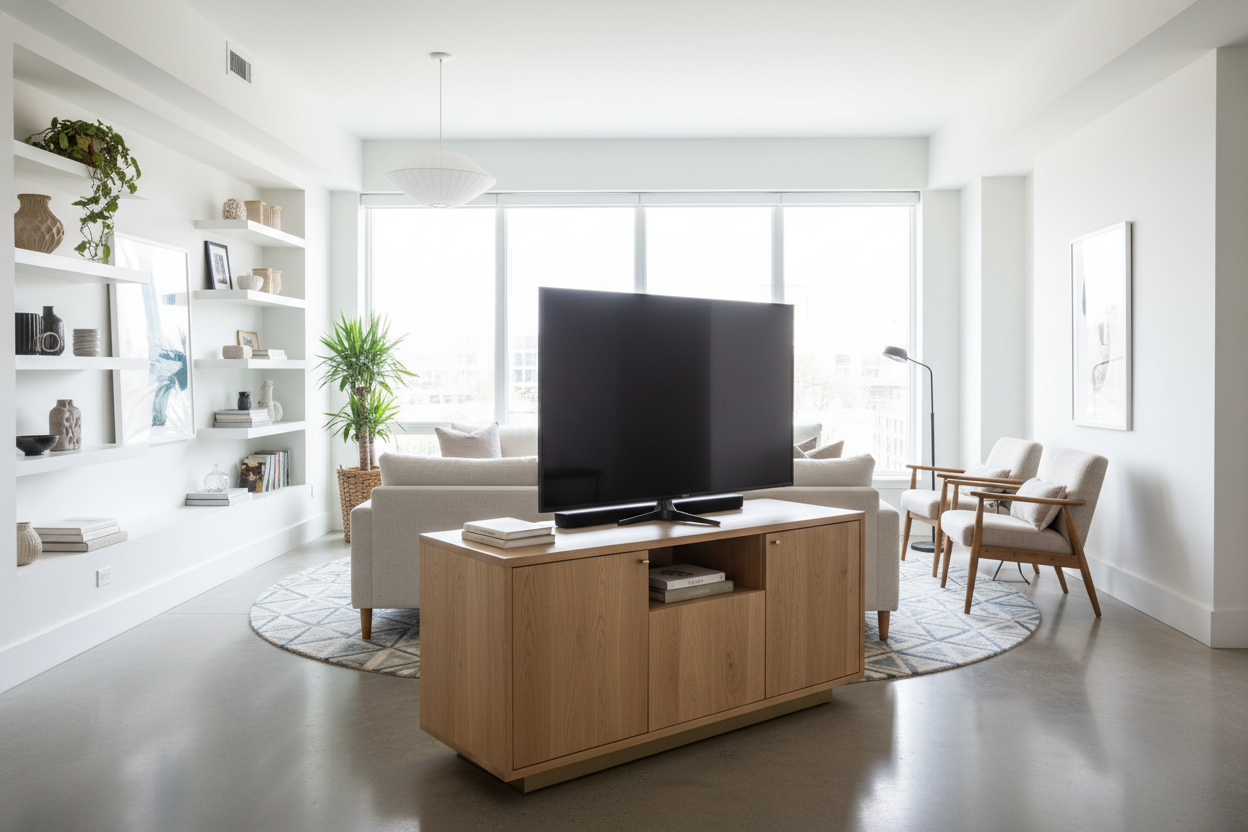
I spent three months staring at a 15-foot gap between my sofa and my television. It felt like a middle school gym during a slow song—awkward, empty, and totally devoid of purpose. Like most people moving into an open floor plan, I followed the primal urge to shove every piece of furniture against the drywall. I thought I was 'saving space,' but I was actually just creating a cavernous void that made my living room feel like a hotel lobby.
The fix wasn't a bigger rug or more wall art. It was moving the middle room tv stand away from the perimeter. Breaking the 'walls-only' rule is terrifying at first, but it is the only way to actually define a zone in a house that doesn't have enough walls.
Quick Takeaways
- Floating furniture creates functional 'rooms' within an open floor plan.
- A middle-room placement requires a console finished on all sides to avoid the 'ugly back' look.
- Cable management is the biggest hurdle, but floor outlets or flat rug-cords solve it easily.
- Pairing a floating stand with a console table or plants helps it feel grounded, not stranded.
The 'Dance Hall' Effect (Why Open Concepts Are So Hard)
Open floor plans are a dream in real estate listings and a nightmare to actually furnish. Without walls to lean things against, we panic. We line the perimeter with sofas and cabinets, leaving a massive, useless square of hardwood in the center. I call this the 'dance hall' effect. It makes conversation difficult because people are sitting ten feet apart, and it makes the room feel unfinished no matter how much decor you buy.
Initially, I tried to solve this by going bigger on the walls. I installed a massive modern wall cabinet for living room storage, thinking that filling the vertical space would fix the horizontal emptiness. It looked great, but the layout was still broken. I was still shouting across a void to talk to anyone on the sofa. I realized that the furniture wasn't the problem—the placement was.
Enter the Middle Room TV Stand (Yes, It's Scary at First)
Pulling your media setup into the center of the room feels like a design crime. You worry about blocking the flow or making the room feel smaller. In reality, a middle room tv stand acts as a low-profile room divider. It creates a 'corridor' behind the TV for foot traffic while making the seating area feel intimate and intentional.
When you use a tv cabinet for middle of room layouts, you are essentially building a wall where there isn't one. It anchors the space. Suddenly, your 84-inch sofa doesn't look like it's floating in space—it's part of a cohesive conversation circle. I found that my 12x14 living area finally felt like a room instead of just a section of the floor.
Tackling the 'Ugly Back' Problem
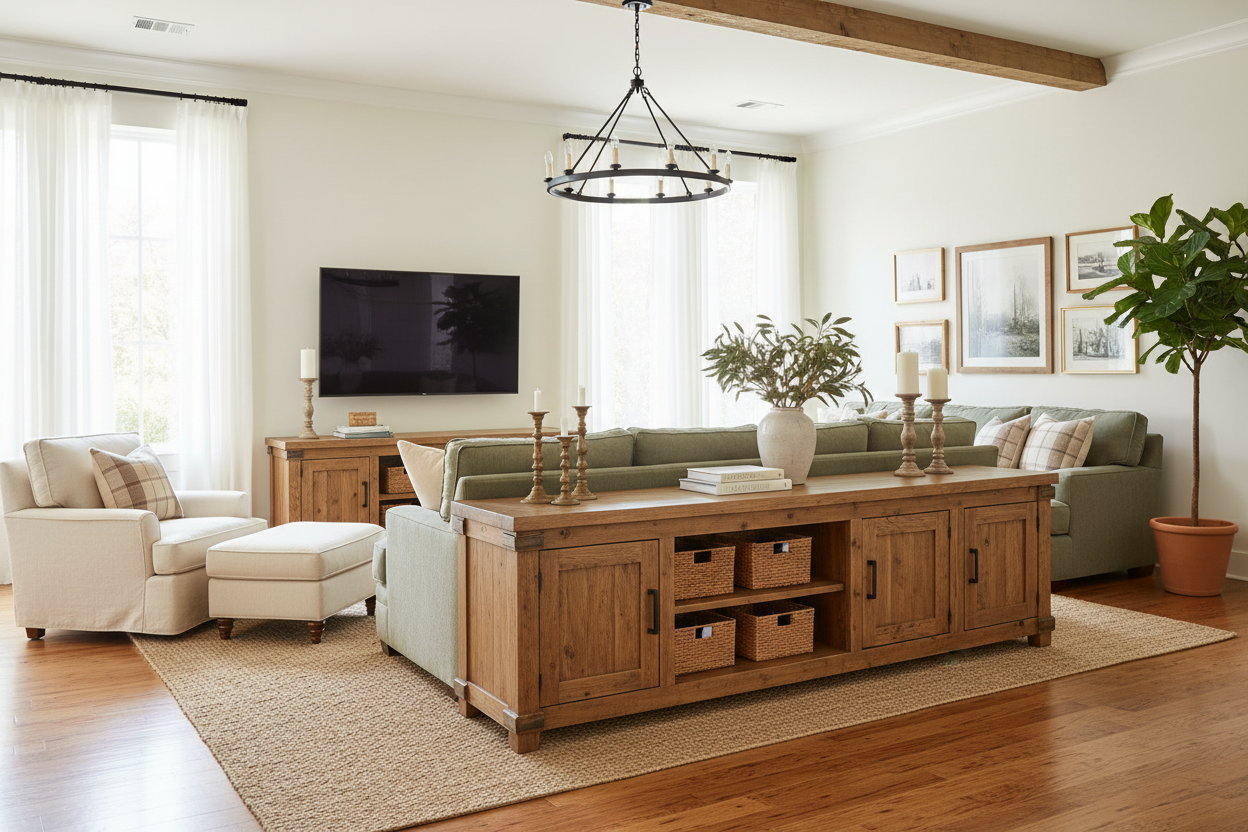
The biggest fear of floating furniture is exposing the 'mullet'—the unfinished back panel of a cheap console. Most standard stands are made of thin MDF on the back, held on by staples. If you're going to have a tv cabinet middle of room, you need a piece that is finished 360 degrees. You want real wood or high-quality laminate on all sides.
If you want to go the high-end route, a hidden Tv mechanism with remote control is the ultimate solution. These cabinets are designed to be seen from every angle. When the TV is down, it looks like a beautiful, handcrafted sideboard. When you want to watch a movie, the screen rises up. It completely eliminates the eyesore of a black plastic screen and messy cables sitting in the center of your sightline.
Managing the Inevitable Cord Chaos
Cables are the enemy of the floating layout. If you don't have a floor outlet, don't just let the black wires snake across the floor like a trip hazard. I used a flat-profile extension cord designed for under-rug use. By placing a large 9x12 area rug over the cord, you can run power from the wall to the middle room tv stand without any visible lumps. Just ensure the cord is rated for it—safety first.
How to Style a TV Cabinet for Middle of Room Placements
A floating stand can sometimes look like a lonely island if you don't dress it up. One trick I swear by is 'layering' the back of the unit. If the cabinet is low, you can place a slightly taller, slim console table directly behind it. This gives you a surface for a lamp or some books, which helps hide the back of the TV itself.
I also recommend balancing the room's visual weight. If your TV setup is in the center, the surrounding walls can feel a bit naked. I added a black cabinet with glass doors against the far wall. It provides a grounded, sophisticated look that mirrors the weight of the TV stand without making the room feel crowded. The glass doors are key here—they reflect light and keep the room feeling airy rather than heavy.
The Verdict: Was Floating My Furniture Worth It?
Absolutely. Breaking the 'push it against the wall' habit changed how I live in my home. The room feels twice as cozy and three times more expensive. It turns out that space isn't something to be 'saved' by keeping it empty; it's something to be used by filling it smartly. If your open floor plan feels like a cavern, stop looking at the walls and start looking at the middle of the floor.
FAQ
Won't a middle room TV stand block the view?
Not if you choose the right height. Keep the cabinet low—around 24 to 30 inches—so that your line of sight remains open across the room. It defines the space without closing it off.
How do I handle the back of the actual TV?
Modern TVs are much thinner and cleaner than they used to be, but you can also use 'cable sleeves' to bundle the two or three wires into one neat tube. Alternatively, a pop-up lift cabinet hides the TV entirely when not in use.
Does this work in small rooms?
It’s actually a secret weapon for small rooms. By pulling the furniture in, you create 'breathing room' around the edges, which can actually make a small space feel larger than if everything is crammed against the walls.


Dejar un comentario
Este sitio está protegido por hCaptcha y se aplican la Política de privacidad de hCaptcha y los Términos del servicio.