










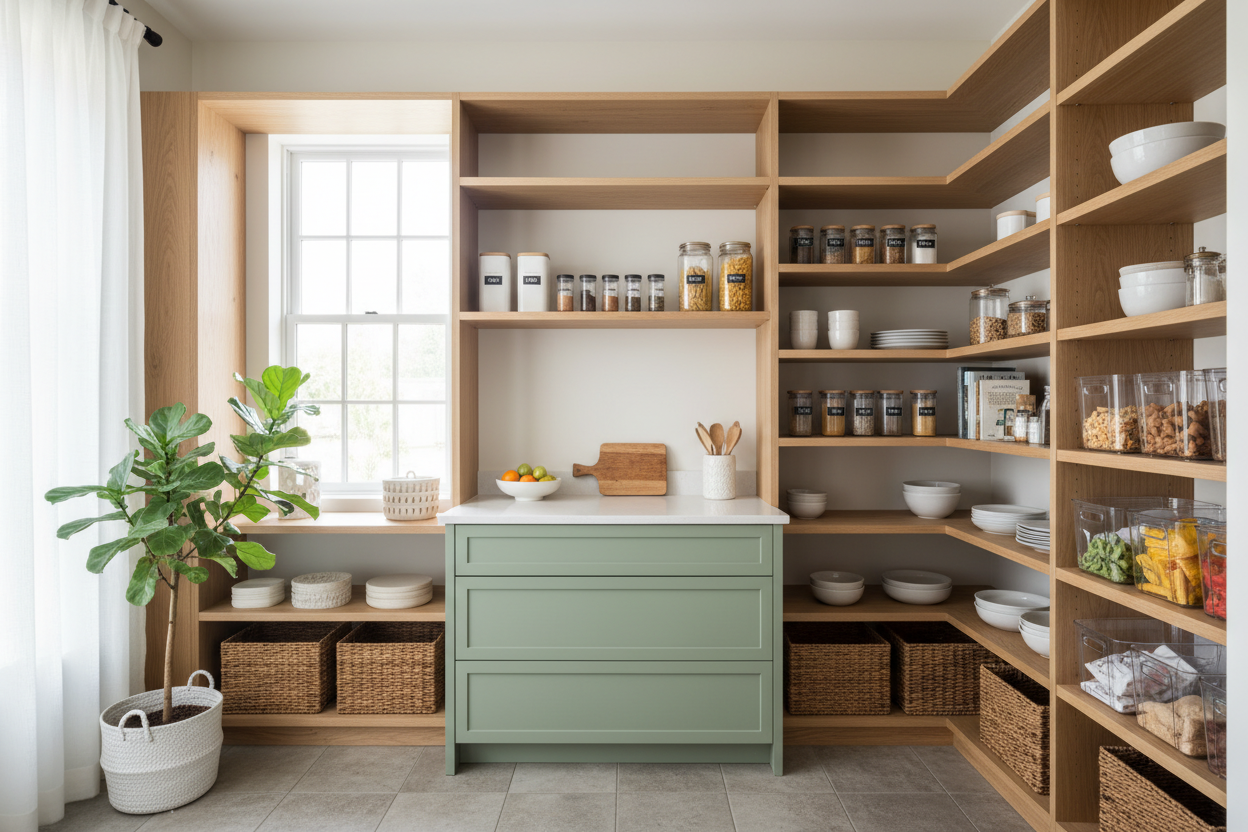
I remember the night I finally hit my breaking point with my walk-in pantry. I was trying to reach a jar of marinara on a top wire shelf, and the whole flimsy unit did that slow, terrifying tilt toward my face. By the time I stabilized it, a box of crackers had already slipped through the wide gaps in the wire and exploded on the floor. It was the third time that week something had tipped over because wire shelving is essentially a ladder for groceries to fall through.
The solution wasn't more plastic bins or a better labeling system. It was admitting that builder-grade wire racks are garbage. I realized I didn't need 'organization'—I needed actual furniture. That is why I decided to install a permanent cabinet in pantry spaces rather than fighting with those sagging metal racks for another year.
Quick Takeaways
- Wire shelving is structurally incapable of holding heavy kitchen appliances or bulk cans without bowing.
- A closed-door cabinet hides visual clutter, making a small walk-in pantry feel significantly larger and cleaner.
- Buying one solid cabinet is often cheaper than buying dozens of high-end matching baskets to hide 'ugly' packaging.
- Freestanding units offer more flexibility and weight capacity than wall-mounted shelving systems.
Why Builder-Grade Wire Shelving Was Driving Me Insane
Let's be honest: wire shelving is the builder's way of saying 'I don't care about your sanity.' It is the cheapest possible way to pass a home inspection. These racks are fine for a few light towels in a linen closet, but they fail miserably when faced with 48 cans of chicken noodle soup and a 20-pound bag of rice. Over time, the plastic clips pull away from the drywall, leaving you with a slanted mess that makes your pantries and cabinets look like a clearance aisle at a budget grocery store.
Everything tips over. Your bags of flour won't sit flat. Your skinny bottles of hot sauce perform a disappearing act through the gaps. It’s a chaotic, noisy way to live. I spent three years trying to 'hack' my way out of it with cardboard liners and shelf risers before I realized I was just putting a bandage on a structural wound. If you want a functional kitchen, you need surfaces that don't move when you touch them.
The 'Aha' Moment: Moving Real Furniture Inside the Closet
The breakthrough happened when I stopped looking at my pantry as a closet and started treating it like an extension of the kitchen. Why was I keeping my heavy stand mixer and my 12-quart stockpot on a wire rack when they belonged on a solid countertop? I decided to rip out the lower level of shelving and slide in a kitchen cupboard pantry cabinet. Suddenly, I had a workspace inside the pantry and drawers that actually glided.
Treating the space like a room instead of a storage locker changes the entire vibe. The process of finding a local pantry cabinet that fit my specific dimensions was a bit of a puzzle—I had to account for the door swing and the baseboards—but once that heavy unit was in place, the room felt anchored. It wasn't just a place where stuff was shoved; it was a curated kitchen pantry units setup that could handle real weight.
Closed Doors Are Cheaper Than Matching Baskets
We have all been brainwashed by home organization shows into thinking we need thirty $20 woven baskets to have a 'dream' pantry. If you do the math, that’s $600 just to hide your cereal boxes and chip bags. It’s a racket. Instead, buying a kitchen pantry with doors allows you to keep the original packaging (which is easier to read anyway) behind a solid panel. You get a clean, minimalist look for the price of a single piece of furniture, and you save yourself the weekly chore of decanting goldfish crackers into glass jars.
How to Measure for a Walk-In Fit (Without Blocking the Door)
Before you rush out to buy pantry units for kitchen upgrades, grab a tape measure. The biggest mistake is buying a standard 24-inch deep base cabinet for a narrow walk-in. Unless your pantry is massive, a 24-inch unit will swallow your floor space and make you shimmy past the door. I usually recommend looking for 'office' or 'narrow' pantry cabinet for kitchen use, which often come in 12-inch or 15-inch depths.
Check your door clearance twice. If your pantry door swings inward, you might be limited to a shallow cupboard pantry cabinet on one side. If you have the height, go for kitchen cabinets pantry units that reach at least 72 inches. For heavy items like gallon jugs of vinegar or glass bottled sodas, I highly suggest a large food pantry kitchen cupboard. These freestanding units are designed with reinforced bases specifically to prevent the sagging you see in cheap particle-board shelves.
Matching the Rest of Your House
Just because it's behind a door doesn't mean it should look like a garage workshop. To make your kitchen cabinet and pantry aesthetics feel cohesive, try to match the hardware to your main kitchen. If your kitchen has matte black pulls, put matte black pulls on your pantry cabinet. It creates a 'flow' that makes the upgrade feel like a custom built-in rather than a random addition.
If your pantry is visible from your dining area, you might even want to blend kitchen storage with dining display by using a cabinet with glass doors on the top half. This allows you to show off your nice serving platters while hiding the bulk-buy paper towels in the bottom cupboards. A little paint goes a long way here too—painting a freestanding unit the same color as your walls can make it 'disappear' into the room.
Does It Actually Make the Space Feel Smaller?
This is the number one fear people have: 'Won't a big kitchen.storage cabinet make my pantry feel like a coffin?' In my experience, the opposite is true. Visual clutter—the 500 different colors and shapes of food packaging—is what actually makes a room feel small and cramped. When you consolidate that mess into pantry cabinets kitchen layouts with solid doors, your eyes have a place to rest.
By clearing the floor and the open shelves of 'visual noise,' the room feels intentional and spacious. If you're still on the fence, start with one base unit and see how it changes your workflow. I suspect once you experience the stability of a real kitchen furniture pantries setup, you'll never go back to wire. If you are ready to stop the 'wire shelf tilt,' upgrading your kitchen pantry storage with a solid cabinet is the single most satisfying DIY you can tackle this weekend.
FAQ
Can I use a standard kitchen base cabinet in a pantry?
Yes, but watch the depth. Standard kitchen bases are 24 inches deep, which can be too bulky for many walk-in pantries. Look for 'vanity' or 'slim' depth cabinets if your space is tight.
Do I need to anchor the cabinet to the wall?
Absolutely. Especially if you are using a tall pantry unit. Once you load it up with heavy cans and jars, it becomes a tipping hazard. Always anchor to the studs.
Is it hard to install a cabinet over existing flooring?
Not at all. Most freestanding pantry units have leveling feet. If you are installing a permanent base cabinet, you might need to add a small piece of base shoe molding to finish the look where it meets the floor.


Dejar un comentario
Este sitio está protegido por hCaptcha y se aplican la Política de privacidad de hCaptcha y los Términos del servicio.