










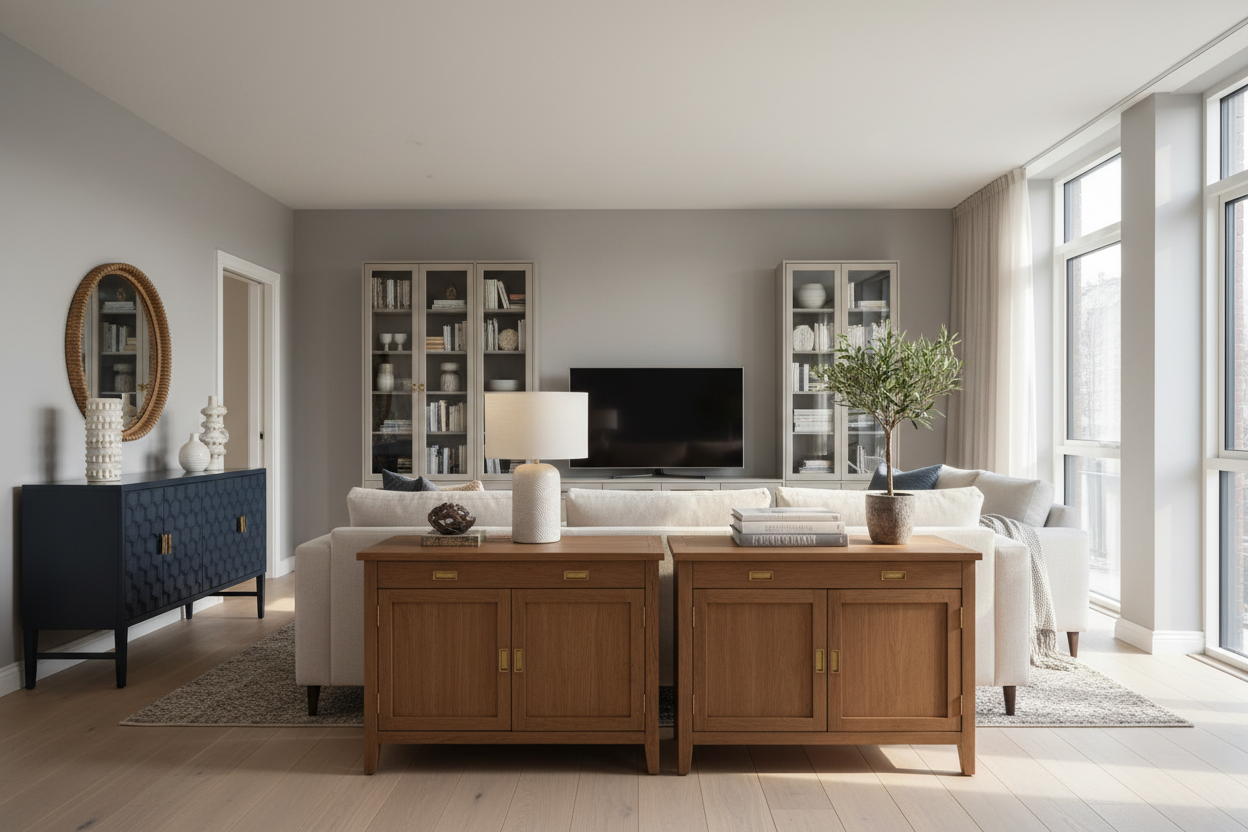
I remember moving into my first open-concept loft. I thought, 'Finally, space!' Then I realized my sofa had to sit in the middle of the room like a lonely island. Staring at the back of a couch is about as exciting as watching paint dry, especially when that back is just a flat, uninspired piece of grey polyester. I tried the usual skinny sofa table, but it looked like a toothpick holding up a boulder. That's when I discovered the magic of cabinet tables.
- Open-leg consoles are dust magnets and hide zero clutter.
- A floor sideboard anchors a floating sofa much better than spindly legs.
- Closed storage is the secret to a living room that looks clean in five minutes.
- Always measure: your cabinet should be slightly shorter than your sofa back.
The Awkward 'Floating Couch' Dilemma
When you have an open floor plan, you don't always have the luxury of pushing your furniture against a wall. My sofa ended up right in the center of the room, creating a weird 'no man's land' between the TV area and the dining table. It felt exposed. Walking into the front door and seeing the unfinished back of a sofa isn't exactly the warm welcome I wanted.
I tried leaving the space empty, but it just looked like I didn't know how to fill a room. The transition zone was too wide to be a walkway but too narrow for a second seating area. It was a classic design dead zone. I needed something that could act as a bridge—something that looked like it belonged there rather than just being a placeholder for real furniture. It needed weight, purpose, and a way to hide the inevitable mess of a lived-in home.
Why Traditional Sofa Consoles Are Actually Terrible
I spent $200 on a thin, gold-framed console table with glass shelves. It looked chic in the studio photos, but in my house, it was a disaster. Because it had open legs, I could see every single cord from my table lamps snaking down to the outlet. It looked like a copper-wire jungle back there. Plus, it gathered dust bunnies like it was getting paid for it.
Beyond the mess, those thin tables have zero visual weight. Against a heavy, deep-seated sofa, a skinny console looks fragile. It doesn't provide a boundary; it just feels like an obstacle you're going to knock over while carrying laundry. Honestly, you should ditch the console tables and look for something with actual presence. A table with four thin legs is just a missed floor-space opportunity that you'll eventually regret when your junk starts piling up on those open shelves.
Enter the Cabinet Tables (My Storage Saviors)
The fix was swapping that flimsy table for a solid floor sideboard. The difference was immediate. It felt like a low-profile wall that defined the living room without blocking the view. When you use an accent sideboard or an accent buffet cabinet, you get a real, sturdy surface for heavy ceramic lamps, books, and even a tray for drinks. It doesn't wobble when someone flops onto the couch.
I ended up choosing a 55-inch buffet cabinet with storage because it spanned the majority of my three-seater sofa. It gives the room a sense of architecture. Instead of seeing the back of a couch, guests see a beautiful piece of furniture. It’s a functional anchor that makes the 'floating' layout feel deliberate. Plus, the sheer amount of hidden space inside an accent buffet is a total lifesaver for anyone living in a place without enough closets. It’s the easiest way to make a room look expensive without actually renovating anything.
The Golden Rule of Sizing Furniture Behind a Sofa
Before you hit 'buy,' you have to grab a tape measure. The biggest mistake I see is people buying an accent credenza that is taller than the sofa back. It looks incredibly awkward, like the cabinet is trying to peek over the couch's shoulder. Ideally, your cabinet should be one to two inches shorter than the top of the sofa cushions. This creates a clean line that leads the eye across the room rather than hitting a vertical speed bump.
For my smaller loveseat in the den, I went with a 47-inch accent buffet table. You also want to watch the depth. If your walkway is narrow, stick to something around 12 to 15 inches deep. Anything more than that starts to eat up the floor space and makes the room feel cramped rather than cozy. You want enough room to walk past without having to turn sideways like you're in a narrow hallway.
What I Actually Hide Inside My Faux-Console
My living room looks like a minimalist dream on the outside, but inside that accent sideboard cabinet is absolute mayhem. I've got board games with missing pieces, three different oversized throw blankets, and the ugly router that used to blink annoyingly in my peripheral vision. I even tucked a small basket inside for the dog's tennis balls so they aren't rolling under the TV stand every five minutes.
If you're worried about a solid cabinet looking too heavy or 'blocky' in a small room, you can always find a black cabinet with glass doors. It lets you display the 'pretty' stuff—like art books or vintage glassware—while still giving you a place to tuck away the clutter behind the frames. It keeps the room looking styled while hiding the chaos of actual daily life. It’s the ultimate way to stay organized without really trying.
Can I use two small cabinets instead of one big one?
Yes, and it’s a great trick for extra-long sectionals. Just make sure they are identical and pushed tight against each other so they look like one custom unit. It often looks more high-end than one massive piece.
Will a solid cabinet make the room feel smaller?
Actually, it usually does the opposite. By creating a clear boundary between the living and dining areas, it makes the layout feel more organized and spacious rather than one big, messy room.
How do I handle lamp cords with a closed cabinet?
Most modern buffet units have cord holes. If yours doesn't, a 2-inch drill bit and a plastic grommet from the hardware store will make it look professional in about five minutes. Just drill through the back panel and tuck the power strip inside.

Dejar un comentario
Este sitio está protegido por hCaptcha y se aplican la Política de privacidad de hCaptcha y los Términos del servicio.