










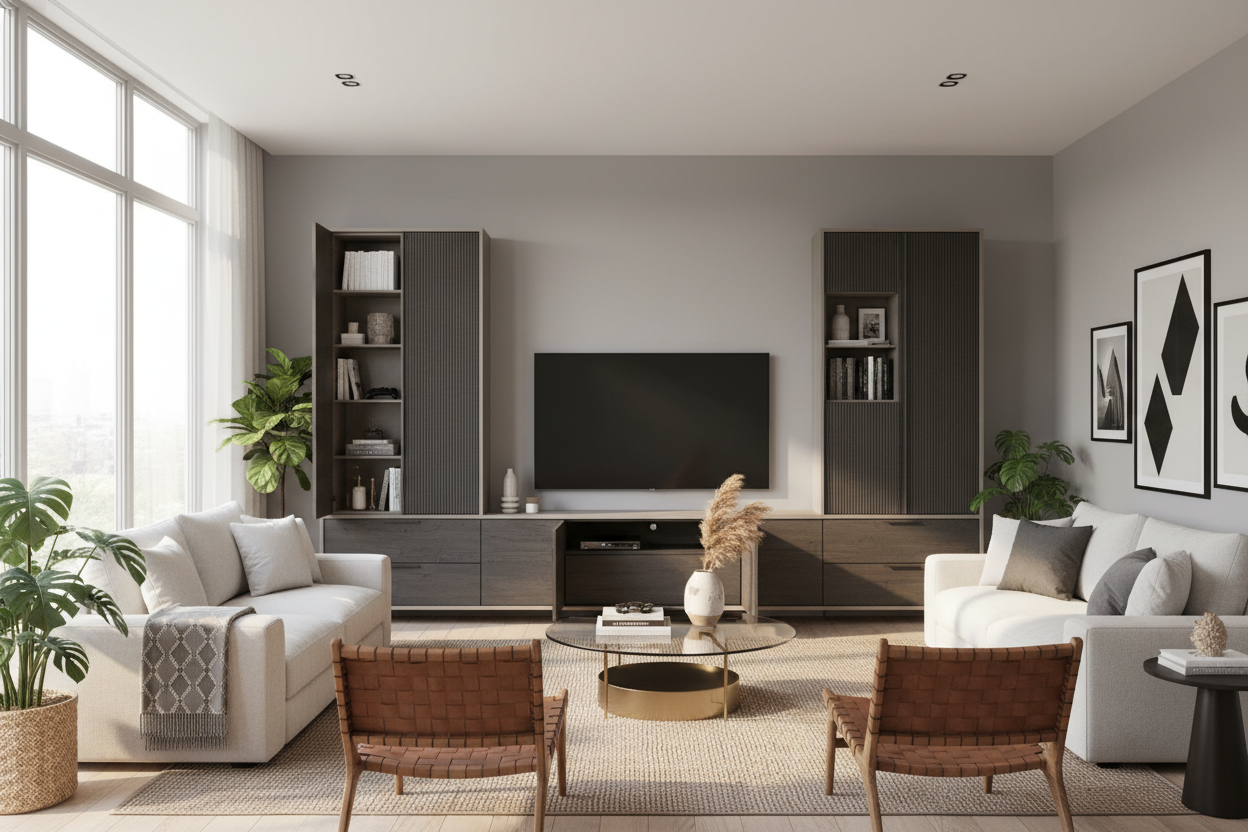
I spent three hours last Tuesday trying to untangle a 'nest' of HDMI cables and dust bunnies that had colonized the space under my minimalist floating shelf. It looked great on Pinterest, but in my actual living room, it looked like a tech store exploded. That was the day I realized I needed a real entertainment center.
- Floating shelves are a trap for anyone with more than one remote.
- Closed doors are the only way to hide the inevitable 'cable spaghetti.'
- Modern units can be slim and airy while still being functional.
- Mixing open and closed storage keeps things from looking like a monolith.
The Minimalist Floating Shelf Delusion
We've all seen those high-end home tours where a TV sits on a tiny, thin shelf with zero visible wires. It’s a lie. Unless you’re drilling through your drywall to hide cables and mounting your router in a closet across the hall, that 'barely there' look is impossible to maintain in a real home.
I lived that life for a year. Every time I bought a new gaming console or a soundbar, the aesthetic died a little more. My living room didn't feel peaceful; it felt like a staged set that I was constantly failing to keep up with. Dust accumulates on those open surfaces faster than you can wipe it off, and don't even get me started on the visible power strips.
The Breaking Point: When Tech Clutter Takes Over
Modern life is loud, and I’m not just talking about the volume. We have routers, switch docks, external hard drives, and charging cables for things we forgot we owned. A storage entertainment center isn't just a piece of furniture; it's a peace-of-mind machine.
I finally admitted that I needed dedicated storage cabinets to shove the mess into. There is a specific kind of joy in closing a door on a tangled mess of black plastic and copper wire. Suddenly, the room feels five degrees cooler and ten times more organized because your eyes aren't constantly darting to the 'clutter corner' under the TV.
Does a TV Entertainment Center With Storage Have to Look Bulky?
The biggest hurdle for me was the 1990s trauma. I grew up with those massive, wall-to-wall honey oak units that looked like they could survive a nuclear blast. I didn't want my living room to feel like a library for VHS tapes or a heavy wood-paneled basement.
Thankfully, design has caught up. You can find a sleek black entertainment center that offers massive internal volume without looking like a heavy block. Look for units with tapered legs or 'floating' bases—they keep the floor visible, which tricks your brain into thinking the room is bigger than it is. A tv entertainment center with storage should serve the room, not dominate it.
Finding the Perfect Balance of Hide-and-Show
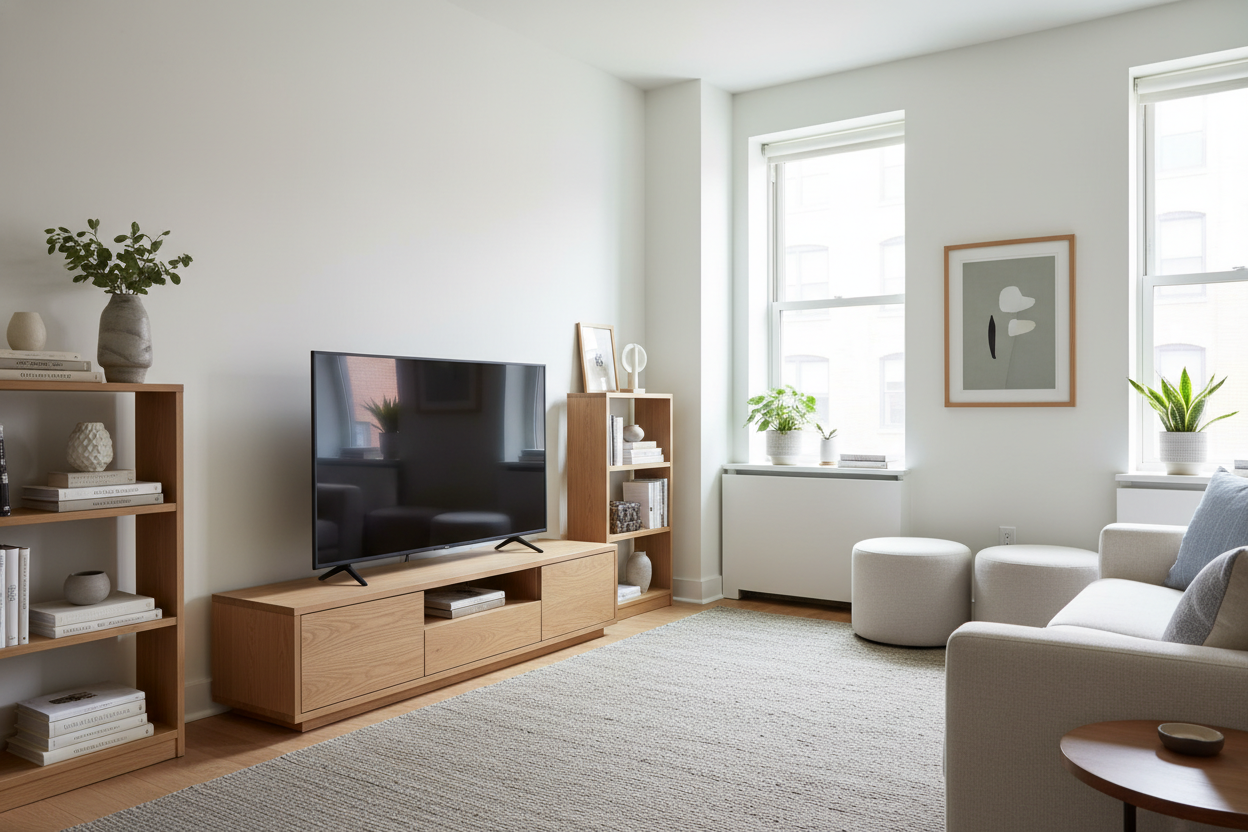
You don't have to hide everything. The goal isn't a sterile box. I love an entertainment center with storage cabinets that also features a few open cubbies. This is where you put the stuff that actually makes you look cool: a stack of coffee table books, a trailing pothos plant, or a vintage record player.
The rule is simple: if it has a blinking light or a cord, hide it. If it’s tactile or beautiful, show it. If you are looking for a modern entertainment center with shelves, ensure they are adjustable so you can fit taller vases next to shorter tech. Finding an entertainment center with storage cabinets and open shelving gives you the best of both worlds without the visual headache.
Why This 'Hidden Mess' Rule Now Applies to Every Room
Once I fixed the living room, the bedroom felt like a disaster zone. I realized that staring at a tangled mess of phone chargers and TV wires from my bed was actually hurting my sleep. It’s amazing how much better you rest when your master bedroom storage actually hides the tech that keeps us awake.
I ended up sourcing a bedroom entertainment center with storage to reclaim that space. It’s the same logic: close the door, hide the blinking LEDs, and let the room be a place for humans instead of electronics. This 'closed door' policy was the single best decision I made for my home last year.
How deep should my media unit be?
Aim for at least 15-18 inches. Most modern receivers and consoles need about 14 inches of depth plus room for the plugs to stick out the back without bending the cables.
Will my consoles overheat inside a cabinet?
Only if there is zero airflow. Look for units with cord management holes or mesh door panels. If the back is solid, I usually take a hole saw to it or just leave the door cracked during long gaming sessions.
What is the best height for a TV stand?
The center of your TV should be at eye level when you are sitting. For most sofas, that means a unit height of 20 to 24 inches. Avoid the 'TV too high' trap at all costs.


Dejar un comentario
Este sitio está protegido por hCaptcha y se aplican la Política de privacidad de hCaptcha y los Términos del servicio.