










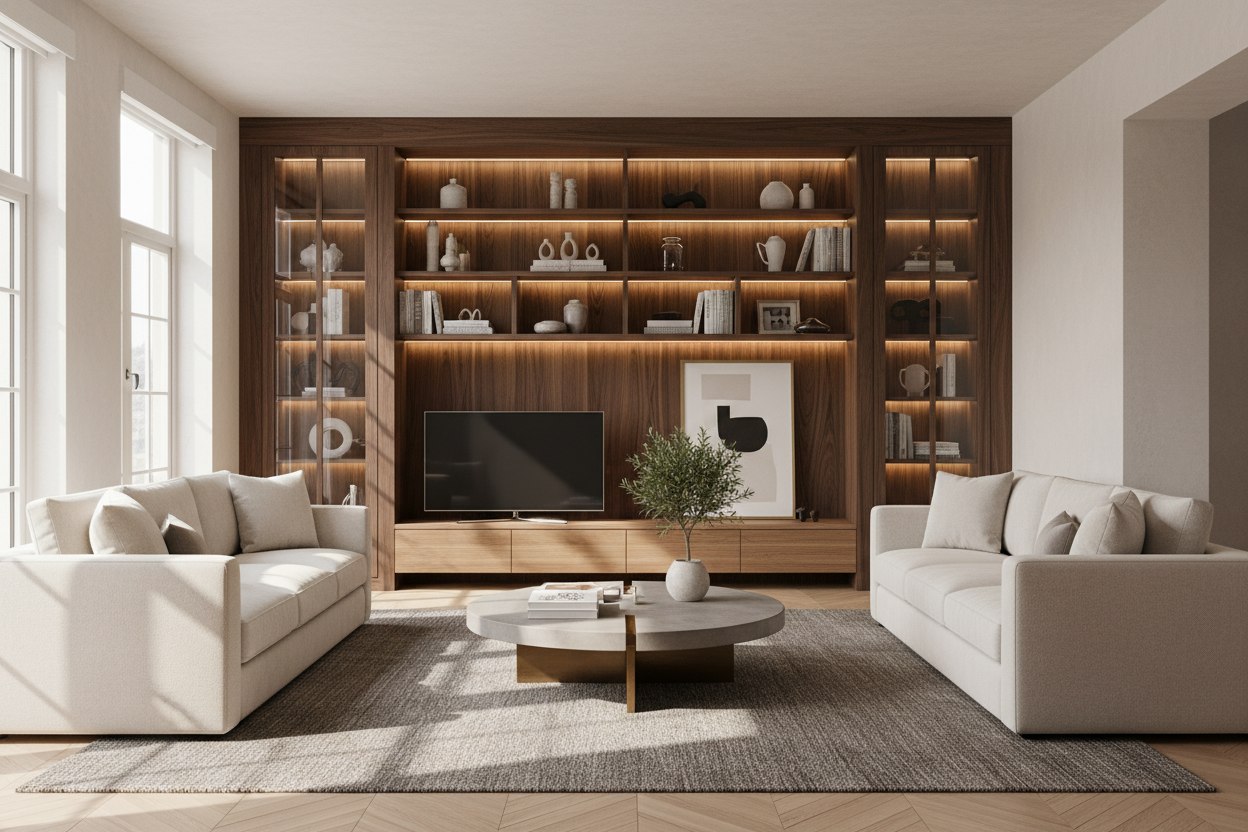
I spent three weeks staring at a 34-inch alcove in my 1920s living room, clutching a tape measure like a security blanket. Every standard cabinet I found online was either 30 inches—leaving a weird four-inch gap for dust bunnies to colonize—or 36 inches, which would have required me to take a sledgehammer to my original plasterwork. That was the moment I stopped trying to force mass-produced furniture into a house that wasn't built for it and started looking into display cases custom built for my specific, crooked walls.
- Total Fit: Custom units eliminate the 'IKEA gap' that makes rooms look unfinished.
- Material Quality: You choose the actual hardwood, not 'wood-look' veneers.
- Lighting: Integrated LEDs can be hardwired so you don't have cables dangling from the shelves.
- Cost: It is more expensive upfront, but it adds permanent value to your home.
The Breaking Point: Why I Gave Up on Big Box Stores
Living in a house built in 1926 means nothing is level. The floors have a gentle slope that makes standard wardrobes lean like the Tower of Pisa, and the walls have a 'texture' that is really just decades of paint layers. I tried the usual route: I bought a beautiful mid-century inspired cabinet from a high-end retailer. It looked great in the catalog, but in my nook, it looked like a mistake. It sat three inches away from the wall because of the chunky baseboards, and the gap on the side was just large enough to lose a remote but too small to clean.
The frustration of shimming legs and staring at awkward dead space finally wore me down. I realized that a custom-made display case wasn't just a luxury; it was the only way to make the room look like an adult lived there. When you go custom, you aren't just buying a box for your stuff; you are buying the ability to ignore your home's architectural flaws because the furniture is designed to mask them.
How Much Does Ordering Display Cases Custom Actually Cost?
Let’s talk numbers, because this is where everyone gets cold feet. For a bespoke, floor-to-ceiling unit in a standard 4-foot wide alcove, I received quotes ranging from $2,200 to $5,500. For comparison, a high-end designer cabinet from a place like Restoration Hardware usually runs about $2,800 plus $300 for shipping. The difference is that the $2,800 unit is made of plywood and might not actually fit your space.
My local carpenter charged me $3,100 for a solid white oak build with integrated lighting and glass doors. Was it more than a flat-pack? Obviously. But when you break down the cost of materials—kiln-dried hardwood is significantly more expensive than the 1.5 lb density fiberboard used in mass-market pieces—the math starts to make sense. You’re paying for 40 hours of labor from someone who knows how to scribe a cabinet to a wonky wall so it looks like it grew out of the architecture. If you're on a tighter budget, choosing paint-grade MDF for the frame but keeping solid wood for the shelves can shave about 30% off the bill.
The 3 Measurements You Cannot Mess Up
If you decide to work with a builder, your tape measure is your best friend and your worst enemy. First, measure your tallest item. I once saw a gorgeous custom build that couldn't fit the owner's favorite art book because they forgot to account for the thickness of the shelf itself. If you have a specific 14-inch vase, give yourself 15.5 inches of clearance. Don't eyeball it.
Second, measure your baseboards. Most people measure wall-to-wall at eye level, but your baseboards often stick out an inch or more. If your builder doesn't know the depth and height of that trim, your cabinet will never sit flush against the wall. Finally, decide on your lighting wiring before the first piece of wood is cut. If you want puck lights or LED strips, you need to know exactly where the nearest outlet is so the builder can notch the back of the unit. Drilling through a $3,000 finished cabinet because you forgot about the plug is a heartbreak you don't want.
The 'Fake Custom' Alternatives for Tight Budgets
I get it—not everyone has three grand sitting around for a cabinet. If you’re in a rental or just saving up, you can 'fake' the look. The secret is in the trim. You can take a standard unit and add crown molding to the top so it hits the ceiling, or side fillers to close those annoying gaps. I’ve even narrow display case into my hallway by using a slim stock unit and painting it the exact same color as the wall. It tricks the eye into thinking it’s built-in.
Another pro tip: look for shapes that naturally occupy difficult spaces. A corner display case is a fantastic way to fill that 'dead' corner in a dining room. Because it fills the entire angle, it feels much more architectural than a rectangular piece just shoved against a wall. Add some high-quality brass hardware, and most people will assume you hired a designer.
The Final Verdict: Was the Wait Worth It?
The lead time was eight weeks, and the installation day was a disaster of sawdust and the sound of a circular saw in my living room. But the second that unit was bolted to the wall and the trim was caulked, the entire room changed. It didn't look like a room with furniture in it; it looked like a finished space. The way the grain of the oak catches the light is something you just don't get with factory finishes.
When I compare it to a standard 4 layer glass door display case, the difference is in the details. The custom unit has zero visible wires, the shelves don't bow under the weight of my heavy stoneware, and there isn't a single millimeter of wasted space. If you plan on staying in your home for more than five years, the investment in custom work pays for itself in the lack of daily annoyance alone.
How long does a custom build usually take?
Depending on the shop, expect 6 to 12 weeks. Small independent makers might be faster, but high-end cabinet shops usually have a backlog. Always ask about the 'lead time' before you put down a deposit.
Do I need to provide the wood?
Usually, no. Your builder has trade accounts at lumber yards where they get better pricing and higher quality 'select' grade wood than you’ll find at a big-box hardware store.
Can I take a custom unit with me if I move?
If it’s 'built-in' (meaning it’s caulked and trimmed to the wall), it’s technically part of the house and should stay. However, you can request a 'freestanding custom' piece that is built to your dimensions but remains a mobile piece of furniture.


Dejar un comentario
Este sitio está protegido por hCaptcha y se aplican la Política de privacidad de hCaptcha y los Términos del servicio.