










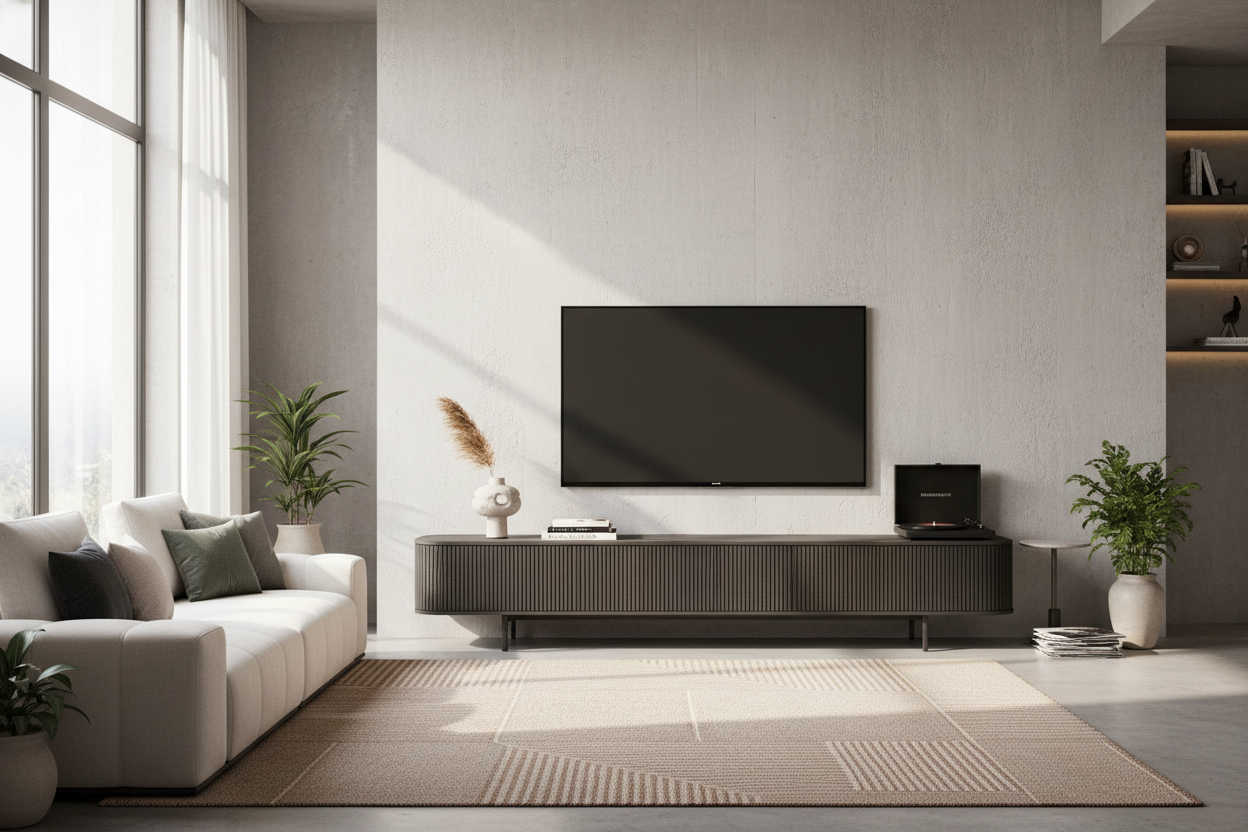
I spent three weeks staring at a Scandinavian floating console that I'd spent six hours mounting to the plaster walls of my 1920s Craftsman. On paper, it was perfect: clean lines, light wood, very 'cool.' In reality, it looked like a piece of office equipment that had accidentally drifted into a library. My house has ten-inch baseboards and original crown molding that actually has some soul. Putting a minimalist box in the middle of all that architectural history felt like wearing sneakers with a tuxedo—and not in the cool, intentional way.
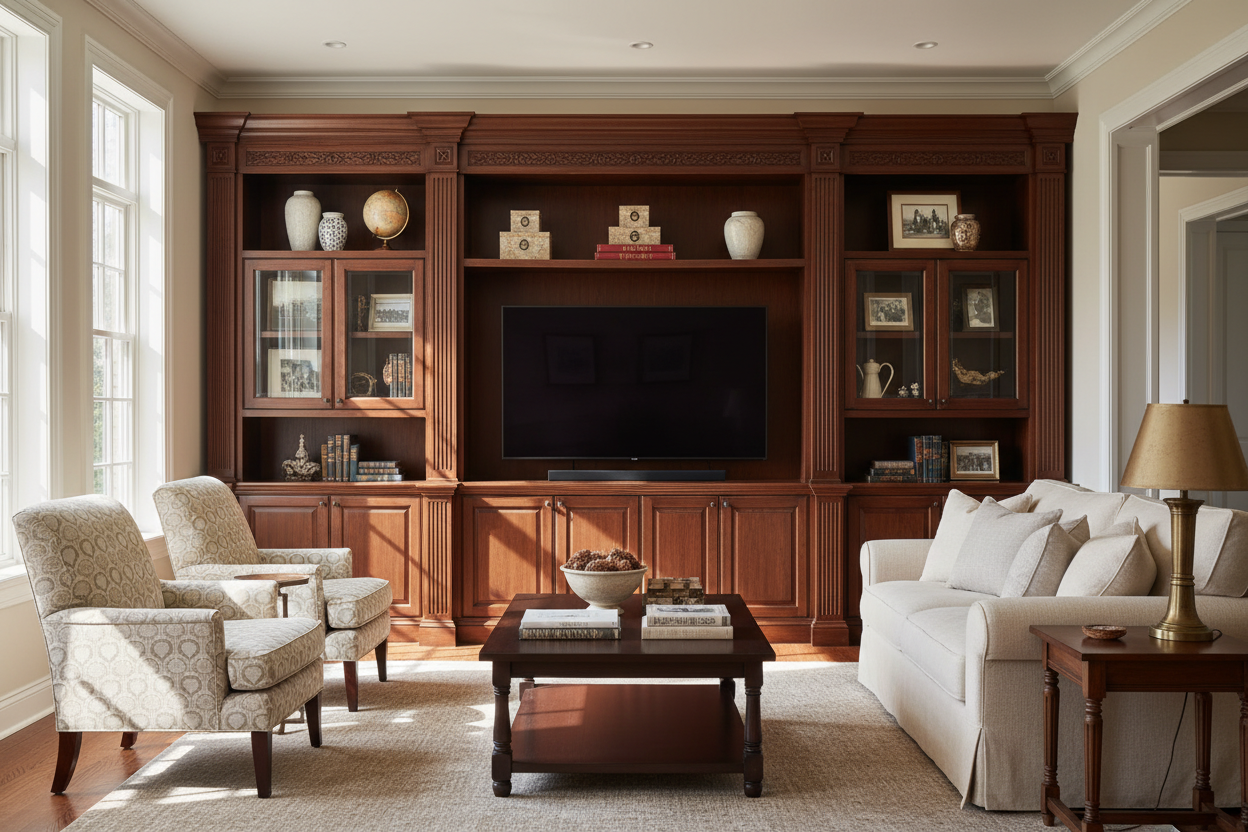
Eventually, I admitted defeat and started looking for traditional entertainment wall units. I needed something with enough visual weight to stand up to the heavy woodwork in the room. Once I swapped the floating shelf for a piece with a real plinth base and crown detailing, the giant 65-inch black rectangle on my wall finally stopped looking like an intruder and started looking like it belonged.
- Architectural scale is everything; if your trim is thick, your furniture needs to be substantial.
- Traditional units hide the 'cable spaghetti' better than any minimalist stand ever could.
- Look for matte or satin finishes to avoid that dated, high-gloss '90s executive look.
- Always measure the interior width, not the exterior; many traditional units have thick side pillars.
The Floating Box Problem in an Old House
The problem with modern, leggy furniture in an old house is the 'hover' effect. When you have original hardwood floors and massive baseboards, you want furniture that feels like it grew out of the floor. That sleek console I bought had these spindly little legs that made the whole setup look fragile. Every time I looked at it, I just saw the gap between the bottom of the cabinet and the floor—a gap that quickly became a graveyard for cat toys and dust bunnies.
In a room with history, minimalism often just looks unfinished. My walls are thick, my windows are encased in heavy oak, and my fireplace is a massive brick statement. A skinny piece of MDF wasn't going to cut it. I realized I didn't just need a place to put my TV; I needed a piece of architecture that happened to hold electronics. The visual clash was constant until I embraced the weight of traditional design.
Why Traditional TV Wall Units Actually Anchor the Room
Traditional units work because they mimic the built-in cabinetry that used to be standard in high-end homes. When you choose a unit with a solid base—no legs, just a sturdy plinth—it grounds the entire wall. It creates a focal point that rivals the fireplace instead of competing with it. The molding on the top of the unit should ideally speak the same language as your ceiling trim, creating a sense of vertical continuity.
I found that brass hardware and recessed panel doors helped bridge the gap between my modern tech and the house's bones. If you're overwhelmed by the options, I highly recommend checking out a buying guide for wall units to understand how to balance scale and storage. You want something that feels permanent, not something that looks like it will blow over if you open a window too fast. These pieces aren't just furniture; they are an extension of the room's character.
Avoiding the '1990s Lawyer Office' Look
The biggest fear people have with traditional entertainment is that it will look like their dad's old study—all shiny cherry wood and gold-plated handles. To avoid this, I stay away from high-gloss finishes. Look for 'distressed' oak, walnut, or even painted finishes in charcoal or navy. These feel modern but the silhouette remains classic. It's about the shape, not the shine.
I also suggest swapping out the standard hardware. Most traditional tv wall units come with generic knobs. Replacing them with unlacquered brass or matte black pulls can instantly modernize the piece. If you're looking for inspiration, browsing through classic entertainment center setups can help you see how designers are using these large-scale pieces without making the room feel like a museum. The goal is 'timeless library,' not 'stuffy boardroom.'
Wait, Can Modern Furniture Ever Work in Historic Homes?
I'm not a total purist. There are times when a high-contrast look works, but it is a high-wire act. If you have a very large, open-concept space that happens to be in an old building, modern wall mounted units can provide a clean, gallery-like feel. But you have to be committed to the contrast and keep the rest of the room equally sparse.
Sometimes, a middle ground works best. A stylish black tv stand can act as a neutral bridge. Black is a great 'cheat' color because it recedes into the shadows, making the piece feel less bulky while still providing that necessary weight. It is less about the style name and more about whether the piece has the guts to stand next to 100-year-old plaster and thick oak trim.
The One Measurement You Can't Ignore
Here is my biggest warning: check your TV width twice. Many older or 'vintage-inspired' wall units were designed when a 42-inch TV was considered massive. Today, we are all rocking 65-inch or 75-inch screens. I almost bought a beautiful mahogany unit on Craigslist only to realize the center opening was three inches too narrow for my LG OLED.
Measure the screen's actual width, not the diagonal size, and leave at least two inches of breathing room on either side so it doesn't look like you shoehorned it in. If the screen is too tight against the sides, it kills the 'built-in' illusion and just looks like a planning error.
How do I hide cables in a traditional unit?
Most quality traditional units have pre-drilled holes in the back panels. If yours doesn't, a simple 2-inch hole saw bit on a power drill will fix it in ten seconds. I use Velcro ties to bundle cables behind the center console so nothing peeks through the glass doors.
Will a large wall unit make my small room look smaller?
Counter-intuitively, no. One large, well-placed piece of furniture often makes a room feel bigger and more organized than five small, cluttered pieces. It draws the eye up and creates a sense of order that small stands can't match.
What wood finish is the most 'timeless'?
Medium-toned walnut or a soft 'weathered' oak are the safest bets. They play well with both light and dark floors and don't have the dated orange undertones of 1980s honey oak or the aggressive red of 1990s cherry.


Dejar un comentario
Este sitio está protegido por hCaptcha y se aplican la Política de privacidad de hCaptcha y los Términos del servicio.