










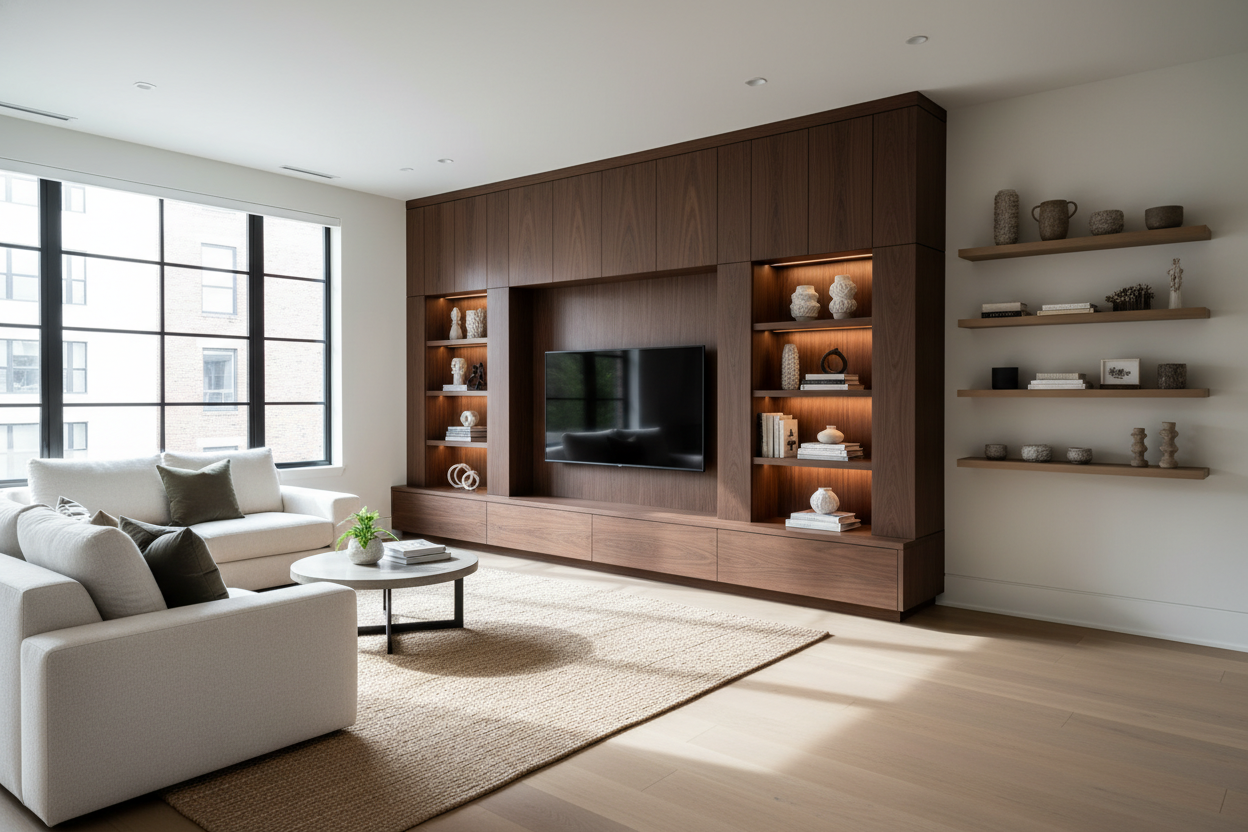
I spent three weeks staring at 47 browser tabs of floating shelves. I finally bought three, spent a Saturday drilling holes in my drywall, and the result was... sad. My 65-inch OLED looked like a giant black hole surrounded by tiny, cluttered sticks. It wasn't until I pivoted to modern tv wall units that the living room finally felt finished and, frankly, like an adult lived there.
- Scale Matters: Large screens overwhelm thin shelves, making your wall look cluttered rather than curated.
- Cable Chaos: Wall units offer integrated channels to hide the 'spaghetti' of HDMI and power cords.
- Visual Peace: One cohesive piece reduces visual noise compared to multiple disconnected shelves.
- Storage Reality: Units provide actual space for consoles and routers that floating shelves can't support.
The Floating Shelf Delusion (Why Open Storage Fails)
We’ve all seen the Pinterest photos: a perfectly balanced TV wall with three staggered shelves, a single succulent, and two vintage cameras. In reality, that setup lasts about ten minutes. Once you add the soundbar, the PlayStation, the Apple TV, and the massive power brick that won't fit anywhere else, your 'minimalist' dream looks like a tech graveyard. I tried to style my 10-inch deep shelves with books and vases, but they just looked dinky next to the massive glowing rectangle of the TV.
The scale is almost always wrong. A 65-inch TV is nearly five feet wide. To make floating shelves look proportional, you need massive, thick slabs that are anchored into every available stud. Even then, you’re left with the 'dusting nightmare.' Every little knick-knack becomes a magnet for gray fuzz, and because everything is at eye level next to a light source (the screen), you see every speck. It’s visual clutter that competes for your attention while you're just trying to watch a movie.
Why Modern TV Wall Units Actually Make Rooms Look Larger
It sounds counterintuitive, but one massive piece of furniture often makes a room feel bigger than four small ones. When you break up a wall with several small shelves and a separate console, your eye has to stop and start a dozen times. This 'visual friction' makes a room feel choppy and cramped. A singular, structural unit creates a continuous line that draws the eye upward and across, tricking your brain into seeing more square footage.
I’ve found that high-end units which mimic built-ins are modern enough for a minimalist space because they lean into the architecture of the room rather than fighting it. By choosing a unit that spans a significant portion of the wall, you create a focal point that feels intentional. It’s the difference between a custom suit and a 'one size fits all' t-shirt. The room stops looking like a collection of random objects and starts looking like a designed environment.
Taming the Cables with Contemporary TV Wall Units
Let’s talk about the 'cable waterfall.' You know exactly what I mean: that dangling cluster of black cords hanging from the bottom of a wall-mounted TV. Floating shelves do absolutely nothing to solve this. You can buy those plastic raceways, but they always look like an afterthought. Fully integrated contemporary tv wall units solve this by design. They feature hollow back panels or dedicated channels that swallow the mess whole.
When I finally swapped my piecemeal setup for a real unit, I managed to hide a mesh router, two gaming consoles, and a tangled power strip behind a single sleek door. If you are tired of looking at a mess of wires every time the sun hits the wall, you should browse modern TV stands and full-wall units that prioritize cable management. It’s the single biggest upgrade you can make for your sanity.
How to Pick a TV Wall Unit Contemporary Enough for Your Vibe
The fear for most people is that a wall unit will look like those chunky, honey-oak entertainment centers from 1994. To avoid the 'grandma's basement' look, you have to be picky about materials. Avoid high-gloss plastics or overly ornate moldings. Look for matte finishes, slim profiles, and 'push-to-open' doors that eliminate the need for bulky hardware. A stylish black TV stand entertainment center with a low profile can ground a room without feeling heavy.
Material choice is everything. I always lean toward walnut veneers or matte charcoal finishes. They have a weight to them that feels expensive. Also, pay attention to the 'air' around the unit. A unit that sits on slim legs or is partially wall-mounted (a 'floating' unit) provides the benefits of a wall unit while keeping the floor visible, which is a classic trick for keeping a space feeling light and airy. Just make sure the unit is at least 10-12 inches wider than your TV on both sides to maintain the correct proportions.
The Cost Comparison: Piecemeal Furniture vs. One Cohesive Unit
I used to think buying a unit was too expensive. But let’s do the math. A decent media console is $400. Three high-quality floating shelves are $150. A cable management kit is $30. The time spent leveling those shelves and patching the 'oops' holes in the drywall? Priceless. By the time you’re done, you’ve spent $600 and a whole weekend on a setup that still looks a bit DIY. A single, well-made wall unit might cost $800 to $1,200, but it looks like a $5,000 custom built-in.
When you style a wall mounted TV stand for a high-end look, you’re investing in the longevity of the room. You won't be replacing it in two years when a shelf starts to sag or you realize you hate the clutter. It’s a 'one and done' purchase. I’ve moved my current wall unit through two apartments now, and it’s the one piece of furniture that always makes the new place feel like home immediately.
Personal Experience: The Cable Waterfall Disaster
I once lived in a rental where I wasn't allowed to go behind the drywall. I tried to mount three reclaimed wood shelves around my TV. Because I couldn't hide the wires in the wall, I had seven different black cables zip-tied together, running down the middle of the wall like a giant, ugly vein. It was all I could see. I eventually bought a modular wall unit with a back panel. It took me three hours to assemble (and I definitely put one shelf in backward at first), but once it was up, the 'vein' disappeared. I learned the hard way: if you can't hide the wires *in* the wall, hide them *with* the furniture.
FAQ
Are modern TV wall units hard to assemble?
They can be a project. Expect 2-4 hours for a full unit. It’s definitely a 'two-person and a bottle of wine' kind of job, but the results are much more stable than individual shelves.
Can I use a wall unit in a small apartment?
Yes. In fact, I recommend it. Using one large piece of furniture instead of several small ones reduces visual clutter, which actually makes small rooms feel more organized and spacious.
How do I know if the unit will fit my TV?
Always measure the actual width of your TV, not the diagonal screen size. Your wall unit should be at least 20% wider than the TV to avoid looking 'top-heavy' or cramped.


Dejar un comentario
Este sitio está protegido por hCaptcha y se aplican la Política de privacidad de hCaptcha y los Términos del servicio.