










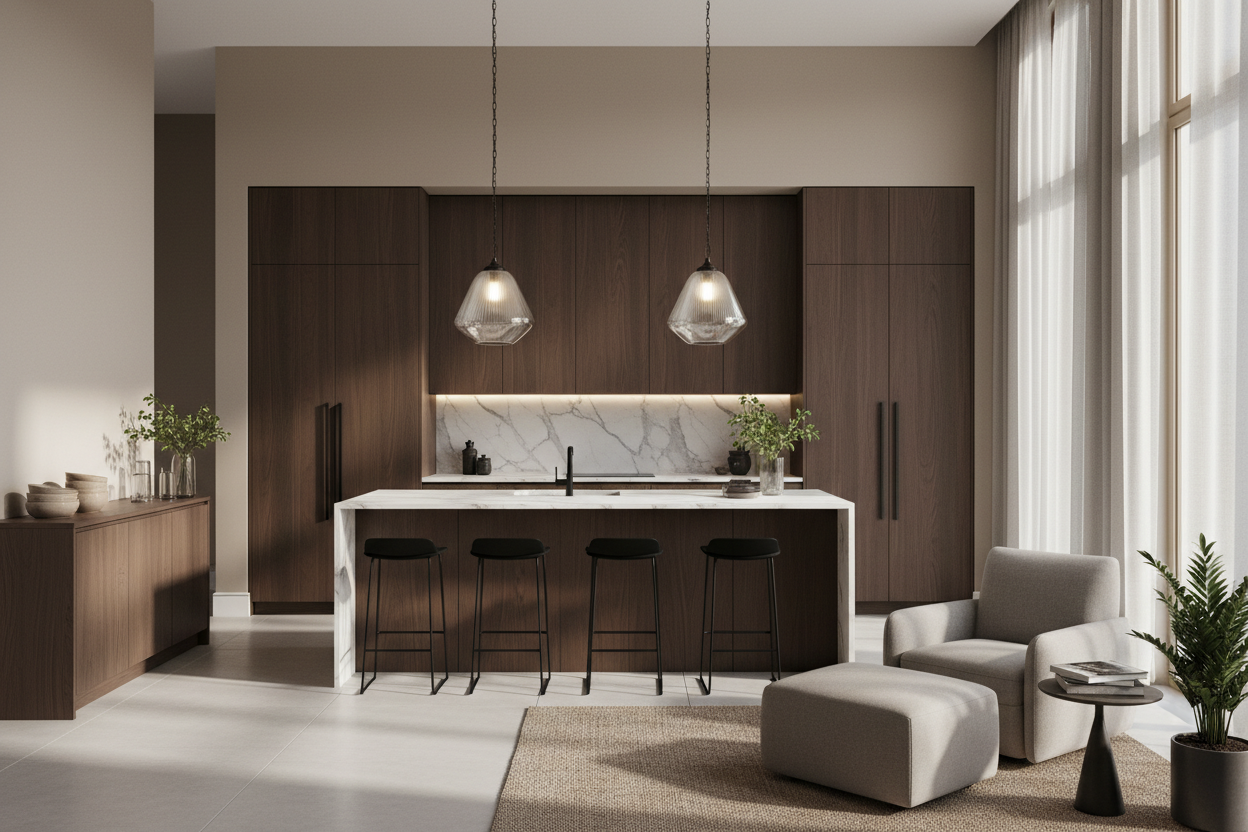
I spent three hours last night scrolling through custom kitchen cabinets images, convinced I could somehow fit a 12-foot island into my 10-foot kitchen. We have all been there—seduced by a high-res render that looks more like a high-end art gallery than a place where someone actually fries bacon and spills orange juice. It is easy to get lost in the pixels and forget that those kitchens are often built for cameras, not for humans.
After designing three kitchens and helping friends troubleshoot a dozen more, I have learned that what you see on a screen is rarely what you get on delivery day. Most viral photos are carefully curated illusions designed to sell a lifestyle, not a functional workspace. If you are planning a renovation, you need to learn how to spot the tricks before you write a five-figure check.
Quick Takeaways
- Professional lighting and wide-angle lenses make small spaces look twice as deep as they really are.
- Building code requirements like outlets and vents are frequently Photoshopped out of 'inspo' shots.
- True custom cabinetry eliminates filler panels, which is a detail many stock-cabinet photos hide with clever angles.
- Minimalist styling masks a total lack of functional storage for real-world groceries.
The Problem With 'Perfect' Pinterest Kitchens
Most of the custom kitchen cabinets pictures you are pinning are not even real photographs. They are hyper-realistic 3D renderings. These digital models do not have to deal with pesky things like gravity, crooked walls, or the fact that your 1920s bungalow has a floor that slopes two inches to the left. Designers can manipulate light sources to make a dark corner look radiant, creating an expectation that no amount of under-cabinet LEDs can actually meet.
Even when the photos are real, they are shot with $5,000 wide-angle lenses. These lenses distort reality, making a standard 24-inch deep counter look like a vast landing strip. When you finally stand in your newly finished kitchen, it might feel claustrophobic simply because you were measuring your expectations against a distorted image. Always look at the floor tiles in the photo—if they look like long rectangles instead of squares, the image is stretched.
They Masterfully Hide the Awkward Transitions
The biggest giveaway of a high-end job is how the cabinets meet the walls and ceiling. In many pictures of custom cabinets, you will see seamless transitions where the wood seems to grow out of the drywall. In reality, cheaper stock cabinets use 'filler panels'—flat strips of wood used to bridge the gap when the cabinet box does not perfectly fit the wall. These look clunky and cheap in person, but photographers are experts at cropping them out.
I once tried avoiding kitchen custom cabinets by using semi-custom boxes, and I regretted it every time I looked at the three-inch gap near my fridge. True custom work means the boxes are built to the exact fraction of an inch, eliminating those dead spaces. If an image shows a perfectly flush fridge or a corner with no visible seams, that is a custom build—and it is going to cost you significantly more than the 'budget-friendly' version the caption might suggest.
Where Are the Outlets? (And Other Practical Flaws)
Here is a fun game: look at those sprawling kitchen islands in your favorite 'dream kitchen' folders and try to find a single electrical outlet. According to the National Electrical Code, you almost certainly need them, but they are the first thing an editor removes in post-production. The same goes for air vents, light switches, and range hood ducting.
When you see pictures of custom kitchen cabinets that look like a solid block of wood with zero interruptions, you are looking at a fantasy. In the real world, you will have a plastic outlet cover right in the middle of that beautiful marble backsplash or a vent cut into your custom toe-kick. If you do not plan for these 'ugly' necessities early, they will ruin the aesthetic you spent months obsessing over.
The 'Minimalist Storage' Illusion
We need to talk about the 'three bowls and a branch' styling. You know the look: a massive wall of custom walnut cabinetry with nothing on the counters except a single ceramic vase. These photos are designed to feel peaceful, but they hide a dark secret: they often lack the everyday kitchen dining storage a real family needs. Where is the toaster? Where is the bag of half-eaten pretzels? Where is the junk drawer filled with dead batteries and old menus?
When you are looking at these images, pay attention to the actual shelf count. Many 'modern' custom designs sacrifice 30% of their usable volume for the sake of 'clean lines.' I have seen people rip out perfectly good cabinets for a custom look they saw online, only to realize they no longer have a place to put their Crock-Pot. Do not let a pretty picture talk you into deleting your upper cabinets unless you have a massive walk-in pantry hiding off-camera.
How to Actually Look at Inspiration Photos Like a Pro
To get the most out of your research, stop looking at the paint color and start looking at the joinery. Look for grain matching—where the wood grain continues uninterrupted across multiple drawer fronts. This is a hallmark of high-end custom work that you will never get with off-the-shelf options. Check the 'reveal' or the shadow lines between doors; in a quality custom build, those lines are razor-thin and perfectly consistent.
Be wary of any DIY hack cost more than actual custom cabinets stories you see on social media. I once spent three weekends trying to 'face-frame' my own stock cabinets to make them look custom, and by the time I bought the tools, the trim, and the matching paint, I had spent more than the local cabinet maker's quote. Analyze the hinge types in photos—are they hidden? Are they soft-close? These details are what make a kitchen feel expensive, not just the color of the Shaker doors.
My Biggest Cabinet Mistake
A few years ago, I fell in love with a photo of 'slim-shaker' cabinets in a deep navy. I obsessed over the image for months. When I finally had them installed, I realized the 'slim' profile was so narrow that my standard cabinet hardware looked bulky and ridiculous. The photo I loved used custom-milled, extra-long pulls that I couldn't afford. It was a harsh lesson: a custom look is a total ecosystem. You can't just pick one element from a photo and expect it to work in isolation.
FAQ
Why do my cabinets look different than the sample?
Lighting is everything. Most showroom samples are seen under bright fluorescent or studio lights. In your kitchen, with its specific window orientation and warm-toned bulbs, that 'cool gray' might suddenly look like muddy purple. Always test a large sample in your actual kitchen for 24 hours.
Is 'custom' always better than 'semi-custom'?
Not necessarily. If your kitchen has standard dimensions, semi-custom can save you 40%. You only need true custom when you have weird corners, non-standard ceiling heights, or a specific need for integrated appliances that require precision fitment.
What is the most important detail to check in a custom quote?
The box material. A lot of shops will give you a 'custom' price but use 1/2-inch particle board for the boxes. Insist on 3/4-inch furniture-grade plywood. It holds screws better and won't swell and disintegrate if your sink leaks.


Dejar un comentario
Este sitio está protegido por hCaptcha y se aplican la Política de privacidad de hCaptcha y los Términos del servicio.