










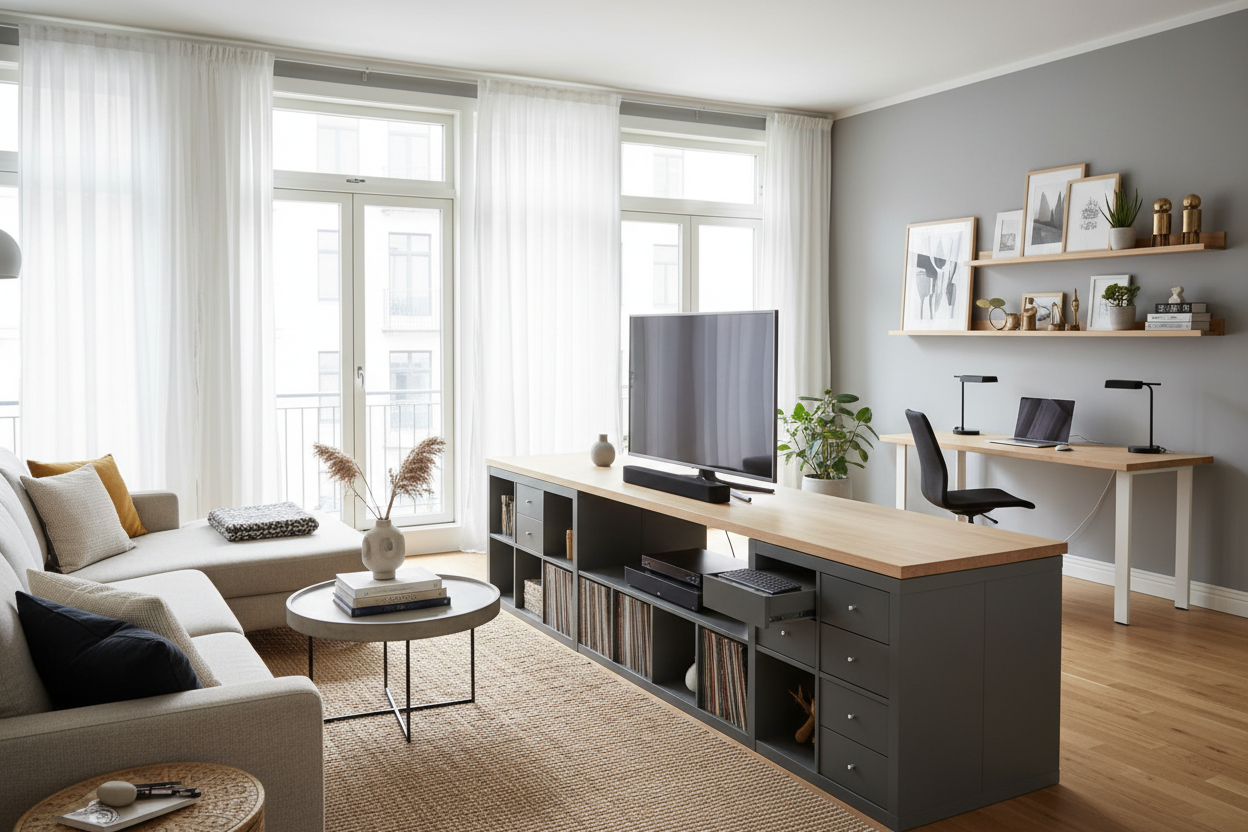
I spent three weeks staring at my 55-inch TV perched precariously on a wobbly coffee table while my laptop charger snaked across the rug like a tripwire. My living room looked less like an 'oasis' and more like a Best Buy clearance aisle. I needed a real entertainment center ikea solution, but everything in the showroom felt like it was designed for a 1990s VCR collection, not a 2024 hybrid-work lifestyle.
Quick Takeaways
- Standard media consoles are often too shallow for printers or office gear.
- Mixing kitchen or office modules provides better storage depth than basic TV units.
- Customizing with hardware and paint removes the 'flat-pack' aesthetic.
- Cable management requires manual drilling for a truly clean look.
My Beef With Standard Living Room Consoles
Most entertainment stand ikea options are built for one thing: holding a screen and maybe a stray remote. They are usually about 15 inches deep, which is fine for a soundbar but useless if you need to stash a printer, a scanner, or a stack of notebooks. I spent weeks scrolling through the standard entertainment unit ikea catalog and realized they all lacked the depth and 'heft' I wanted. When you live in a small apartment, your furniture has to work double shifts. A basic entertainment console ikea might look sleek, but it fails the moment you need it to hide your 9-to-5 life.
I’m tired of furniture that assumes I don't have hobbies or a job. Most of these units are made of 1/2-inch particle board that starts to bow under the weight of a heavy receiver or a stack of books. I wanted something that felt architectural, not like a temporary solution I’d be tossing in a dumpster next time I moved. The frustration peaked when I realized I was trying to fit a 21st-century workstation into a mid-century modern shell that was never meant to hold more than a DVD player.
The Lightbulb Moment: Mixing Desks With Media Units
The epiphany happened while I was wandering the office section. Office furniture is built for weight and depth. It’s designed to hide messy cables and bulky hardware. I realized that if I wanted a wall unit that actually worked, I had to stop looking at the living room section entirely. By planning an ikea entertainment center with desk functionality, I could finally hide my work life when the clock hit 5 PM. I wanted to take basic modules and frame them out to look like high-end architectural built-ins, much like this guide on an IKEA desk with storage how to make it look custom built.
Instead of one long, low bench, I envisioned a wall-to-wall setup that incorporated a workspace. The beauty of the IKEA ecosystem is that the dimensions are often compatible across different lines. By using desk-height components for the media side, I created a continuous line that didn't chop up the room visually. It made the space feel ten feet wider just by maintaining a single horizon line across the wall. No more staring at my printer while trying to watch a movie; it was tucked away in a deep cabinet, ready to be ignored until Monday morning.
The Exact Parts I Used for My Frankenfurniture Build
I skipped the flimsy ikea entertainment table and went straight for the Sektion kitchen cabinets as the base. Why? Because they are 24 inches deep. That is the magic number. It’s deep enough to swallow a printer, a gaming console, and all those annoying power bricks. I used three base cabinets and topped them with a solid oak butcher block. This created a surface sturdy enough to act like heavy-duty ikea tv stands for 55 inch screens without even a hint of sagging. For the desk portion, I used a single Alex drawer unit to support the other end of the wood slab.
One major warning: watch out for the common IKEA corner desk with storage layout mistake. I originally planned to wrap the unit around the corner, but I realized it would block the natural light from my only window and make the walkway feel like a tunnel. Stick to a single wall if you can. I also swapped the standard cardboard backings for 1/4-inch plywood. It costs about twenty bucks at the hardware store and makes the entire unit feel like real furniture instead of a cardboard box. The difference in stability is massive; when I knock on the side of this thing, it doesn't hollowly echo back at me.
Hiding the Cords (And Other Custom Secrets)
Cable management is where these projects live or die. Most media storage ikea units have those tiny, pre-drilled punch-out holes that fit exactly one HDMI cable. I bought a 2-inch hole saw and went to town on the back of the cabinets. I installed a power strip inside one of the cabinets, so only one cord actually leaves the unit to plug into the wall. Everything else—the router, the Hue bridge, the laptop dock—is hidden behind closed doors. It’s the cleanest my living room has ever looked.
To get rid of the 'I bought this in a flat box' vibe, I painted the cabinet doors in a matte charcoal and replaced the plastic IKEA pulls with heavy brass hardware. It’s a simple swap that tricks the brain into thinking this is a custom built-in. If you use a high-quality primer (like Zinsser B-I-N), the paint actually sticks to that laminate surface and won't chip off the first time you bump it with a vacuum. It’s about spending an extra $50 to make a $400 unit look like a $4,000 designer piece.
Not Handy? Try These Ready-Made Options Instead
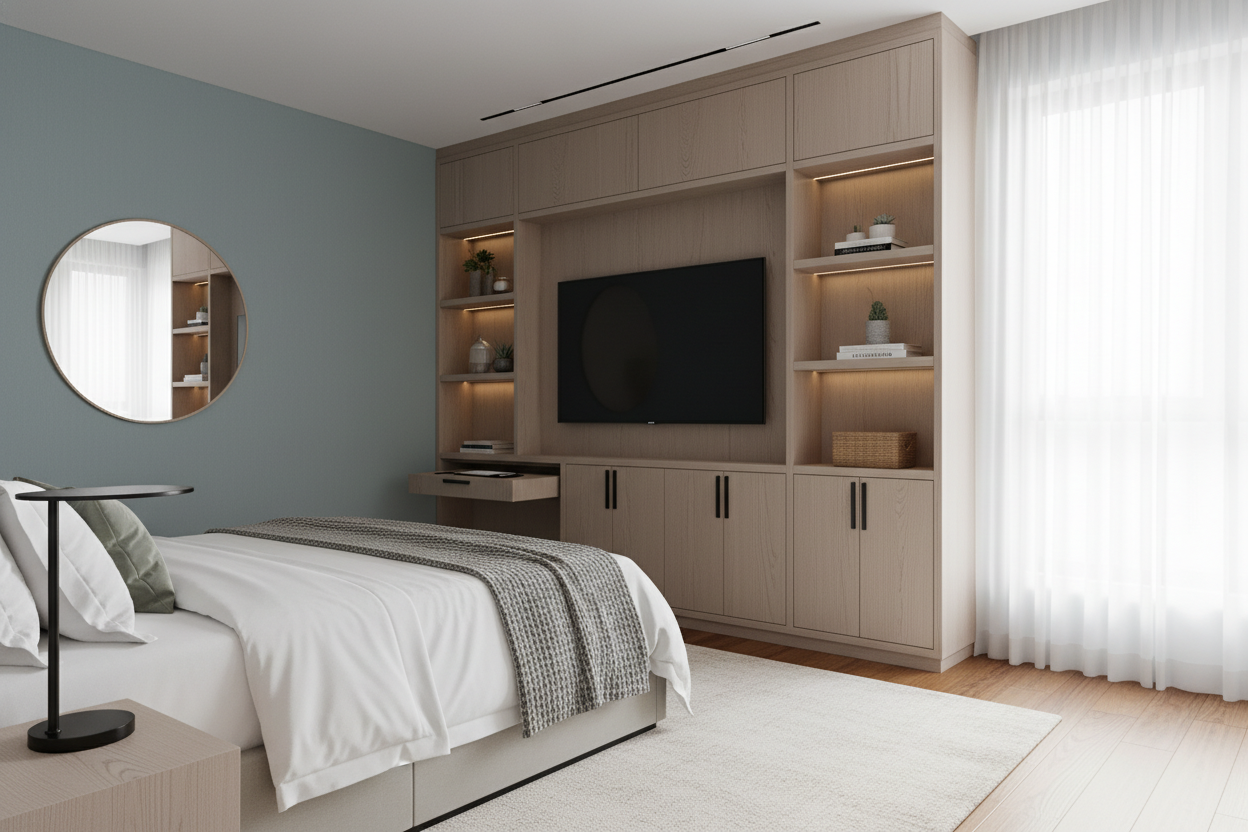
I get it—not everyone wants to spend their Saturday covered in sawdust and wood glue. If the idea of 'hacking' kitchen cabinets makes you break out in a cold sweat, there are plenty of solid out-of-the-box choices. You can find a ready-made entertainment center that offers similar vibes without the DIY trauma. Look for units that feature closed cabinetry to hide the inevitable clutter of modern life.
If you want that high-end look without the effort, a stylish black TV stand entertainment center is a fantastic alternative. It provides the visual weight of a custom piece and plenty of hidden storage for your tech, minus the need for power tools. Whether you build it from scratch or buy it whole, the goal is the same: stop letting your TV stand be a messy afterthought and start making it the hardest-working piece of furniture in your home.
FAQ
Can IKEA TV stands hold a 65-inch TV?
Most of them can, but you need to check the weight capacity. A 55-inch is the sweet spot for the Besta line, but if you go larger, ensure the unit sits directly on the floor rather than on legs or wall-mounts to avoid bowing over time.
How do I stop my IKEA furniture from wobbling?
Always use the wall anchors. Beyond safety, anchoring the unit to the studs pulls the frame tight and eliminates that side-to-side sway common in flat-pack furniture. Also, add a bead of wood glue to the dowels during assembly.
Is the IKEA Besta or Kallax better for media storage?
Besta, hands down. Kallax is great for vinyl records, but it’s too shallow for most modern receivers and has no built-in cable management. Besta is designed specifically for media and offers much better door options to hide your messy wires.

Dejar un comentario
Este sitio está protegido por hCaptcha y se aplican la Política de privacidad de hCaptcha y los Términos del servicio.