










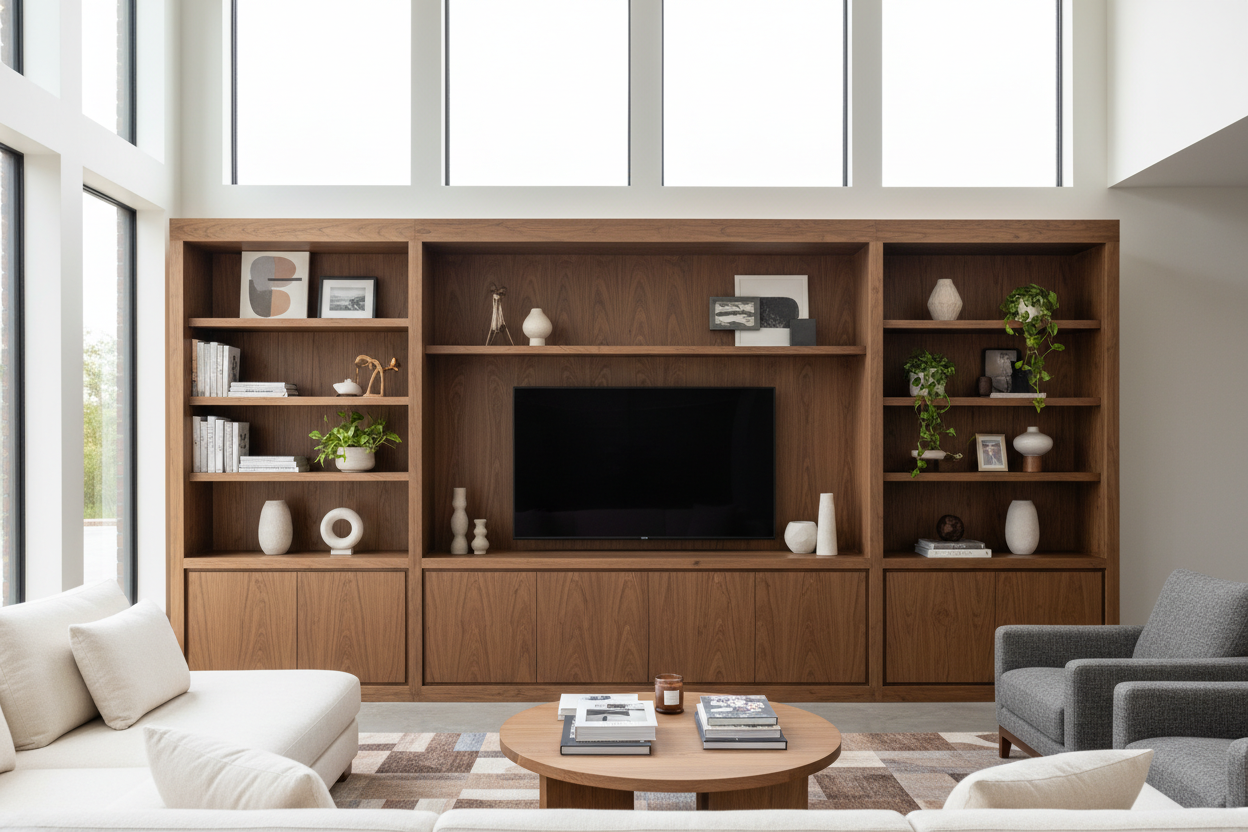
I remember staring at my TV floating on a flimsy white shelf that looked like it belonged in a college dorm. It was functional, sure, but it had zero soul. My living room felt like a waiting room—sterile, cold, and cluttered with a 'spaghetti' mess of black cables trailing down the wall. I realized I didn't need more 'minimalism'; I needed a piece of furniture that actually did its job. That is when I finally committed to a brown wood entertainment center.
- Visual Weight: It anchors a large wall so your TV doesn't look like a lonely black rectangle.
- Cable Management: Solid wood units usually have much better cord routing than wire racks.
- Warmth: Brown tones offset the 'tech' feel of gaming consoles and soundbars.
- Longevity: Unlike trendy acrylic or glass, wood grain hides dust and minor scratches.
The Fear of the 'Heavy' Living Room
Most people I talk to are terrified of 'heavy' furniture. They think a dark or mid-tone wood will make their house feel like a 1990s time capsule filled with mothballs. When I was first shopping for an entertainment center, I almost chickened out and bought another spindly metal unit. I was worried a large piece would 'eat' the room.
The truth? A small, leggy stand often makes a room look more cluttered because you can see everything behind and under it. A substantial wood piece creates a clean boundary. It defines the 'zone' of the living room. If you go for a mid-century modern silhouette or a clean-lined transitional style, that 'heavy' feeling disappears and is replaced by a sense of permanence.
Why I Pivoted to a Brown Entertainment Center Wall Unit
I eventually stopped looking at small consoles and went full-scale with a brown entertainment center wall unit. My living room has 9-foot ceilings and a massive blank wall that made every sofa look like dollhouse furniture. I needed architectural interest, and I didn't want to deal with the hassle of a gallery wall that I'd just have to level every time the door slammed.
Choosing a large wood unit was about texture. In a world of drywall and plastic, vintage charm beats modern sterility every single time. The grain of the wood adds a natural pattern that calms the eyes. It turned my TV area from a 'tech corner' into a library-style feature. It’s the difference between a house that feels like a rental and a home that feels curated.
The Magic is in the Mix: Styling the Shelves
If you get a brown entertainment center with bookshelves, the biggest mistake you can make is filling every inch. That is how you end up in 'grandma's house' territory. I follow the 60/40 rule: 60% items, 40% empty space. This lets the wood grain breathe and prevents the unit from feeling like a giant dark block against your wall.
I mix my old hardcovers with modern ceramics—think matte white or terracotta vases. Adding a trailing plant like a Pothos on a higher shelf breaks up the linear lines of the wood with some organic movement. Avoid lining up books like a retail store; stack some horizontally, lean others vertically, and use a few as pedestals for smaller objects. This turns the brown entertainment setup into a personal museum rather than just a place to put the remote.
Hiding the Mess: The Joy of Closed Doors
Let's talk about the 'shame' cabinets. A brown entertainment center with storage is a lifesaver for people who actually live in their homes. I have a collection of board games with battered boxes, a router that glows with annoying blue lights, and three different gaming controllers. In a minimalist setup, those are eyesores. In a wood unit, they simply don't exist.
I specifically looked for a wood grain color entertainment center with solid doors rather than glass. Glass doors are a trap—they just show you the mess in high definition. With solid pull-down or swing doors, I can shove the clutter away in five seconds before guests arrive. It’s the most effective 'cleaning' hack I own.
How to Balance the Rest of the Room
To keep the room feeling airy, you have to balance the wood. If you have a massive brown unit, don't buy a brown leather sofa. You'll feel like you're sitting inside a cigar box. I paired mine with a light grey linen sectional and a cream-colored rug. The contrast makes the wood pop without making the room feel dark.
I also look for pieces that incorporate mixed materials. A unit with a natural wood and black finish helps bridge the gap between the organic wood and the black glass of the TV screen. The black hardware or metal accents ground the piece and give it a contemporary edge that keeps it from feeling dated.
My Honest Takeaway
I did make one mistake: I didn't measure my baseboards. My unit didn't sit flush against the wall at first, leaving a two-inch gap that drove me crazy. I had to buy a specialized saw to notch out the back of the unit. Measure twice, or look for pieces with 'baseboard cutouts' already built in. It’ll save you a Saturday of frustration.
FAQ
Does dark wood make a small room look smaller?
Not necessarily. If the unit is the same color as the floor, it can actually blend in. The key is keeping your walls a lighter, contrasting color and ensuring you have good lighting inside the shelves.
How do I keep a wood entertainment center from looking dated?
Swap the hardware. Replacing standard brass knobs with matte black or oversized oak pulls can completely change the vibe of a traditional unit.
Is real wood better than MDF for an entertainment center?
Real wood or high-quality plywood is better for longevity and weight capacity. If you have a 75-inch TV, cheap MDF might sag over time. Look for kiln-dried hardwoods if your budget allows.

Dejar un comentario
Este sitio está protegido por hCaptcha y se aplican la Política de privacidad de hCaptcha y los Términos del servicio.