










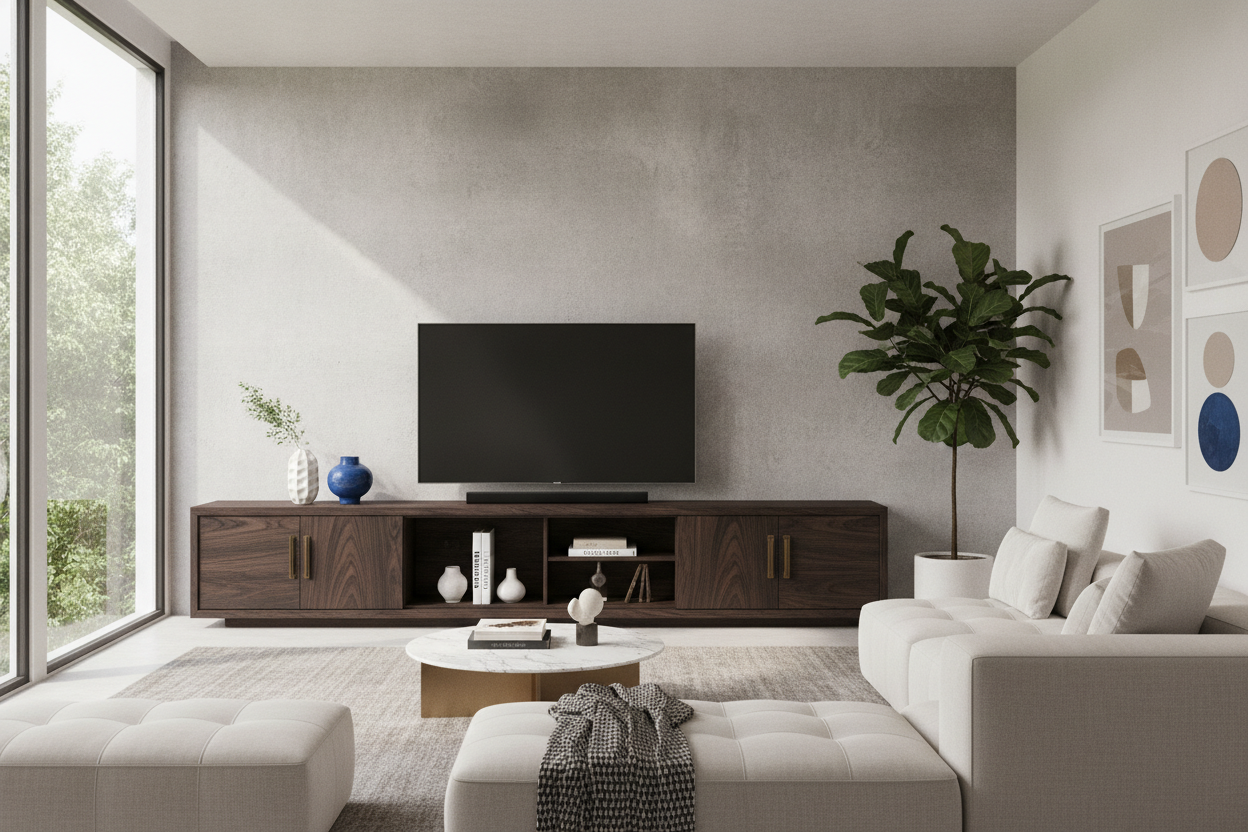
I spent my first three years as a renter trying to recreate a Pinterest board titled 'Scandi-Breezy.' I bought a light birch dining table, a beige rug, and a pale oak media unit. By the time I finished, my living room felt like it was floating. There was no gravity. It was less of a 'sanctuary' and more of an unseasoned bowl of grits. I finally realized I didn't need more light; I needed a tv stand dark enough to actually anchor the room.
The moment I swapped that flimsy birch unit for a rich, heavy dark wood tv stand, everything changed. The walls looked whiter, the rug looked intentional, and the room finally felt like a grown-up lived there. If you're stuck in the 'everything must be light' trap, here is why you should consider going to the dark side.
- Dark wood provides the visual weight necessary to ground high ceilings or light-colored floors.
- A dark finish helps a large TV screen 'disappear' into the furniture rather than standing out as a giant black plastic rectangle.
- Mixing wood tones (like walnut and oak) makes a room look curated over time, not like a showroom set.
- Storage is non-negotiable—look for units with hidden cable management to keep the look clean.
The 'Floating Room' Problem (And Why Light Woods Aren't Helping)
We've been told for a decade that light wood makes a space feel bigger. While that's true for a 200-square-foot studio with one window, in most average-sized rooms, too much light oak or birch just washes everything out. I call it the 'floating room' effect. Without a high-contrast piece like a tv console dark wood, your eyes never find a place to land.
A dark wood entertainment center acts like an exclamation point at the end of a sentence. It defines the 'entertainment' zone of your living room. When I brought in my dark wood tv console, it suddenly made my light gray sofa look crisp instead of dingy. You need that tension between light and dark to create depth.
Will a Dark Console Make My Small Living Room Feel Tiny?
This is the biggest hurdle for most people. I get it. I had a tiny apartment in Brooklyn where I lived in constant fear of 'heavy' furniture. But here is the secret: a dark wood tv stand modern in its silhouette—meaning clean lines and maybe some tapered legs—actually recedes into the wall. It doesn't crowd you; it creates a shadow-like effect that feels sophisticated.
Think about the TV itself. Most of us have a 55-inch or 65-inch black screen. Putting that on a white or light wood stand makes the TV look like a massive intruder. Putting it on a dark tv console allows the screen to blend in. I Was Afraid a Modern Dark Wood TV Stand Would Ruin My Room, but once it was in place, the room actually felt more organized and less cluttered because the visual 'noise' of the TV was minimized.
3 Rules for Mixing Dark Wood With Your Existing Furniture
You don't need to throw out your light oak coffee table. In fact, a media console dark wood finish looks incredible when paired with lighter elements. The trick is to make it look like a choice, not an accident. I usually aim for at least two shades of difference between my floor and my dark wood entertainment stand.
Pay Attention to the Undertones
Not all dark tv stand options are created equal. You have to look at the 'temperature' of the wood. A dark wood media cabinet in espresso usually has cool, almost purple undertones, which looks great with gray walls. A dark wood tv cabinet in walnut or mahogany has warm, reddish-orange undertones. If your walls are a warm cream, go with the walnut. If they're a cool 'hospital' white, stick to the cooler charcoals.
Balance the Visual Weight With Storage
A solid block of dark wood can feel like a tombstone if you aren't careful. I always look for a dark wood tv stand with storage that has some 'breathability.' Look for fluted doors, mesh fronts, or even a small dark wood tv stand with high legs that let you see the floor underneath. This keeps the piece from feeling like a giant monolith in the middle of your wall.
If you have a massive wall to fill, a modern 3 piece entertainment center is a great way to balance dark finishes with natural wood elements. It provides that grounding dark base while using vertical space to keep the room feeling open. I've found that having a dark wood tv stand 65 inch or larger works best when there's some open shelving to break up the mass.
Why I'm Never Going Back to the All-White Aesthetic
I used to think 'sophisticated' meant 'all white and airy,' but it actually just felt unfinished. Swapping my tv unit dark wood piece into the mix finally made the room feel like a home. It is the difference between a hotel room and a library. There is a richness and a history to dark wood that white laminate just can't replicate. Even a tv cabinet dark wood unit that isn't solid heirloom mahogany brings a level of polish that anchors the whole vibe.
If your room feels like it is drifting away, stop buying more beige. Check out some Tv Stands in deeper finishes. You might find that the 'heavy' piece you were afraid of is exactly what your light and airy room was missing all along.
FAQ
Does dark wood show more dust?
Yes, unfortunately. A dark wood finish is a magnet for dust and fingerprints. Keep a microfiber cloth in one of the drawers—it takes thirty seconds once a week to keep it looking sharp. It is a small price to pay for the aesthetic upgrade.
Can I put a dark stand on a dark floor?
You can, but you need a rug to create a 'buffer.' If you put a dark espresso stand directly on a dark walnut floor, it all bleeds together. Throw down a light jute or a colorful Persian rug first to separate the two wood tones.
What size stand do I need for a 65-inch TV?
Don't just match the width. Your stand should be at least 4-6 inches wider than the TV on both sides. For a 65-inch TV (which is usually about 57 inches wide), look for a stand that is at least 65 to 70 inches long. Anything smaller looks top-heavy and precarious.


Dejar un comentario
Este sitio está protegido por hCaptcha y se aplican la Política de privacidad de hCaptcha y los Términos del servicio.