










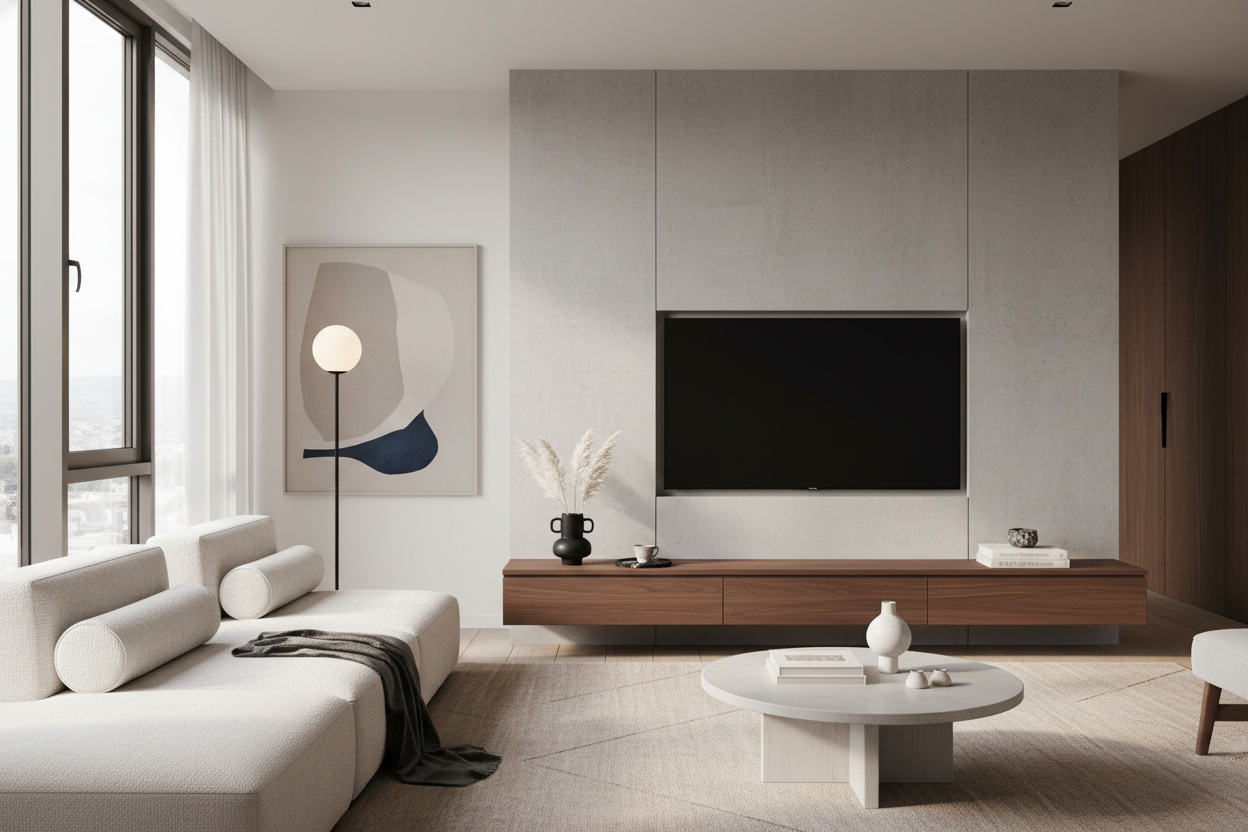
I remember my first attempt at a minimalist living room. I’d just moved into a 700-square-foot loft and decided that 'less is more' was my new personality. I bought a white console, a white rug, and mounted my TV on a white wall. Two days later, I sat on my sofa and realized I wasn’t living in a sanctuary—I was living in a gallery that had been looted. It was cold, it was echoey, and the TV looked like a giant, lonely eye staring back at me. This is the 'minimalist trap' we all fall into: stripping away the clutter but accidentally throwing out the soul along with it.
Creating a minimalist tv setup is actually harder than just buying a bunch of stuff. It’s about the tension between what’s there and what isn't. If your entertainment zone feels like a hospital waiting room, you’ve missed the mark on 'warm minimalism.' It’s a design style that requires more intent, not less. As I’ve noted in my minimalist tv stand guide, achieving that high-end, curated look is about making sure every single piece earns its keep through both function and texture.
Quick Takeaways
- Proportions over everything: Your console should always be significantly wider than your TV to avoid a 'top-heavy' look.
- Texture is your friend: Use wood grains, wool, or stone to add warmth without adding physical clutter.
- Cable management is a lifestyle: If a single wire is visible, the minimalist illusion is shattered.
- Layer your light: Avoid overhead 'big lights'; use ambient glow to soften the sharp lines of modern furniture.
There's a Fine Line Between Minimalist and Just Plain Empty
The biggest mistake I see is people thinking minimalism means 'empty.' When you have a large screen on a blank wall with nothing around it, the room lacks a focal point that feels human. You end up with a space that feels unfinished rather than intentional. To fix this, you have to think about the 'weight' of the room. A 65-inch TV is a massive visual heavy-hitter. If the furniture underneath it is flimsy or too small, the whole room feels off-balance.
Warm minimalism is the cure. It’s the practice of using natural materials—like a heavy oak grain or a matte ceramic—to provide the visual interest that 'stuff' used to provide. You want your guests to walk in and feel like they can actually sit down and relax, not like they’re about to be interrogated. This means considering how sound bounces off your walls and how light hits your surfaces. If your voice echoes when you talk to your cat, you need a rug and maybe some textured wall panels.
The Core Elements of a Setup That Actually Works
A functional minimalist space relies on the math of negative space. Negative space isn't 'nothing'; it's the breathing room that allows your eyes to rest. When I design a layout, I follow the 25% rule: at least a quarter of your console surface should remain completely empty. This prevents the 'cluttered shelf' look while still allowing for one or two high-quality items, like a heavy coffee table book or a single sculptural vase.
Start With the Right Foundation (Aka the Console)
Your TV stand is the anchor. If you get this wrong, nothing else matters. I’m a huge advocate for closed storage because, let’s be honest, life is messy. You have routers, remotes, and that one weird HDMI cable you’re afraid to throw away. A modern minimalist tv stand is the perfect solution here because it offers those clean, unbroken lines while swallowing up the chaos behind soft-close doors. I personally love the 71-inch walnut models—they have enough length to make a large TV look proportional.
When you browse minimal tv stands, ignore anything with fussy hardware or glass doors. You want push-to-open mechanisms and solid fronts. Glass doors just show off your dusty cable box, which is the opposite of what we’re doing here. Look for pieces that sit low to the ground or are wall-mounted (floating) to keep the floor space clear, which trick the eye into thinking the room is much larger than it actually is.
Ruthless Cord Management is Non-Negotiable
I’m going to be blunt: if I can see your power strip, you’ve failed. A single dangling black cord against a light-colored wall is a visual tragedy. It’s the first thing anyone will notice. When I set up my current rig, I spent four hours just on cable routing. Use cord raceways that you can paint to match your wall, or use Velcro ties to bundle everything behind the console legs. If you’re mounting the TV, please, for the love of design, install a recessed media box. It costs $50 and an afternoon of work, but it saves your sanity every time you look at the wall.
How to Add Warmth Without Adding Clutter
The 'hospital' vibe happens when everything is flat and white. To fix this, you need to introduce organic elements. I always suggest a 'one-in, one-out' rule for decor, but focus on the quality of the material. Instead of five small picture frames, use one large, framed canvas with a neutral, textured print. Instead of a plastic lamp, use a stone base with a linen shade.
One of my favorite 'cheat codes' for adding warmth is a tv stand with electric fireplace. It sounds counter-intuitive for a minimalist, but hear me out: it provides a secondary light source that is warm (around 2700K) and adds a physical 'flicker' to the room that breaks up the static nature of modern furniture. It’s a piece of furniture that does two jobs at once, which is the ultimate minimalist win. It gives you that cozy, hearth-like feeling without needing a mantle covered in knick-knacks.
Dealing With the 'Giant Black Box' Problem
A TV is a giant black void when it’s off. In a minimalist room, this can feel like a hole in the wall. You have a few options to mitigate this. You can go the 'stealth' route by using modern wall tv units that build a structure around the screen, making it look like a deliberate architectural feature. This works incredibly well in larger rooms where a lone TV might look a bit 'lost' on a massive wall.
Another trick is to balance the screen with something of equal visual weight on the opposite side. If your TV is on the left side of a long console, put a tall, structural plant (like a Dracaena) or a large floor lamp on the right. This creates a diagonal balance that feels natural to the eye. My biggest mistake early on was trying to 'hide' the TV with tiny plants. It didn't work. It just looked like a TV surrounded by weeds. Embrace the scale of the screen and balance it with equally bold, simple moves.
Personal Experience: The Glass Table Disaster
A few years ago, I bought a glass-topped minimalist media console. I thought it would look 'invisible' and airy. In reality, it was a nightmare. Every single fingerprint, every speck of dust, and every glowing LED from my router was magnified. It looked like a science experiment. I eventually swapped it for a solid wood unit with a matte finish. The lesson? Minimalism should make your life easier, not give you a new cleaning hobby. Stick to matte finishes and solid doors.
FAQ
How high should I mount my TV?
The center of the screen should be at eye level when you are sitting on your sofa. For most people, that’s about 42 inches from the floor. Stop mounting your TVs over the fireplace; your neck will thank you.
What is the best color for a minimalist TV stand?
If you want it to disappear, match it to your wall color. If you want it to feel like a piece of furniture, go with a natural wood like walnut or oak. Avoid high-gloss black—it’s a magnet for dust and scratches.
Do I really need a rug in a minimalist room?
Yes. Hardwood floors plus a minimalist setup equals a 'tin can' acoustic effect. A low-pile wool rug will absorb sound and make your movie nights feel much more immersive.


Dejar un comentario
Este sitio está protegido por hCaptcha y se aplican la Política de privacidad de hCaptcha y los Términos del servicio.