










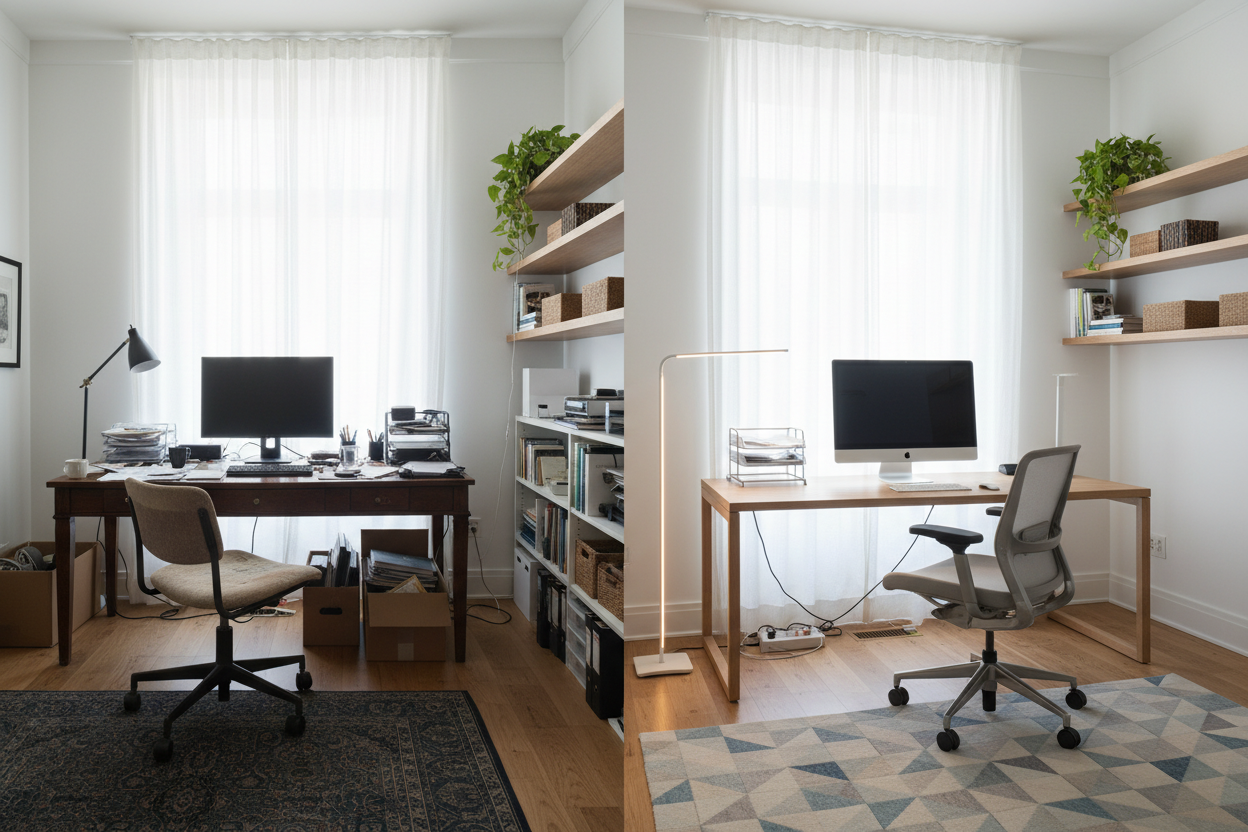
If you have spent the last few years working from a makeshift dining table corner or a chaotic spare bedroom, you know that a poorly planned workspace drains your energy before noon. An unbalanced layout or the wrong furniture scale can make a room feel claustrophobic instead of inspiring. Getting your office room setting right is about more than just ordering a desk online; it requires a deliberate approach to spatial flow, lighting, and visual weight.
In this guide, we will break down the exact spatial rules and furniture strategies you need to build a workspace that looks intentional and actually supports your daily workflow.
Quick Decision Guide
- Position your desk perpendicular to windows to maximize natural light while eliminating harsh screen glare.
- Leave a minimum of 36 inches of clearance behind your desk to allow your chair to roll and swivel comfortably.
- Anchor an open concept home office with a dedicated area rug to visually separate the workspace from living areas.
- Prioritize closed storage for paperwork and electronics to reduce the visual clutter that negatively impacts focus.
Mastering Space Planning and Layout
The foundation of any successful office room set up is the floor plan. In North American homes, we often deal with either cavernous bonus rooms that feel empty or tight secondary bedrooms where every inch counts. The goal is to create a layout that feels balanced and grounded.
The Command Position
Whenever possible, place your desk in the command position. This means your back is to a solid wall and you have a clear view of the door. Floating a desk in the center of the room instantly makes the space feel more executive and high-end, provided you have at least 3 feet of walkway clearance around the perimeter. If you are working with a tight footprint, anchoring the desk perpendicular to a wall is a great compromise that avoids the dreaded staring-at-a-blank-wall scenario.
Adding a Home Office Seating Area
If your square footage allows, incorporating a secondary home office seating area completely changes how you use the room. A pair of comfortable accent chairs or a small apartment-sized sofa gives you a place to step away from the screen for reading, taking phone calls, or reviewing physical documents. It shifts the vibe from a corporate cubicle to a casual home office that feels integrated with the rest of your house.
Balancing Style with Ergonomics
One of the biggest challenges in office room design at home is merging residential aesthetics with commercial-grade comfort. You want the room to look beautiful, but you also need to sit there for eight hours a day.
Choosing the Right Desk Surface
Material matters immensely for work room design. Solid wood offers warmth and durability, making it ideal for a traditional or transitional look. However, if you write heavily on paper, a smooth veneer or a desk with an inset leather pad provides a better writing surface. Avoid heavily textured reclaimed wood for your primary work surface, as it makes using a mouse or writing incredibly frustrating.
Designer's Honest Take: Lessons from My Own Projects
Over my 15 years designing residential workspaces, I have learned that aesthetic restraint is crucial when executing functional home office ideas. Early in my career, I designed a stunning workspace for a client featuring a massive, minimalist glass desk. It looked incredible in the portfolio photos.
The reality? It was an absolute nightmare for daily use. Every single fingerprint showed, the optical mouse would not track on the glass, and hiding the computer cables was nearly impossible without a solid modesty panel. The glass also felt physically cold to the touch during winter mornings. I learned the hard way that a workspace must prioritize tactile comfort and cable management over pure visual impact. Now, I almost exclusively specify desks with built-in wire routing and warm, matte finishes.
Frequently Asked Questions
How do I create a functional layout in a small room?
In small spaces, utilize vertical real estate. Install floating shelves above the desk to draw the eye upward and keep the work surface clear. Opt for a desk with a lighter visual weight—such as one with thin metal legs—rather than a chunky, solid wood executive desk.
Where should my desk face?
Ideally, your desk should face into the room with a view of the doorway, while sitting perpendicular to a window. This setup gives you a psychological sense of control over the space, provides flattering natural light for video calls, and prevents harsh backlighting or screen glare.
Is a dedicated room strictly necessary?
Not at all. If you are integrating your workspace into a larger living area, visual boundaries are key. Use a distinct rug, a change in wall paint, or a strategically placed bookshelf to define the zone, ensuring your workspace feels deliberate rather than like an afterthought.


Dejar un comentario
Este sitio está protegido por hCaptcha y se aplican la Política de privacidad de hCaptcha y los Términos del servicio.