










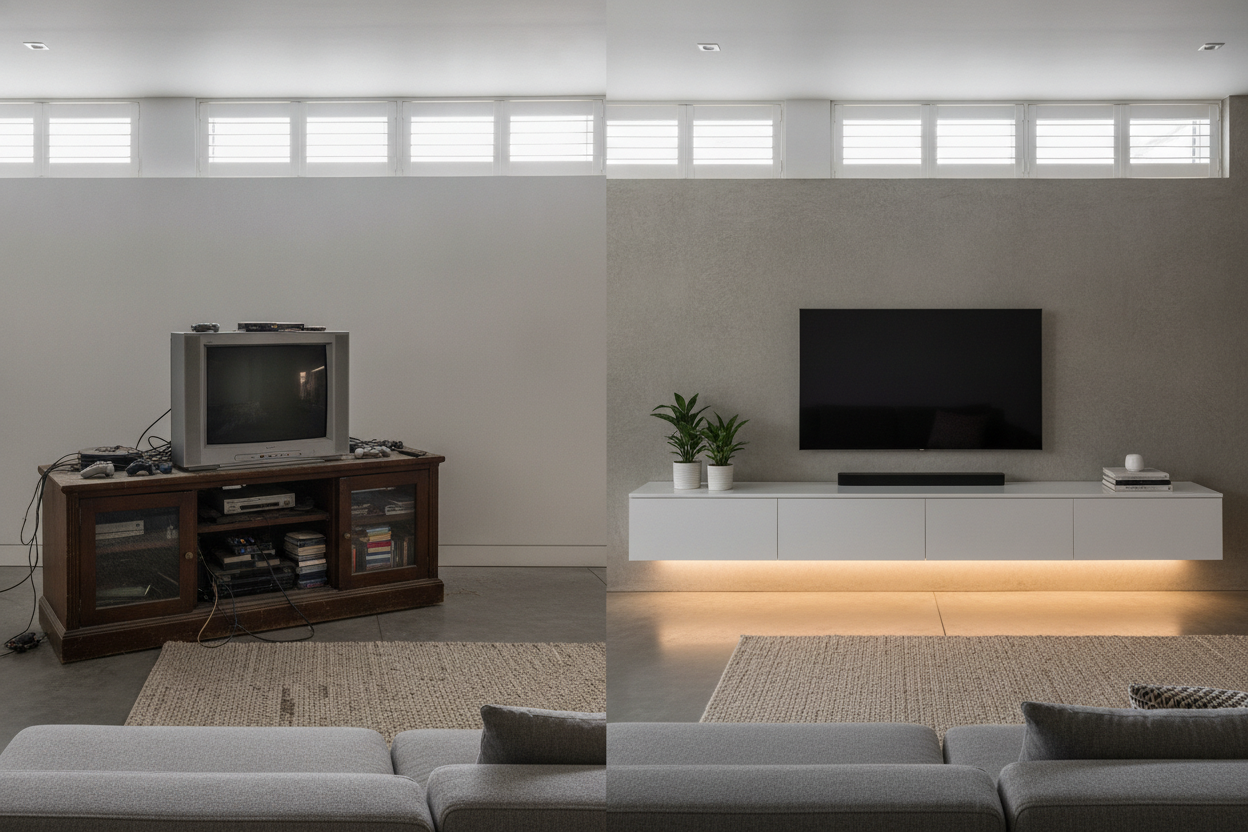
I remember the day I decided to 'finish' my basement. After spending a fortune on luxury vinyl plank and recessed lighting, I did the one thing every homeowner does to save a buck: I dragged my 2012 espresso-finish IKEA unit down the stairs. It was heavy, it scraped the fresh paint off the drywall, and the moment I set it against the wall, the whole room felt like a college dorm. It was a classic mistake. We treat the lower level like a furniture retirement home, but if you actually want a space where you can binge-watch a series without feeling like you're in a storage unit, you need a proper basement tv stand.
Quick Takeaways
- Avoid MDF that sits flush on the floor; it acts like a sponge for basement humidity.
- Keep the profile low. High units make 7-foot basement ceilings feel even more claustrophobic.
- Prioritize cable management. Basements are usually the 'hub' for routers, switches, and consoles.
- Consider a built-in heater. Concrete floors are heat sinks that kill the movie night vibe.
Stop Using the Downstairs as a Furniture Graveyard
The 'good' furniture stays upstairs where the guests can see it, and the scratched, wobbly, or outdated stuff gets demoted to the basement. I’ve been there. But here is the problem: a basement is already a challenging environment. It’s often darker, cooler, and more cramped than your living room. When you throw in a bulky, dated console that doesn't fit the scale of the room, you're essentially giving up on the space before you even sit down.
A media room should feel intentional. You still need to balance style and function even if the only people seeing it are you and the kids. If your stand is too tall, you’re craning your neck because basement seating (like those deep, slouchy sectionals) usually sits lower than formal living room furniture. If it's too small, your 75-inch TV looks like a lollipop on a toothpick. Stop settling for leftovers.
The Moisture Factor: What Actually Survives on Concrete
Basements breathe differently. Even if you don't have an active leak, concrete floors are naturally porous and hold moisture. I once owned a cheap particle-board stand that sat directly on the floor. After one humid summer, the bottom edges started to 'mushroom'—that lovely effect where the wood swells and the laminate peels off. It looked like garbage within six months.
When you are looking for a tv stand for basement use, look for legs. You want airflow. Metal frames or solid wood legs keep the main body of the unit away from the cold, damp floor. Browsing a curated collection of TV stands with elevated bases is the best way to ensure your furniture doesn't become a breeding ground for mildew. I personally swear by powder-coated steel legs; they don't rust, they're easy to wipe down, and they give the room a much-needed sense of 'lightness.'
Low Ceilings? Why Scale is Everything Down Here
Most basements are plagued by low ceilings, soffits, or those annoying bulkheads hiding your HVAC ducts. If you put a standard 30-inch tall media console in a room with 7-foot ceilings, you're cutting the visual height of the room in half. It makes the space feel like a cave. I learned this the hard way when I tried to fit a traditional hutch downstairs; it felt like the ceiling was literally resting on top of the TV.
The goal is to emphasize the horizontal, not the vertical. A wide adjustable TV stand is a lifesaver here. By choosing a unit that is long and low to the ground, you create the illusion of more wall space. It draws the eye across the room rather than up and down. Plus, an adjustable unit lets you tweak the width to fit between those weird basement pillars or corners that always seem to be in the most inconvenient spots.
Fighting the Chill: The Genius of the Hearth Console
Let’s be honest: basements are freezing. My first winter in my current house, I tried to have a movie night and ended up wearing a puffer jacket and two pairs of socks. Space heaters are ugly and always seem to trip the breaker. That is when I discovered the hearth console. It’s a media unit with an integrated infrared heater that actually looks like a fireplace.
It sounds cheesy until you use one. Choosing a fireplace TV stand solves the biggest problem with lower-level living: the chill. I bought one with a 5,000 BTU output, and it warmed my 400-square-foot media zone in about twenty minutes. Just a word of advice from my own trial and error: make sure the heater vents from the front, not the top, so you don't cook your expensive electronics sitting right above it.
Taming the Exposed Wires and Sump Pump Chaos
Basements are usually the utility hub of the house. You’ve got the router, the gaming consoles, maybe a network switch, and probably a mess of wires coming out of the wall. A standard living room console usually has one pathetic little hole in the back for cables. That won't cut it down here.
You need a unit with serious cable management. Look for 'clamshell' style backs or wide-access channels. I prefer units with ventilated back panels because gaming consoles like the PS5 run hot, and in a basement with less natural airflow, you don't want to trap that heat. If you can find a stand that hides the power strips and the 'spaghetti' of cords, your basement will actually feel like a finished room rather than a utility closet with a TV in it.
Basement TV FAQ
Should I wall mount my TV or use a stand?
In a basement, I always suggest a hybrid approach. Mount the TV to save space, but keep a low-profile stand underneath. You need a place for your gear, and a floating TV without a piece of furniture under it often looks 'lost' on a large basement wall.
What color furniture works best in a dark basement?
Avoid dark espresso or black. They absorb what little light you have. Go with light oak, walnut, or even a soft grey. It helps the room feel less like a dungeon and more like a retreat.
How wide should my stand be?
Your stand should be at least 6 to 10 inches wider than your TV on both sides. In a basement, a wider stand helps ground the room and prevents the 'top-heavy' look that happens when a big screen sits on a tiny cabinet.

Dejar un comentario
Este sitio está protegido por hCaptcha y se aplican la Política de privacidad de hCaptcha y los Términos del servicio.