










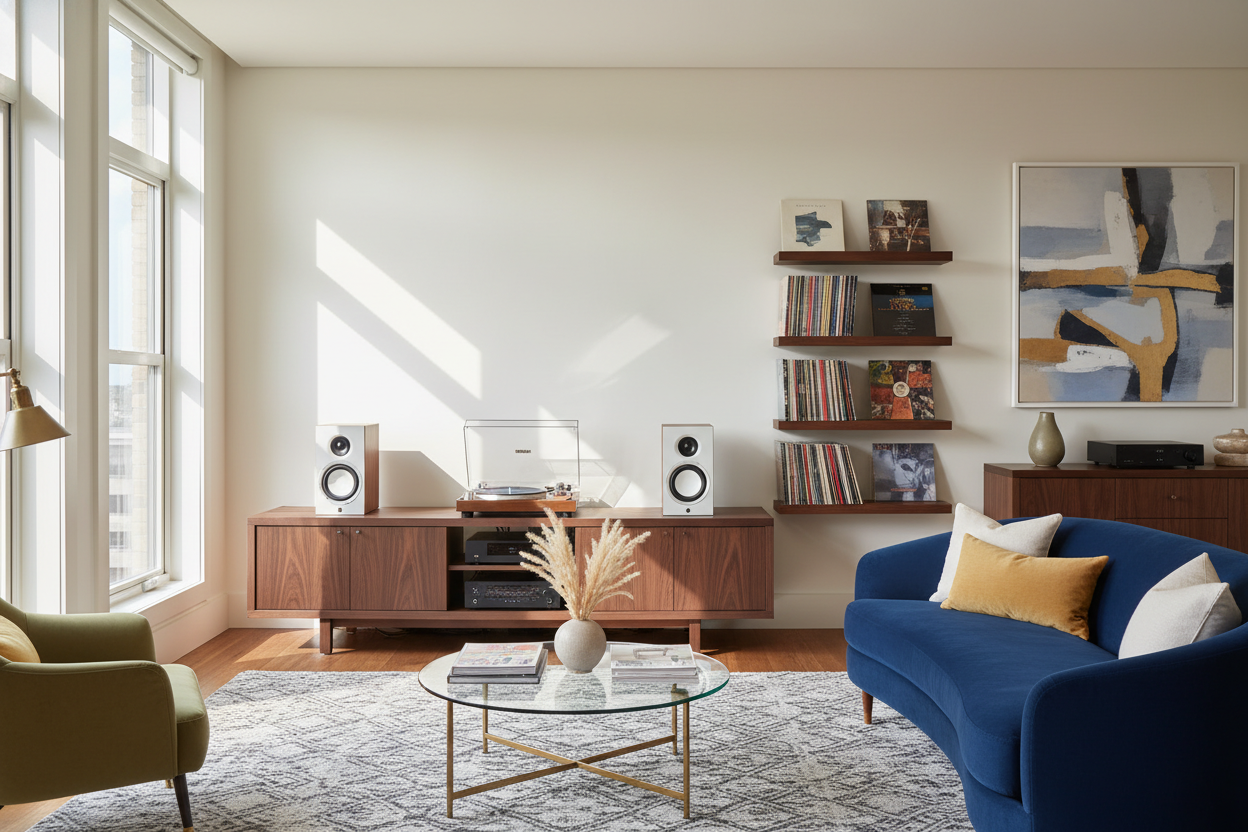
I remember the first time I set up my turntable on a flimsy, $40 particle-board bookshelf. Every time my dog walked into the room, the needle skipped across my favorite Bowie record like it was on ice. It was heartbreaking and, frankly, a little embarrassing. We spend hundreds—sometimes thousands—on high-fidelity gear, only to shove it onto furniture meant for plastic DVD cases and lightweight cable boxes.
A real music entertainment center isn't just about aesthetics; it's about making sure your gear actually works the way it was designed to. You wouldn't put a high-performance engine in a rusted-out chassis, so why put a precision instrument on a wobbly stand?
- Vibration Control: Heavy-duty builds keep your needle from jumping every time someone breathes.
- Depth Matters: Most vintage receivers are deeper than modern slim-profile TV stands.
- Airflow: Amps get hot. Give them room to breathe or prepare for a repair bill.
- Weight Capacity: Vinyl is heavy. A foot of records weighs about 35 pounds.
The Problem With Putting Audio Gear on a Standard TV Stand
Most modern media consoles are built for the 'streaming era.' They are shallow, thin, and designed to hold a 15-pound OLED screen and maybe a soundbar. If you try to shove a 1970s Marantz receiver into one of those 14-inch deep cubbies, the back will stick out like a sore thumb, or the cables will be crushed against the wall.
Then there is the vibration issue. Turntables are incredibly sensitive to micro-movements. If your stand is hollow or wobbly, your speakers will create a feedback loop that muddies your sound. You might find yourself wondering is an entertainment center worth the space when you could just use a wall shelf, but the right piece of furniture provides the mass needed to dampen those vibrations. A flimsy stand acts like a drum, amplifying every footstep in the room.
What Actually Makes a Good Music Hub?
Structural integrity is the hill I will die on. You want something with a solid back panel or, better yet, a reinforced frame. Look for furniture that specifies its weight load. If it can't handle 100 pounds on the top shelf, it shouldn't be holding your turntable and amp. I have seen too many 'minimalist' stands buckle under the weight of a decent amplifier.
Wire management is the other big hurdle. Audiophile setups involve a rat's nest of RCA cables, speaker wire, and power cords. I always look for pieces with pre-drilled cable channels or open backs. It is worth the effort to browse a dedicated entertainment center collection specifically to find units that prioritize cable routing and heavy equipment over just looking pretty. You want enough depth (at least 18 inches) to ensure your cables aren't bent at 90-degree angles, which can damage the internal wiring over time.
The Receiver Ventilation Rule I Learned the Hard Way
I once lived in a tiny studio and thought I was being clever by hiding my vintage Sansui receiver inside a closed cabinet with no back. I thought the open back was enough. It wasn't. After two hours of playing a bass-heavy jazz record, I smelled something like burning hair. The amp had overheated so badly it melted a capacitor. Now, I only use slatted doors or completely open shelving. If you can't feel a breeze, your amp is slowly dying. Heat is the number one killer of high-end audio gear.
Don't Forget the Golden Rule of Vinyl Storage
Records are deceptively heavy. A standard 12-inch LP weighs about 180 grams, but once you add the jacket and a protective sleeve, a collection adds up fast. Most 'lifestyle' bookshelves will bow in the middle under the weight of just fifty records. You need vertical dividers every 12 to 15 inches to keep the records upright and prevent them from leaning, which causes warping over time.
I personally like a wood grain entertainment center with pull down doors because it lets you hide the cleaning kits, extra headshells, and those ugly plastic outer sleeves while keeping the heavy records supported on a solid base. It keeps the focus on the gear, not the clutter. Look for reinforced bottom shelves; if the shelf is held up by four tiny plastic pegs, walk away.
How to Style It So It Doesn't Look Like a Dorm Room
The biggest risk with a dedicated music station is that it ends up looking like a tech graveyard. All those black boxes and wires can feel cold. I like to break up the tech look by adding a trailing Pothos plant on one end and a dimmable warm lamp on the other. Lighting is everything when you're flipping through records at night. Avoid harsh overhead LEDs; go for something that makes the wood grain pop.
If you have the wall space, styling a bookcase and entertainment center together creates a built-in look that anchors the room. Instead of a lonely stand, you get a full library vibe. Mix in some art books or a few framed photos to make it feel like a living space, not just a listening booth. It turns a piece of equipment into a focal point of the home.
FAQ
Can I put my speakers on the same stand as my turntable?
Ideally, no. The vibrations from the speakers can travel through the furniture and cause feedback in the turntable's needle. If you must, use isolation pads or thick rubber feet under the speakers to decouple them from the wood surface.
How deep should my music stand be?
Aim for at least 18 inches. Most vintage receivers are 16-17 inches deep once you factor in the knobs on the front and the RCA cables sticking out the back. Anything shallower will force you to leave the unit sticking out.
Is solid wood better than MDF for audio?
Solid wood or high-quality plywood is generally better because it is denser and less likely to resonate or sag. Cheap, hollow particle board is the enemy of good sound—it acts like a resonator for all the wrong frequencies.


Dejar un comentario
Este sitio está protegido por hCaptcha y se aplican la Política de privacidad de hCaptcha y los Términos del servicio.