










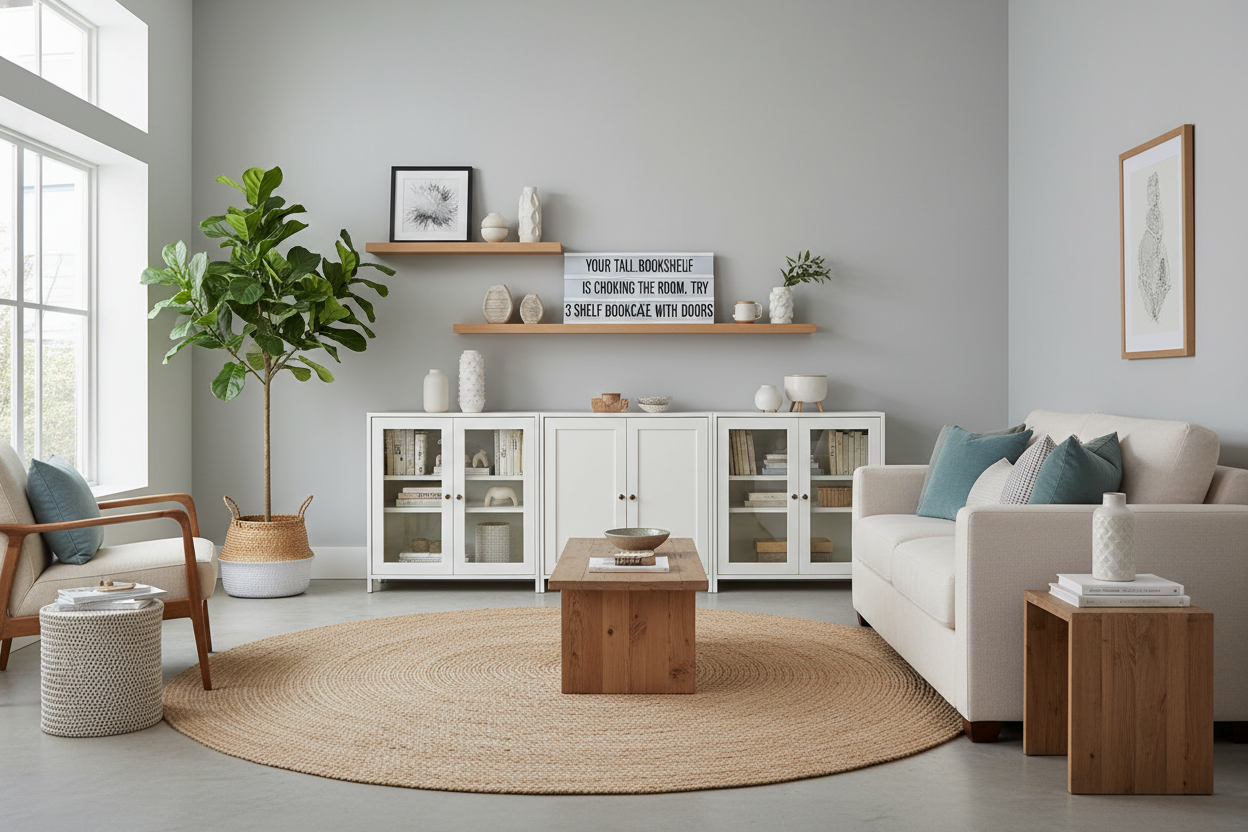
I spent three hours last night staring at my living room wall, wondering why it felt like the walls were closing in on me. It wasn't the paint color or the oversized 84-inch sofa—it was the massive, floor-to-ceiling bookshelf I bought thinking I’d finally look like a sophisticated intellectual. Instead, it just looked like a giant, dark monolith sucking the natural light out of the room. I finally swapped it for a 3 shelf bookcase with doors, and I am never going back to towering open shelves again.
Quick Takeaways
- Lower furniture (30-42 inches) keeps the upper third of your walls open, making small rooms feel significantly larger.
- Doors are the ultimate 'lazy' hack for hiding visual clutter like routers, mismatched books, and paperwork.
- A glass-front unit offers the display benefits of open shelving without the weekly dusting ritual.
- Waist-high units double as functional surfaces for lamps, drinks, or entryway drop zones.
The Problem With Floor-to-Ceiling Shelves
Floor-to-ceiling shelves are the 'expectation vs reality' meme of the furniture world. We see them in architectural magazines filled with perfectly aged leather-bound books and cascading ivy. In reality, in a standard 12x14 living room, a 7-foot shelf just looks like a dark tower. It blocks the bounce of natural light from your windows and makes 8-foot ceilings feel like you're living in a basement. It creates a heavy vertical line that stops the eye, making the room feel segmented and cramped.
Beyond the visual weight, there is the 'styling tax.' An open shelf is never just a shelf; it is a stage. If you have a stack of mismatched paperbacks, a plastic router with blinking lights, or a collection of old magazines, everyone sees it. You end up spending hours moving objects around just to make the storage look like it isn't actually storing anything. It demands a ridiculous amount of curation—color-coordinating spines and buying overpriced vases—just to look presentable. If you aren't ready to be a full-time librarian and curator, a tall open shelf is just a high-visibility junk drawer.
Enter the 'Console Hack' (Why Shorter is Better)
The math of a small space is simple: the more floor and upper wall you can see, the bigger the room feels. This is why the waist-high 3-tier bookshelf with doors is the secret weapon of interior designers. Most of these units top out around 35 to 40 inches. By keeping the storage low, you leave the top two-thirds of your wall completely open. This allows you to hang a large mirror to double your light or a single piece of statement art that actually has room to breathe.
I call this the 'Console Hack' because these units are effectively deep consoles with double the storage capacity. When you align your furniture with the height of your window sills or the back of your sofa, you create a continuous horizontal line. This trick draws the eye across the room rather than up and down, which trickily suggests the space is wider than it is. You aren't losing storage footprint either; you are just shifting it into a more usable, less intrusive silhouette that doesn't dominate your peripheral vision while you're trying to relax on the couch.
Solid vs. Glass: Hiding the Mess
Choosing the right door type is a matter of being honest about your habits. If you are a 'piler' rather than a 'filer,' solid doors are your best friend. I have a solid-door unit in my home office that hides a literal mountain of messy charging cables, half-finished tax returns, and old instruction manuals. The doors stay shut, and the room looks like a Pinterest board. It’s the ultimate stress-reducer because you don't have to look at your 'to-do' list every time you walk past the shelf.
However, if you have a collection you're actually proud of—think vintage ceramics or a set of hardcovers—a 3 shelf bookcase with glass doors is the way to go. It offers the best of both worlds. You get the visual depth and 'museum' vibe of a 3 shelf glass cabinet without the maintenance nightmare. Glass doors keep the dust off your items, which is a major win if you hate spending your Saturdays with a microfiber cloth. It keeps the space feeling airy and light while still providing a protective barrier for your favorite things.
Three Unexpected Places This Piece Works Wonders
Because of their height, these units are incredibly versatile. One of my favorite placements is behind a floating sofa in an open-concept layout. It hides the back of the sofa, which is usually the least attractive part of the furniture, and provides a surface for a table lamp or a drink. It’s much more functional than a thin sofa table because you actually get three levels of enclosed storage underneath.
In a narrow hallway, a 12-inch deep unit acts as a perfect 'drop zone' for keys and mail without choking the walkway. I've even seen people use them as makeshift dining room buffets to store heavy Dutch ovens and seasonal platters that don't fit in the kitchen cabinets. Now, I will admit that if you live in a massive converted loft with 15-foot vaulted ceilings, a short unit might look a bit like dollhouse furniture. In those specific cases, you actually need the height of a freestanding wood bookcase with 3 glass doors to ground the room. But for 90% of us in standard apartments or suburban homes, staying low is the smarter play.
What to Look For Before You Buy
Before you hit 'add to cart,' look at the hardware. Cheap 'euro-style' hinges are the first thing to fail; they’ll sag within six months, and your doors will never line up straight again. Look for steel hinges with at least three adjustment points. Also, consider the door clearance. If you’re putting this in a tight spot, make sure the doors don't block the entire path when they're swung open. If space is really tight, sliding doors are a lifesaver.
Most importantly, prioritize adjustable shelf storage. I once bought a beautiful fixed-shelf unit only to realize my favorite coffee table book was exactly a quarter-inch too tall to fit inside. I had to stack my books horizontally like a stack of pancakes, which was not the 'vibe' I was going for. Adjustable pins allow you to customize the interior for everything from tall wine bottles to short paperbacks. It’s a small detail that makes a massive difference in how much you’ll actually use the piece over the next five years.
Personal Experience: The Wobbly Bargain
I once bought a 'bargain' 3-shelf unit that had a backboard as thin as a cereal box. Every time I closed the doors, the whole thing wobbled, and my glassware inside rattled like an earthquake was hitting. I ended up having to buy L-brackets to anchor it to the wall just to keep it stable. My advice? Check the weight capacity. A good unit should be able to hold at least 30-40 lbs per shelf without bowing. If the manufacturer doesn't list the weight limit, it's usually because they don't want you to know how flimsy it is.
FAQ
Can I use a 3-shelf bookcase as a TV stand?
Absolutely, provided the height works for your eye level. Most 3-shelf units are 35-40 inches tall, which is perfect if you're watching from a higher bed, but might be a bit tall if you're sitting on a low-profile sofa. Check your measurements first.
Are glass doors hard to keep clean?
Not really. A quick spray of glass cleaner once a week is all it takes. The trade-off is that you never have to dust the actual books or objects inside, which saves you way more time in the long run.
Should I anchor a short bookcase to the wall?
Yes. Even though they are shorter and less likely to tip than a 6-foot tower, once you add doors, the center of gravity shifts forward when they are open. If you have kids or pets, anchoring is a non-negotiable safety step.


Dejar un comentario
Este sitio está protegido por hCaptcha y se aplican la Política de privacidad de hCaptcha y los Términos del servicio.