










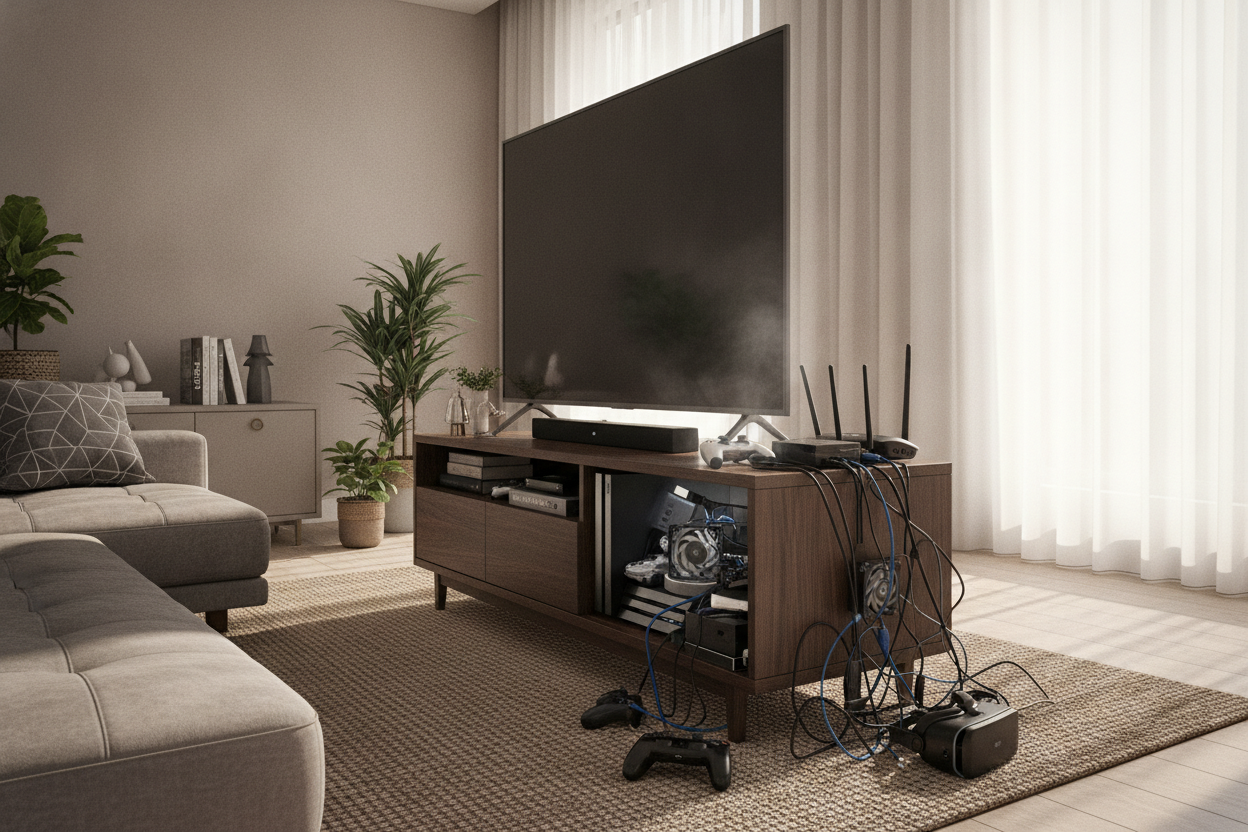
I spent forty-five minutes last Tuesday trying to untangle a Nintendo Switch power adapter from a cluster of dust-covered HDMI cables behind my old mid-century credenza. It was the breaking point. My living room looked like a Pinterest board from the front and a back-alley server room from the side. I finally admitted that my aesthetic furniture wasn't built for my actual life—which involves a PS5, an Apple TV, and a massive soundbar.
I started looking into the tv stands whalen builds because they promise something most 'design-forward' units don't: a way to actually hide the mess without drilling six-inch holes in my drywall. I needed to know if these hybrid mounting systems were actually sturdy or just a glorified metal pole that would tip over if my cat looked at it funny.
Quick Takeaways
- Cable Mastery: The hollow spine really does swallow cords, provided you don't have twenty of them.
- Rock Solid: Surprisingly heavy steel construction makes it much more stable than it looks in photos.
- Rental Friendly: No wall drilling required to get that 'floating' TV look.
- Aesthetic Trade-off: It looks like a tech hub, not a piece of heirloom furniture.
Why I Finally Gave Up on My Traditional Media Credenza
My old media unit was beautiful—solid walnut, tapered legs, very 'adult.' But it had one tiny, circular cutout in the back for cables. Trying to shove a power strip and five thick power bricks through that hole was like playing a high-stakes game of Tetris where everyone loses. Every time I looked at my media setup, I realized my open console is exposing your mess in a way that no amount of Velcro ties could ever truly fix.
The whalen entertainment center approach is different. It’s built around the idea that cables exist and they are ugly. Instead of trying to hide them behind a thin piece of particle board, these stands use a central steel spine. I realized I’d rather have a slightly more industrial-looking stand that actually functions than a gorgeous sideboard that looks like it's being attacked by a black plastic octopus.
The 'Spine' System: Does It Actually Conceal the Wires?
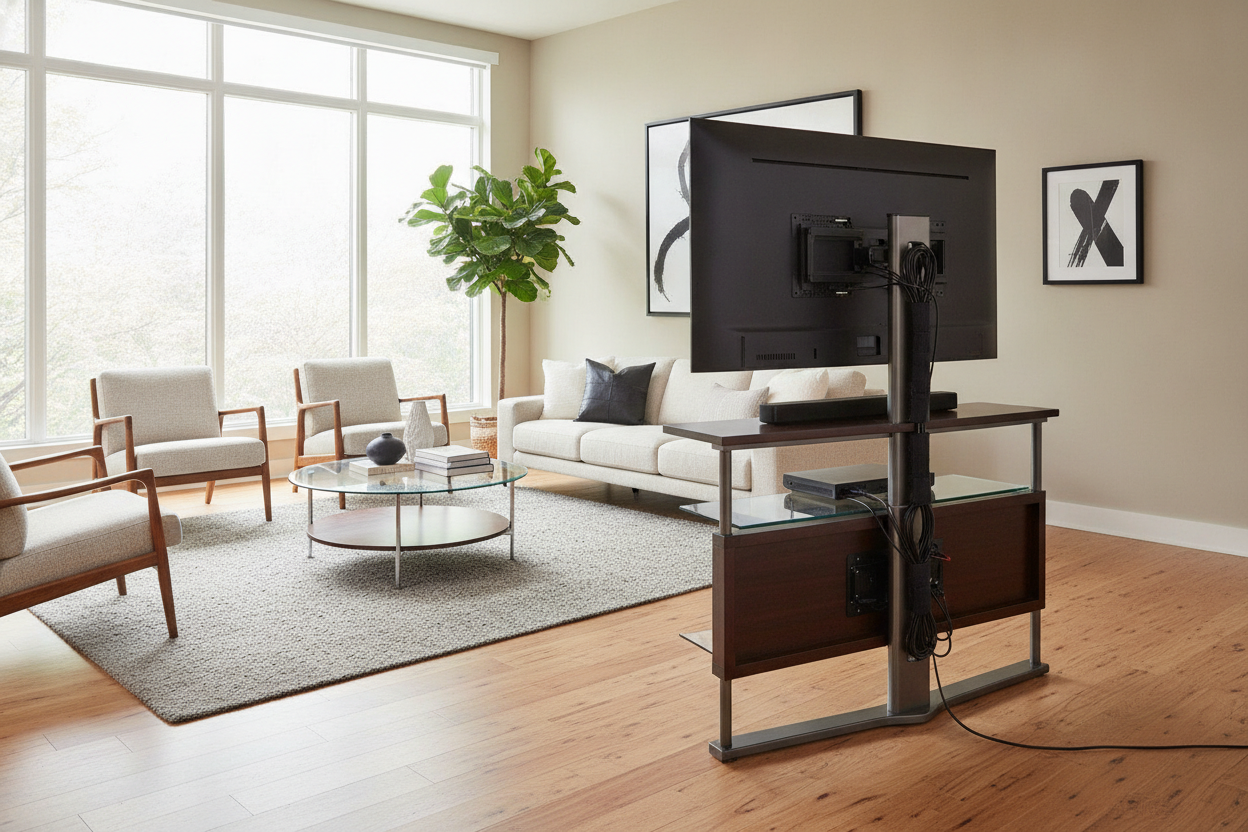
The main selling point of a whalen tv console is the cable management column. In theory, you thread everything through the back and it disappears. In practice, it works, but there is a learning curve. If you’re trying to run two HDMI 2.1 cables, a thick power cord for a 65-inch OLED, and a chunky Ethernet cable, that column gets crowded fast.
I found that I had to be strategic. I fed the thinnest cables first and saved the thick power cords for last. The openings are generous, but they aren't infinite. However, once the back panel is snapped into place, the 'spaghetti monster' is genuinely gone. It’s the first time in years I haven't seen a single dangling wire from my seated position on the couch. It’s a massive relief for anyone with even a hint of cable-induced anxiety.
Trusting My 65-Inch Screen to a Metal Pole
I’ll be honest: I was nervous. Putting a $1,500 television on a single vertical support feels like an act of faith. But Whalen uses heavy-gauge, powder-coated steel. This thing is dense. During assembly, I dropped one of the support brackets on my toe and I'm pretty sure the floor took more damage than the metal did. It’s significantly more stable than the flimsy 'universal' stands you find on the cheap end of the market.
I finally stopped drilling walls and bought a Whalen after my third apartment move in two years. Patching drywall is a nightmare, and finding studs in old buildings is a guessing game I usually lose. While a wall mount is the ultimate 'clean' look, this hybrid system gives you the height and tilt adjustability without the security deposit deductions. It doesn't wobble when I walk past it, and even when my 15-pound tabby jumps on the lower glass shelf, the screen stays level.
Aesthetically, It's Functional (But Here's How I Styled It)
Let’s talk about the elephant in the room: these stands look like they belong in a Best Buy. The dark wood and black glass aesthetic can feel a bit 'bachelor pad' if you aren't careful. If you are looking for that ultra-modern, high gloss LED TV stands vibe, this isn't exactly it. It’s more transitional and heavy.
To stop it from looking too cold, I swapped out the standard tech-heavy decor. I put a large, leafy snake plant on the bottom shelf to soften the hard edges of the tempered glass. I also added a warm LED strip behind the main pillar to create some depth. By layering in some textures—like a couple of linen-bound books next to the PS5—you can make the stand feel like a part of the room rather than just a mounting bracket that happens to have shelves.
The Final Verdict: Who Should Actually Buy This?
If you own more than three gaming consoles or a soundbar that requires its own zip code, this is a solid buy. It solves the cable problem better than almost anything else at this price point. It’s a lifesaver for renters who want their TV at eye level without the hassle of a drill. However, if you’re a design purist who hates the sight of metal supports, you might want to browse other TV stands before committing to this beast.
FAQ
Is the glass shelf strong enough for a receiver?
Yes, the tempered glass is surprisingly thick. Most Whalen models rate the middle shelves for about 25-50 lbs, which easily handles a heavy-duty AV receiver or a stack of consoles.
How long does assembly take?
Budget about 45 minutes to an hour. It’s not difficult, but the parts are heavy, and you’ll definitely want a second person to help you lift the TV onto the mounting bracket at the end.
Can I use it as a regular tabletop stand?
Most Whalen 3-in-1 models allow you to ditch the tall spine and just use the console as a standard table, but you lose the cable management benefits that make it worth buying in the first place.

Leave a comment
This site is protected by hCaptcha and the hCaptcha Privacy Policy and Terms of Service apply.