










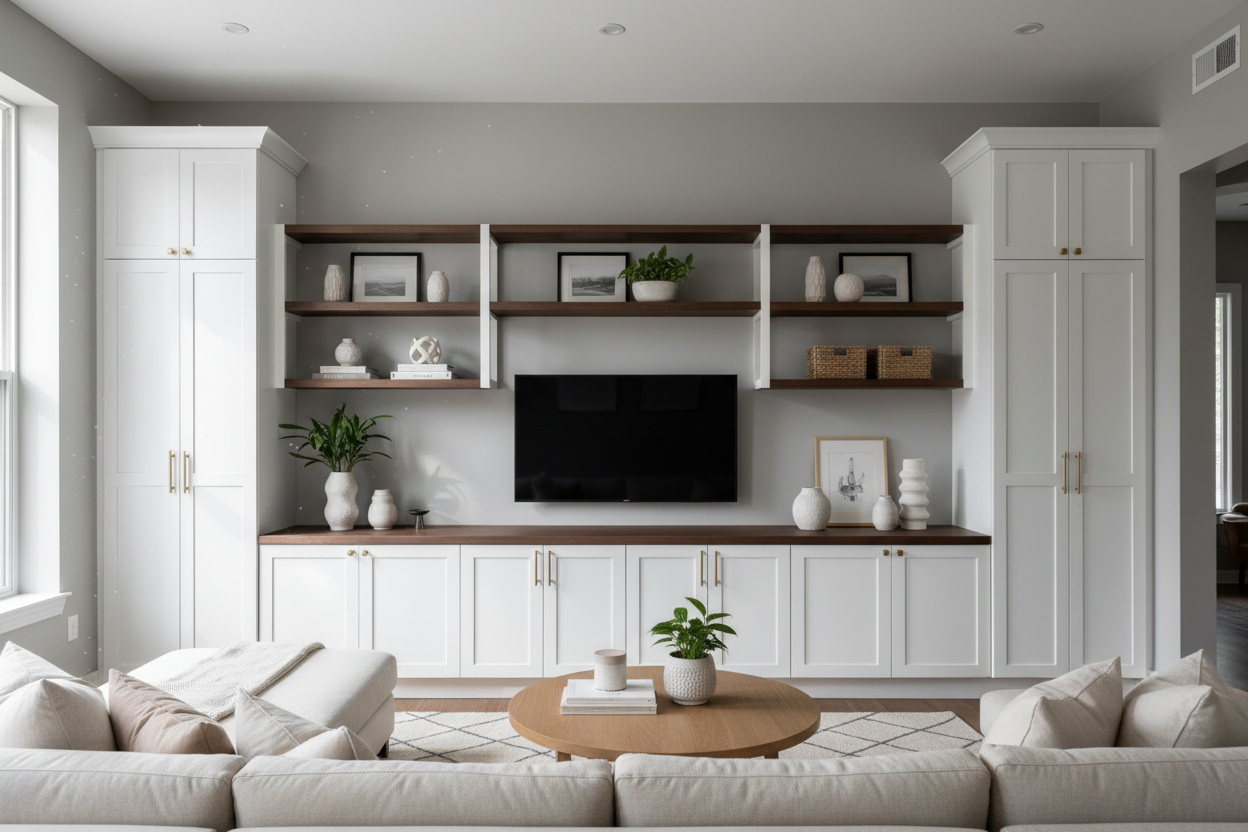
I spent three weeks staring at a blank wall in my living room that was practically begging for a library-style setup. When the local millwork guy quoted me $8,500 for a custom floor-to-ceiling installation, I laughed, then I cried, and then I opened forty-seven browser tabs of stock kitchen units. I knew there had to be a way to get that high-end look without a second mortgage.
The secret isn't some magical carpentry skill; it is the strategic use of built cabinets that started their lives as basic, pre-assembled boxes. By using mass-produced modules and some clever trim work, you can trick anyone into thinking you hired a bespoke craftsman. It is all about the illusion of permanence.
Quick Takeaways
- Kitchen base units are sturdier and deeper than standard living room furniture.
- The 'built-in' look depends entirely on your trim and molding, not the boxes themselves.
- Always build a 2x4 base platform to lift your cabinets above the floor trim.
- Color-drenching (painting everything one color) hides the seams between prefab units.
The $8,000 Quote That Forced Me to Get Creative
Sticker shock is a powerful motivator. When you realize that bespoke carpentry costs more than a decent used car, you start looking at a built-in cabinet differently. Most people think 'custom' means the wood was felled and planed specifically for their alcove. In reality, even the pros often use pre-made boxes and just face them with fancy doors.
I realized that if I wanted built ins cabinets that didn't look like a cheap DIY disaster, I had to stop looking at 'bookcases' and start looking at kitchen modules. Using cabinets for built in projects allows you to work with standard dimensions that are designed to fit together. It turns a complex construction project into a game of Tetris with heavy wooden boxes.
The goal is to find cabinets for built-ins that have solid frames. Forget the flimsy flat-pack stuff that wobbles when you sneeze. You want built in cabinet units that have a 1/2-inch or 3/4-inch back panel. This gives you something substantial to screw into the wall studs, which is non-negotiable for safety.
Sourcing Lower Cabinets for Built Ins That Actually Work
If you are building a media center or a reading nook, you need a solid foundation. I always recommend using a built in cabinet for kitchen use as your base. Why? Because they are typically 24 inches deep, which is perfect for storing everything from board games to bulky electronics. Standard bookshelves are often too shallow, leaving your stuff hanging off the edge.
For my last project, I looked at a corner kitchen pantry cabinet set as a potential anchor. These types of units provide a substantial weight capacity that you just won't find in 'accent' furniture. Using a built in kitchen cabinet as a base allows you to top it with a single, long piece of butcher block or plywood to create a seamless counter surface.
When shopping for built in kitchen unit pieces, look for built in base cabinets with adjustable feet or a solid toe-kick area. If you are using base cabinets for built ins in a living room, you will likely need to build a 'riser' out of 2x4s so the doors can clear your thick carpet or rug. It’s a small detail that makes a massive difference in how 'finished' the final result looks.
The Secret is in the Trim (Hiding the Seams)
This is where the magic happens. A built in cabinet with doors only looks like it was 'built in place' because of the filler boards. You are never going to find stock units that fit your wall perfectly from edge to edge. You’ll likely have a 3-inch gap on one side or a 5-inch gap in the middle. This is where you use diy built ins with stock cabinets techniques to bridge the space.
I buy 1x4 poplar strips and rip them down to fit those awkward gaps. Once you nail those filler strips into the cabinet face frames and caulk the edges, the gaps disappear. This is how you create built in place cabinets without actually building the boxes from scratch. You are essentially 'skinning' the gaps.
Don't forget the crown molding at the top and a chunky baseboard at the bottom. By running one continuous piece of trim across three separate cabinets that look like built-ins, you trick the eye into seeing one massive architectural feature. If you use built-in looking cabinets but skip the crown molding, they will always look like furniture pushed against a wall. The molding is the 'glue' that holds the aesthetic together.
When You Actually Shouldn't Hack It
I am a huge fan of built in wood cabinets, but I’ve learned the hard way that they aren't for every room. If you have a small, oddly shaped room, a wall of built in lower cabinets can actually make the space feel smaller and more cramped. Sometimes, the permanence of built ins from stock cabinets is a disadvantage if you like to rearrange your layout every six months.
In my guest room, I realized that the floor-to-ceiling built ins using kitchen cabinets I planned were going to block too much natural light. I ended up deciding to swap my boring built-ins for kitchen accent cabinets because I wanted the flexibility to move things around. Freestanding pieces have a 'breathability' that wall-to-wall installations lack.
Also, if you are a renter, using built ins using stock cabinets is a no-go. These are permanent fixtures that require screwing directly into the studs and floor. If you aren't ready to commit to that wall for the next five years, stick to standalone units that you can take with you when you move.
Paint the Whole Wall, Not Just the Wood
The final step to selling the lie of pre built built in cabinets is the paint job. If you use using stock cabinets for built-ins, they usually come in a 'stock' white or a wood grain that looks like a 1990s dentist office. You need to paint the cabinets, the filler strips, and the wall directly behind any open shelving the exact same color and sheen.
If you start with something like a large modern white wardrobe armoire, you can't just paint over that factory finish. You have to scuff-sand it with 120-grit sandpaper and use a high-adhesion primer. I learned this the hard way when I tried to paint over a laminate finish without priming—the paint peeled off in sheets like a bad sunburn two weeks later.
Using kitchen cabinets as built ins works best when you use a dedicated cabinet paint (like a water-based alkyd). It levels out as it dries, so you don't see brush marks. When you finish, the stock cabinets for built-ins will have a hard, durable shell that looks like it came straight from a high-end showroom. Whether you use unfinished cabinets for built ins or pre-finished ones, that final unified coat of paint is what makes the using kitchen cabinets as built ins hack actually look professional.
FAQ
Can I use stock cabinets for built-ins if my walls are crooked?
Yes, and they probably are. You use 'scribing' to shave down your filler strips so they follow the curve of your wall. Caulk will hide any remaining small gaps. Most people using stock cabinets for built ins rely heavily on caulk and wood filler to hide wall imperfections.
Is it cheaper to use inbuilt kitchen cabinets or build from scratch?
Using prefab cabinets for built-ins is almost always cheaper because of the economy of scale. Buying raw plywood, edge banding, and hardware separately usually costs 20-30% more than just buying the pre-assembled boxes at a big-box store.
What is the best wood for built-in cabinets?
If you are painting them, use maple or poplar face frames with birch plywood boxes. If you want a natural wood look, oak is traditional, but it has a heavy grain that can look dated if not handled correctly. Most diy built in wood cabinets projects use paint-grade materials to keep costs down.

Leave a comment
This site is protected by hCaptcha and the hCaptcha Privacy Policy and Terms of Service apply.