










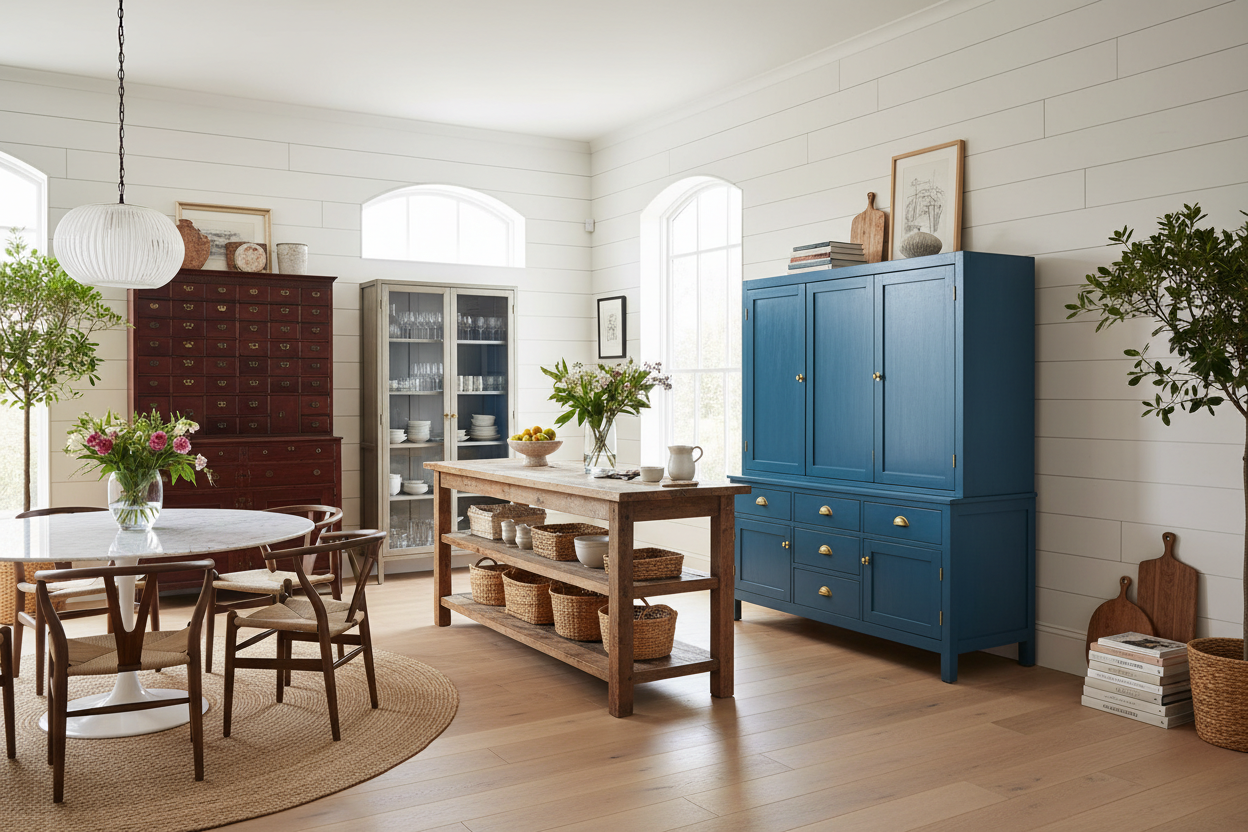
Last year, I stood in my kitchen and realized it felt less like a home and more like a high-end dental office. Every square inch of wall was covered in identical white Shaker cabinets. It was efficient, sure, but it had zero soul. I was suffering from 'built-in fatigue,' a common side effect of modern design that prioritizes uniform storage over actual personality.
The fix wasn't a full renovation. I didn't need more drywall work or a custom contractor. I just needed to rip out one useless section of lower cabinets and replace them with **kitchen accent cabinets**. It was the single best design decision I have made in five years.
Quick Takeaways
- Built-ins make a room feel static; freestanding pieces make it feel 'collected.'
- Accent cabinets are the best way to introduce different wood tones or bold colors without committing to a full kitchen repaint.
- They act as a visual bridge in open-concept homes, softening the transition from the 'work' zone to the 'relax' zone.
- Freestanding furniture is often more affordable than custom cabinetry but offers the same (or better) storage depth.
The Wall-to-Wall Built-In Trap
We have been conditioned to believe that every wall in a kitchen must be 'maximized' with matching boxes. This leads to what designers call the 'commercial prep kitchen' look—sterile, repetitive, and frankly, a bit boring. The 'unfitted kitchen' trend is the antidote to this. It is the idea that a kitchen should look like it evolved over time, using individual pieces of furniture rather than a monolithic block of cabinetry.
When you cover every wall in the same finish, you lose the opportunity for shadows, texture, and architectural interest. It feels heavy. By leaving a wall open for a standalone piece, you let the room breathe. You’re not just storing plates; you’re creating a focal point that says someone actually lives here and has taste beyond a showroom catalog.
Why a Kitchen Chest Cabinet Changes the Vibe
Swapping a standard base unit for a dedicated **kitchen chest cabinet** is a total mood shift. Unlike built-ins that sit on a recessed kickplate, a chest cabinet often has legs or a decorative base. This small gap of floor visibility makes the entire room feel larger. It breaks up the 'heavy' look of cabinets that go straight to the floor.
I’m a huge fan of mixing finishes here. If your main cabinets are white or light oak, go for a chest in a deep navy or a rich, moody walnut. It gives the eye a place to rest. If you are worried about the cost of standalone furniture, you can find pieces that look custom-made if you know where to actually find quality without the designer markup. You want solid construction—think dovetail joints and real wood veneers—not that paper-thin laminate that peels the second a steamer hits it.
Bridging the Gap Between Cooking and Living Spaces
In most modern homes, the kitchen just... ends, and the living room begins. It’s an awkward transition. Traditional **kitchen accent furniture** is the perfect mediator. It doesn’t look quite like a kitchen tool, but it’s more rugged than a bedroom dresser. It’s the handshake between your stove and your sofa.
For instance, a large sideboard display buffet with drawers works wonders at the edge of a kitchen. It provides a landing zone for mail or groceries while hiding the 'ugly' stuff like the air fryer or the oversized slow cooker that usually clutters the counters. By using a piece that looks like 'living room' furniture in the kitchen, you soften those hard industrial lines of the fridge and dishwasher.
3 Awkward Kitchen Zones Begging for Freestanding Storage
Most kitchens have 'dead zones' where the original builder just gave up. The first is the empty wall opposite the sink. If you don't have room for a full island, a shallow accent cabinet can provide a coffee bar station without blocking traffic. It is a much tighter, more intentional look than a rolling cart.
The second zone is the gap near the pantry or back door. This is usually where the vacuum ends up leaning against the wall. A tall, slim cabinet here can hide cleaning supplies while looking like a deliberate design choice. Finally, check your breakfast nook. A low cabinet under a window can hold linens and seasonal platters that you only use twice a year. For those with narrow footprints, these pieces are often better than kitchen islands because they hug the wall and keep the walkway clear.
How to Style Your New Kitchen Furniture
The goal is to make the piece look intentional, not like you just ran out of money for built-ins. Start with lighting. A small battery-powered lamp or a plug-in sconce above the cabinet immediately 'grounds' the piece. It turns a storage box into a curated 'moment.'
I also suggest using the top for things that aren't strictly utilitarian. Display your three prettiest cookbooks, a bowl of citrus, or a ceramic pitcher. Inside, keep the heavy lifting organized. I use my accent cabinet for the stuff I use every day but hate looking at—the toaster, the bread box, and the mountain of reusable water bottles. If you're struggling with which style fits your layout, there is a great guide on choosing the perfect sideboard or buffet cabinet for your kitchen that covers the math of it all.
My Honest Mistake
I’ll be real: my first attempt at this was a disaster. I bought a vintage piece that was only 12 inches deep. It looked great, but it was so light that every time I pulled the drawer out, the whole thing tipped forward. I had to anchor it to the wall like a toddler’s dresser. Lesson learned: for the kitchen, you want weight. Look for a piece with a bit of 'heft' so it doesn't shimmy when you're chopping something nearby.
FAQ
Can I mix different wood types?
Yes, and you should. If your floors are oak, try a painted cabinet or a much darker walnut. Matching everything perfectly is the fastest way to make a room look cheap and dated. Aim for contrast, not a 'close enough' match.
Are accent cabinets sturdy enough for heavy appliances?
Only if they are made of solid wood or high-density MDF. Avoid the super-cheap particle board stuff if you plan on putting a 20-pound Stand Mixer inside. Check the shelf weight capacity before you buy.
Do I need to anchor them to the wall?
If the cabinet is tall or top-heavy, absolutely. Kitchens are high-traffic areas, and a bumped cabinet is a disaster waiting to happen. Most modern units come with a simple anti-tip kit—use it.

Leave a comment
This site is protected by hCaptcha and the hCaptcha Privacy Policy and Terms of Service apply.