










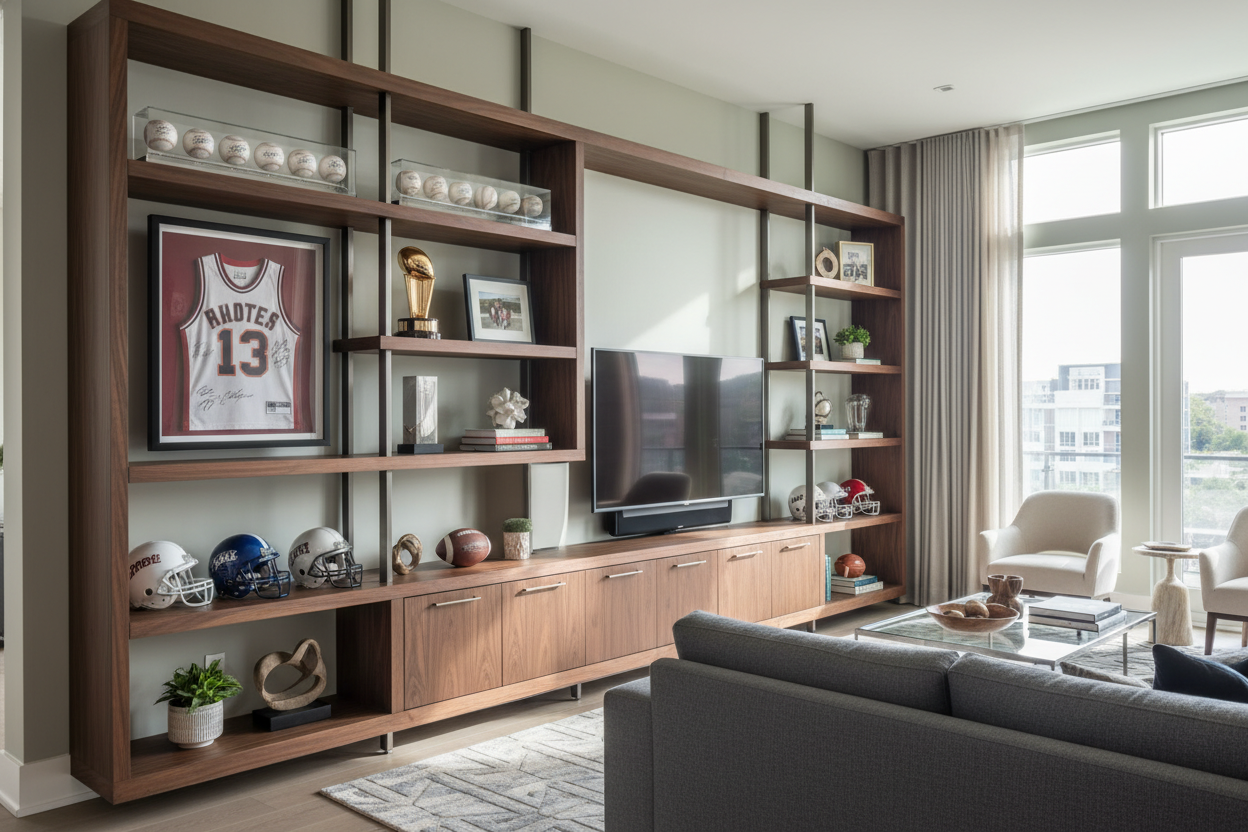
I stood in our living room for twenty minutes staring at a cardboard box filled with my partner’s 'treasures.' It was a mix of signed mini-helmets, a slightly deflated football from a 2004 playoff game, and enough ticket stubs to fill a scrapbook. I love him, but I wasn't about to let our home look like a suburban Buffalo Wild Wings.
The solution wasn't hiding it all in the basement. It was finding a shelf for sports memorabilia that actually complemented our mid-century modern vibe. It took some trial and error (and one very sad incident involving a falling trophy), but I finally cracked the code on displaying gear without sacrificing style.
- Edit ruthlessly; not every ticket stub needs a frame.
- Use glass to protect autographs from UV light and dust.
- Mix in 'normal' decor like plants to soften the look.
- Invest in high weight-capacity shelving for heavy acrylic cases.
The 'Dive Bar' Effect: Where Most Fan Displays Go Wrong
The biggest mistake I see is the 'shrine' approach. People think that because they love a team, they need to display every single piece of merch they’ve ever touched in one square yard of space. This creates a visual mess that feels cluttered rather than curated. When you cram thirty bobbleheads onto one surface, none of them look special—they just look like a dust magnet.
Good sports shelf decor requires an editor's eye. I told my partner we were only displaying the 'top tier' items—the ones with real stories or significant value. The rest went into a nice archival box. By giving each piece room to breathe, the display actually looks like it belongs in a grown-up home rather than a college frat house. You want people to ask about the item, not feel overwhelmed by the sheer volume of polyester and plastic.
Ditch the Plastic Cubes: Choosing the Right Foundation
I’ve tested those cheap, snap-together plastic cubes you see on big-box sites. Don't do it. They feel flimsy, they rattle when you walk by, and they eventually sag under the weight of a heavy glass display case. If you want a sports memorabilia display shelf that looks intentional, you need actual furniture with some architectural weight.
I personally prefer the grounded look of a solid unit over floating shelves for sports memorabilia if you have a large collection. Floating shelves are great for a single 'hero' item, but if you have multiple helmets or heavy acrylic boxes, you’ll want the stability of a floor-standing piece. I highly recommend looking for adjustable shelf storage. Sports gear is notoriously awkward in size—a signed basketball needs way more vertical clearance than a row of signed pucks, and fixed shelves will leave you with awkward, wasted gaps.
Why Glass Doors Are a Game-Changer for Autographs
If you own anything with a signature, you have two enemies: dust and sunlight. I learned this the hard way when a signed baseball from my childhood started to yellow because I left it on an open shelf near a window. Dust is also surprisingly abrasive; if you're constantly wiping down a signed helmet, you're eventually going to degrade the ink.
Enclosing your sports memorabilia display shelves behind glass makes the whole thing look like a museum exhibit rather than a collection of toys. When choosing the perfect display cabinet, make sure the doors have a tight seal. It keeps the maintenance to a minimum and adds a layer of 'don't touch this' authority that is very helpful if you have kids or curious guests.
How to Mix Baseballs, Helmets, and Everyday Decor
The secret to making sports shelves look chic is integration. I don't group all the sports stuff in one corner and the 'nice' stuff in another. I weave them together. I used a free standing bookcase in our main living area and treated the sports gear like any other piece of art.
I placed a signed football next to a stack of matte-finish coffee table books. I put a small trailing ivy plant on the shelf above a row of graded cards to soften the sharp edges of the plastic slabs. Using different textures—leather from the ball, paper from the books, and greenery from the plant—breaks up the 'plastic' feel that often plagues sports displays. It makes the sports memorabilia shelf feel like a part of the room's story, not an intrusion.
My Go-To Heavy Duty Units for a Grown-Up Fan Zone
If you're a serious collector, you know that weight adds up fast. Those acrylic display cases for full-sized helmets are surprisingly heavy, and if you have a row of five or six, a cheap shelf will start to bow in the middle within months. I’ve seen it happen, and there’s nothing that ruins the look of a room faster than a sagging shelf line.
For a high-capacity setup, I suggest a multi-tier storage shelf for collectibles. You want something tall that utilizes vertical space but has the structural integrity to handle 50+ pounds per shelf. I opted for a dark wood finish which provides a nice contrast to the bright colors of jerseys and team logos. It feels substantial and permanent, which is exactly the vibe you want for a prized collection.
FAQ
How do I keep my sports shelf from looking cluttered?
Use the 'Rule of Three.' Group three items of varying heights together—like a tall trophy, a medium-sized photo, and a small signed ball. Leave empty space between these groups so the eye has a place to rest.
Should I take my memorabilia out of the boxes?
For display, yes. Original retail packaging usually looks tacky. If you want to preserve value, put the item in a high-quality UV-protected acrylic case instead. It looks much more professional on your sports display shelves.
What is the best lighting for sports memorabilia?
Avoid direct sunlight at all costs. LED strip lights or puck lights inside a cabinet are great because they don't emit heat or UV rays that can damage signatures or fade the colors of a jersey.


Leave a comment
This site is protected by hCaptcha and the hCaptcha Privacy Policy and Terms of Service apply.