










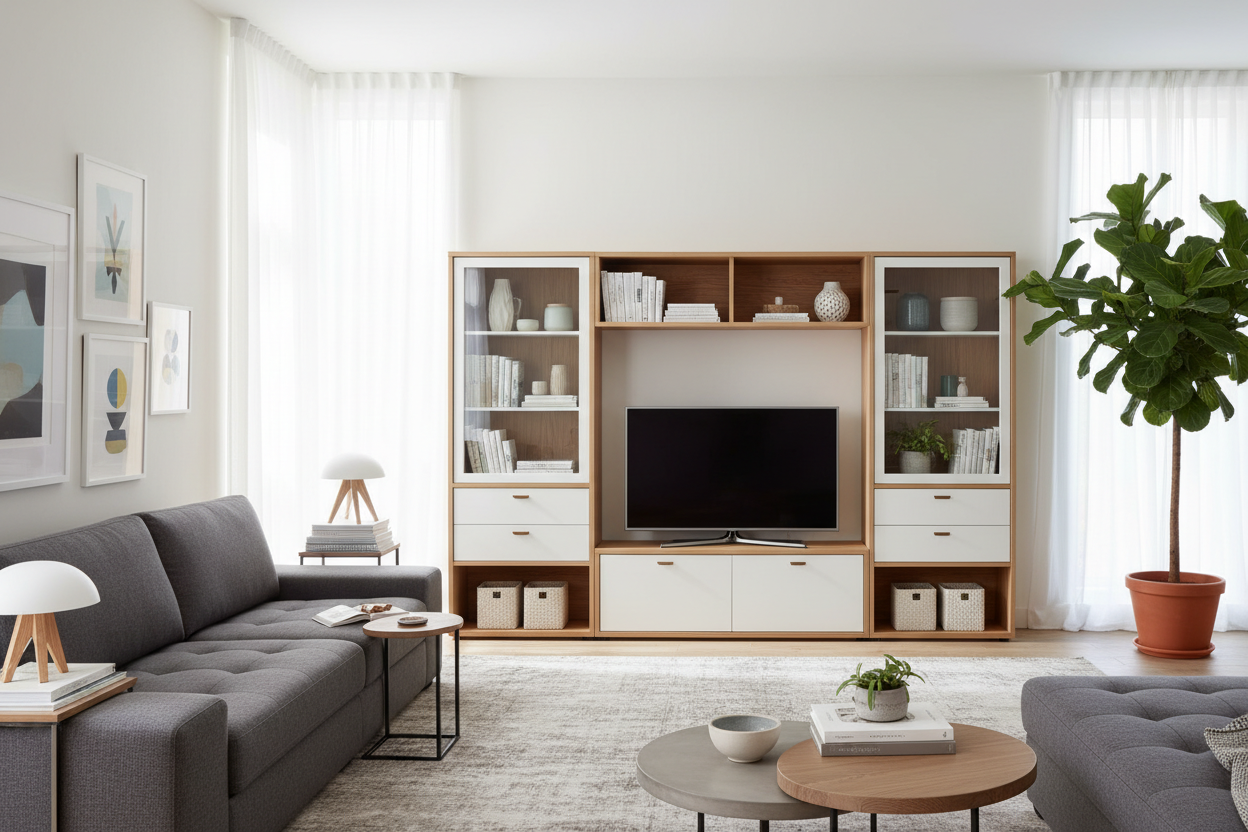
I have spent too many Sunday nights staring at a pile of Allen wrenches and weeping over particle board instructions. My biggest furniture mistake wasn't the cheap side table that lasted two months; it was the 7-foot, solid-oak media center I bought for my first 'adult' apartment. It looked majestic in the showroom, but in the real world of narrow hallways and rental leases, it was a 250-pound anchor.
After dragging that behemoth through four different ZIP codes, I finally wised up. I swapped the heavy, single-piece unit for a modular 3 pieces wall unit. It was a revelation. It gave me the same architectural 'oomph' of a custom built-in without the logistical nightmare of hiring a piano mover every time my landlord hiked the rent.
- Easier to transport in a standard SUV or small moving truck.
- Adjustable width to fit different wall lengths and TV sizes.
- Visual weight is distributed, making small rooms feel less cramped.
- Better resale value because it fits in more types of homes.
The U-Haul Incident That Changed My Mind
The turning point happened in a 1920s walk-up in Chicago. We were three hours into a move, sweating through our shirts, trying to pivot my old one-piece entertainment center around a 90-degree landing. The wood groaned, the drywall crumbled, and my best friend nearly lost a pinky finger. We ended up leaving it on the sidewalk for three hours while we debated taking the front door off the hinges. It never made it inside.
I sold that monster for fifty bucks on Craigslist that night. I realized then that my furniture needed to be as mobile as I was. A three-piece system allows you to carry one manageable box at a time. If you can't lift it by yourself, or at least with one other person without needing a weightlifting belt, you shouldn't own it as a renter.
What Exactly Makes Up a 3 Pieces Wall Unit?
The anatomy is simple: you have a central TV console flanked by two standalone bookcases or 'piers.' This setup acts as a modern entertainment center wall unit that anchors the room without feeling like a giant dark hole in your living space. By breaking the unit into three distinct vertical elements, you allow the wall color to peek through the gaps, which keeps the room feeling airy.
Most of these units span about 80 to 110 inches in total width. The side towers are usually around 15 to 18 inches deep—just enough for books and decor, but not so deep that they eat up your precious floor real estate. It creates a frame for your television, turning it into part of a curated display rather than just a black rectangle on the wall.
Why Modular Beats the Single-Piece Behemoth Every Time
The math is simple: three small things are easier to manage than one giant thing. Beyond the physical weight, there is a psychological weight to heavy furniture. When you own a massive, solid unit, you feel stuck. Modular pieces give you permission to change your mind.
You Can Actually Get It Through the Door
I’ve lived in apartments where the 'freight elevator' was actually just a slightly larger-than-normal passenger lift from 1950. A three-piece unit fits in an elevator. It fits in the back of a Subaru. It fits through a standard 32-inch doorway without requiring you to remove the trim. This saves you hours of frustration and potentially hundreds of dollars in professional moving fees.
It Adapts to Weird Floor Plans
Not every living room has a perfectly centered 12-foot wall. I once lived in a place where a radiator sat exactly where the left side of my media center should have been. Because I had three separate pieces, I just moved the left tower to the opposite corner of the room. It still looked intentional. You can't do that with a solid 90-inch credenza unless you're handy with a circular saw.
How to Style the Sections So They Look Like Custom Built-Ins
The trick to making separate pieces look like a million-dollar built-in is all about visual continuity. Use the 'Rule of Three' across the tops of the units. If you have trailing ivy on the left tower, put a similar plant on the right. This draws the eye across the entire span, tricking the brain into seeing one cohesive unit.
I also recommend using a cabinet with wall hanging decorations strategy. Mount a few floating shelves or some framed art directly above the side piers to extend the height toward the ceiling. This verticality is what gives built-ins their prestige. Don't be afraid to leave some negative space; a wall unit stuffed to the gills looks like a storage locker, not a design choice.
Don't Hit 'Add to Cart' Without Checking This First
Before you buy, check the leveling hardware. Floors in old apartments are never level—they slope like a black diamond ski run. Look for units with adjustable feet hidden in the base. If the three pieces aren't perfectly level with each other, the gaps between them will look sloppy and amateurish.
Also, watch out for the red flags when you see a tv wall unit for sale, like 'paper foil' finishes that peel if they get damp. You want a unit with a decent weight capacity—at least 100 lbs for the center console—and cord management cutouts that actually line up. If the manufacturer doesn't show photos of the back, assume it's unfinished cardboard and keep scrolling.
FAQ
Will a 3-piece unit work with a 75-inch TV?
Usually, yes, but check the width of the center console. You want at least 2-3 inches of 'breathing room' on either side of the TV stand so the screen doesn't look like it's bursting out of the frame.
Do I have to bolt all three pieces together?
You don't have to, but I highly recommend using the included mending plates or brackets. It keeps the pieces from drifting apart over time, especially if you have kids or pets running around.
How do I hide the cords between the three pieces?
Run your cables horizontally along the back of the units using adhesive cable clips. If you have a power strip, hide it inside the center console and run only one main cord to the wall outlet.


Leave a comment
This site is protected by hCaptcha and the hCaptcha Privacy Policy and Terms of Service apply.