










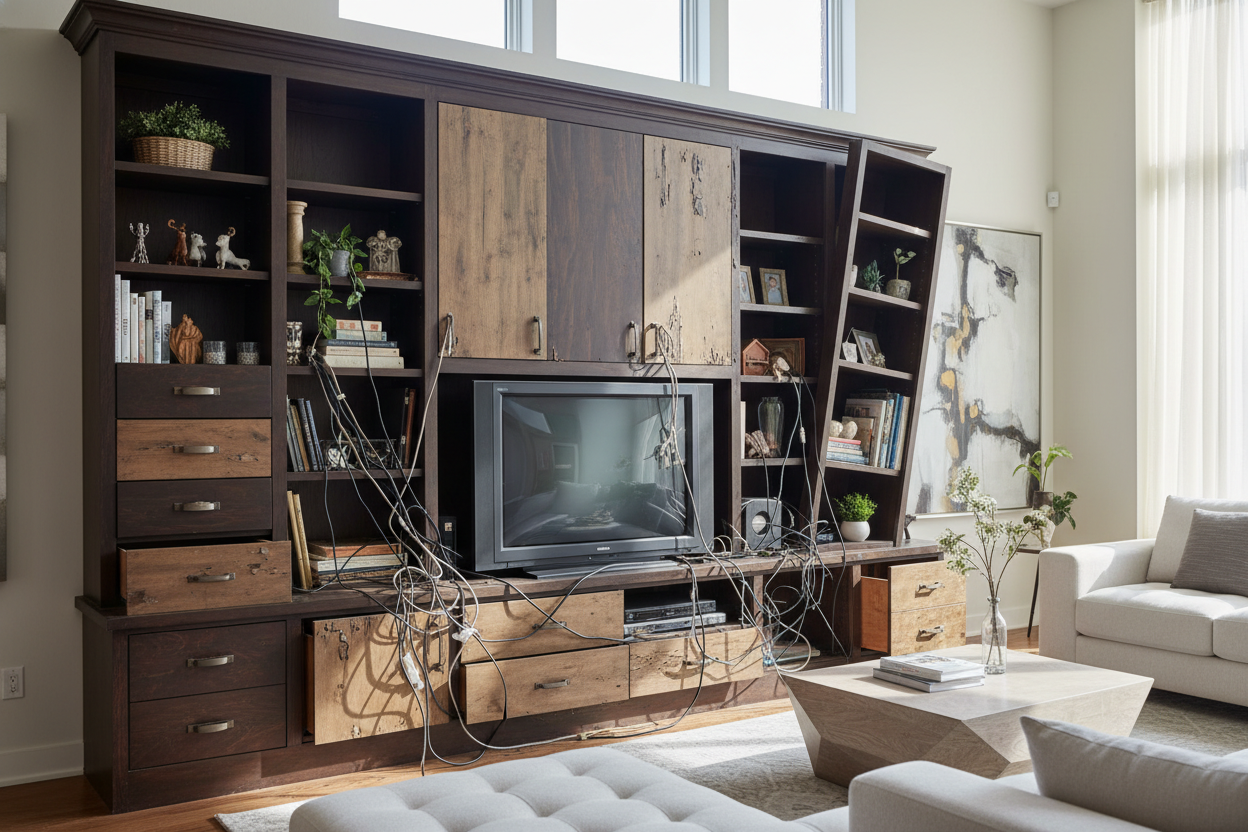
I spent three hours last night scrolling through listings for a tv wall unit for sale, and honestly, it felt like navigating a minefield. We've all been there: the photo looks like a $5,000 custom built-in from a high-end architectural magazine, but the price tag says $299. It is tempting to hit 'add to cart' and hope for the best, but with furniture this big, 'the best' rarely happens without some serious skepticism.
- If weight limits aren't listed, assume they are dangerously low for modern electronics.
- Cam locks alone won't hold up a massive unit for more than a year of real-world use.
- Repeating wood patterns are a dead giveaway for cheap, paper-thin laminate that will peel.
- Modular designs are almost always sturdier and easier to level than one giant box.
Why Buying Giant Media Furniture Online Is So Risky
Buying a coffee table online is low stakes. If it is junk, you hide it with a tray or a stack of books. But a media center is the structural backbone of your living room. It has to hold a 75-inch TV, three gaming consoles, and probably a decade's worth of 'stuff' you don't want guests to see. The sheer scale of these pieces makes cheap materials painfully obvious once they are sitting in your actual house.
When I finally moved on from my small, sturdy vintage pieces to a larger tv wall unit sale, I realized the scale changes everything. I remember when I considered a wall mount TV entertainment unit because I was tired of seeing my floors disappear under massive, poorly made blocks of particleboard. Large units made of budget materials don't just look bad; they physically fail under their own weight because the spans are too wide for the material strength.
Red Flag 1: The 'Weight Capacity' Is Suspiciously Hidden
If a listing doesn't explicitly state how many pounds a shelf or the main deck can hold, run. Seriously. A standard 65-inch TV weighs about 50 to 60 pounds, and a decent AV receiver can add another 20. If you have a soundbar or a collection of heavy coffee table books, you are pushing 100 pounds easily.
Cheap manufacturers hide these numbers because their 'wood' is actually low-density compressed sawdust that starts to bow the second you set a heavy object on it. I have seen shelves sag half an inch in six months. If the 'specs' section is a ghost town, that unit isn't built for your gear—it is built for the landfill. Look for a minimum capacity of at least 100 lbs for the main surface.
Red Flag 2: It Relies Entirely on Thin Cam Locks
You know those little silver circles you turn with a screwdriver? They are called cam locks. They are fine for a small nightstand, but they are a disaster for a 7-foot tall wall unit. Over time, the weight of the unit causes the holes to widen, and the whole thing starts to lean like the Tower of Pisa.
A massive piece needs real structural integrity—think back panels that actually screw into the frame, or better yet, a modular design. I much prefer something like a wall mounted and freely arranged TV stand. By breaking the unit into smaller, manageable sections that mount directly to your wall studs, you aren't relying on eight tiny pieces of zinc hardware to keep your expensive electronics off the floor.
Red Flag 3: The 'Wood' Grain Repeats Every Six Inches
There is nothing that kills a room's vibe faster than 'contact paper' wood grain. If you look closely at the product photos and see the exact same knot in the wood grain repeating every few inches, you are looking at a low-resolution print on top of paper-thin laminate. It looks like plastic because, well, it is.
It peels at the edges. It chips if you breathe on it too hard. And it looks incredibly fake under natural light. If your budget doesn't allow for solid wood, go for a solid color instead. I have found that a white media center wall unit looks ten times more expensive than a fake 'espresso' or 'rustic oak' finish because it isn't trying to pretend to be something it isn't. It just looks like a clean, intentional part of the architecture.
How to Actually Spot a Good TV Wall Unit Sale
Look for the 'boring' details. Does it have integrated cable management holes with metal or high-quality plastic grommets? Does it use soft-close hinges? These are signs that the manufacturer actually thought about the user experience, not just the shipping cost. Also, check the weight of the shipping boxes—if a 70-inch unit weighs only 50 pounds, it is made of air and hope.
The best time to shop is usually late January or mid-summer when retailers are clearing out inventory for new collections. When you find a deal, check the assembly manual online first. If it is 60 pages of cam locks and no mention of wall anchors, keep looking. Browsing for quality TV stands requires a bit of detective work, but it saves you from the heartbreak of a collapsed living room six months down the line.
Can I fix a sagging shelf?
Not really. Once particleboard bows, the internal fibers have stretched and weakened. You can try to flip the shelf over if it is finished on both sides, but that is a temporary band-aid. It is better to reinforce it with a metal L-bracket from the start.
Are wall-mounted units hard to install?
They require a stud finder, a level, and a bit of patience. If you can't find the studs, do not hang it. But if you do it right, they are significantly sturdier than freestanding units made of the same materials because the wall is doing the heavy lifting.
Is MDF always a bad sign?
No. High-density MDF is actually great for painted finishes because it doesn't expand and contract like real wood, meaning the paint won't crack. The problem is 'low-density' board, which is basically glorified cardboard. Check the weight; heavier is usually better.


Leave a comment
This site is protected by hCaptcha and the hCaptcha Privacy Policy and Terms of Service apply.