










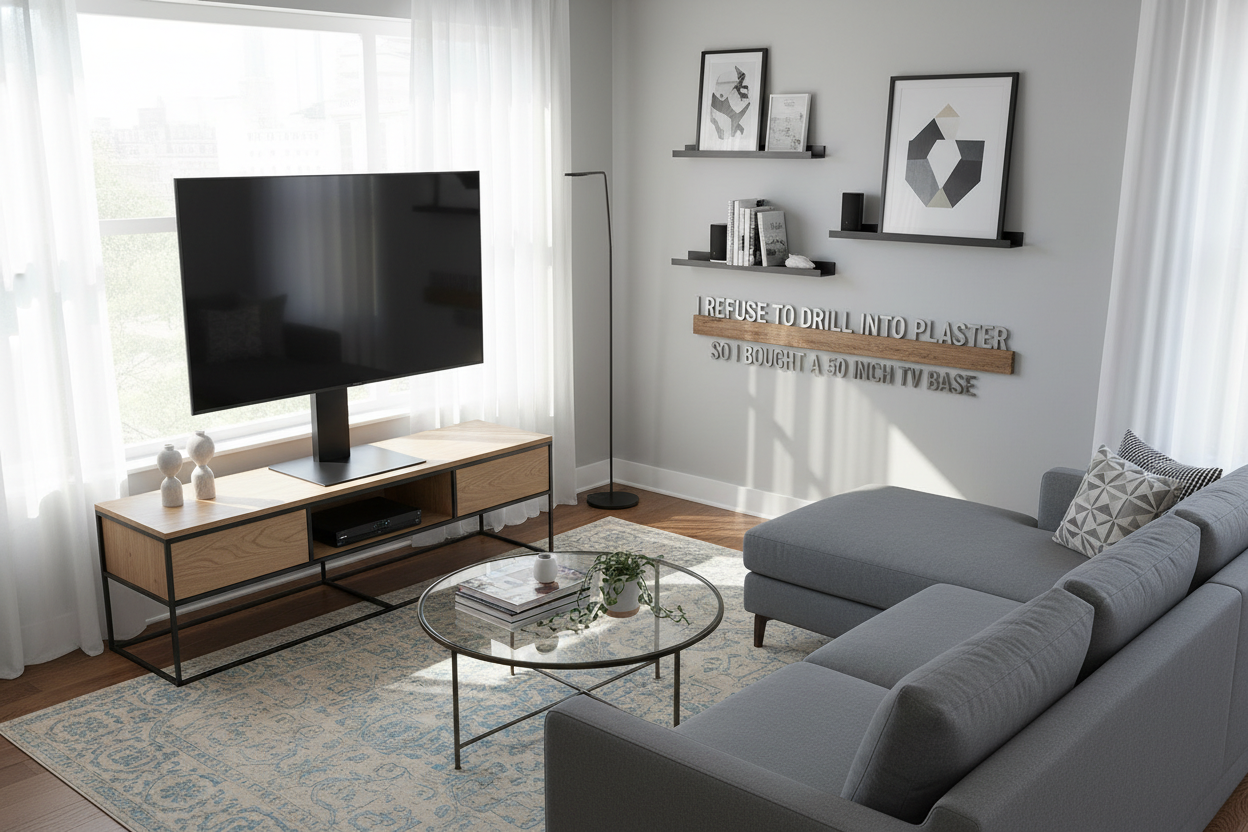
I stared at my living room wall for forty minutes, drill in hand, before I finally admitted defeat. My 1920s apartment has these gorgeous, thick plaster walls that feel like they could withstand a siege, but the moment you bring a masonry bit near them, they crumble into expensive white dust. I have seen enough horror stories on Reddit to know that mounting a 45-pound screen on these walls is a recipe for a 3 AM crash and a lost security deposit.
Instead of risking my lease or my sanity, I finally grabbed a 50 inch tv base. It is the best compromise I have found for getting that sleek, high-end look without the structural anxiety. It turns out you do not actually need to drill holes to get your screen at the perfect eye level.
- Stability: It uses a heavy tempered glass or steel plate that keeps the screen from tipping.
- Adjustability: You can swivel and tilt the screen, which most cheap factory legs do not allow.
- Cable Management: Most models hide those ugly black cords inside a central spine.
- Rental Friendly: When you move, you just unscrew the VESA plate and pack it up.
The Plaster Wall Nightmare (Why I Put the Drill Down)
If you have ever lived in a pre-war building, you know the 'stud finder' is a lying piece of plastic. You think you have found wood, but you actually just found a lath strip that is about as thick as a popsicle stick. I once tried to hang a heavy mirror in my last place, and the wall basically disintegrated, leaving me with a hole the size of a golf ball and a landlord who was less than thrilled.
The stress of wondering if your TV will stay up while you sleep is not worth it. A 50 in tv stand with mount gives you the exact same height and viewing angle as a wall mount, but the weight is distributed straight down to your furniture or the floor. It is physics that actually works in your favor for once.
Enter the 50 Inch TV Base (My Rental Savior)
Most TVs come with these flimsy, wide-set plastic 'chicken feet' that require a massive piece of furniture to sit on. If your TV is 44 inches wide, you need a 50-inch surface. That is a lot of wasted floor space in a small apartment. By swapping those out for a heavy-duty pedestal, you can actually browse standard TV stands that are much narrower than your screen.
I personally went with a 50 tv stand with mount that has a swivel feature. It allows me to angle the screen toward the kitchen when I am meal prepping and back toward the sofa when I am finally ready to rot. It feels solid—no wobbling when the cat jumps on the media console, which is my gold standard for furniture testing.
Wait, Isn't That Just a Regular Console?
Not exactly. A traditional console is just a table your TV sits on. A dedicated 50 tv stand with mount is a piece of hardware that bolts into the back of your TV (using the VESA holes) and holds it aloft on a metal pillar. You get that 'floating' aesthetic without the commitment of a permanent wall fixture.
The Unexpected Perk: Flawless Cord Hiding
My biggest pet peeve is 'cable spaghetti'—that tangled mess of HDMI and power cords dangling under the screen. When you wall mount, you either have to fish wires through the wall (illegal in many rentals) or use those plastic cord hider tracks that never quite match your paint color.
Most pedestal bases have a hollow spine or clips in the back. I managed to tuck my Roku, power strip, and soundbar cables into the center column. I totally faked a floating screen look by keeping the base tucked behind a few well-placed books and a potted pothos plant. It looks professional, and I did not have to touch a stud finder once.
When You Might Want to Upgrade to a Lift
If you are the type of person who hates seeing a giant black rectangle in your room when the TV is off, there is a next-level move. I have seen friends in studio apartments use an electric vertical lift cabinet at the foot of their bed. It is the ultimate flex—the TV stays hidden inside a sleek chest and rises up with a remote. It is a bit more of an investment, but for a minimalist layout, it is unbeatable.
FAQ
Will a universal base fit my specific TV brand?
Yes, as long as your TV has VESA holes on the back. Almost every modern 50-inch screen uses a standard 200x200 or 400x400 pattern. Just check the manual or measure the distance between the screw holes on the back of your set.
Is it hard to assemble?
If you can build a LEGO set, you can build this. It is usually just four bolts for the base and four for the TV bracket. I did mine in about 15 minutes with a single screwdriver.
Can the glass base break?
Most use thick tempered safety glass. I have dropped a heavy remote on mine and it did not even scratch. Just do not go hitting it with a hammer, and you will be fine.


Leave a comment
This site is protected by hCaptcha and the hCaptcha Privacy Policy and Terms of Service apply.