










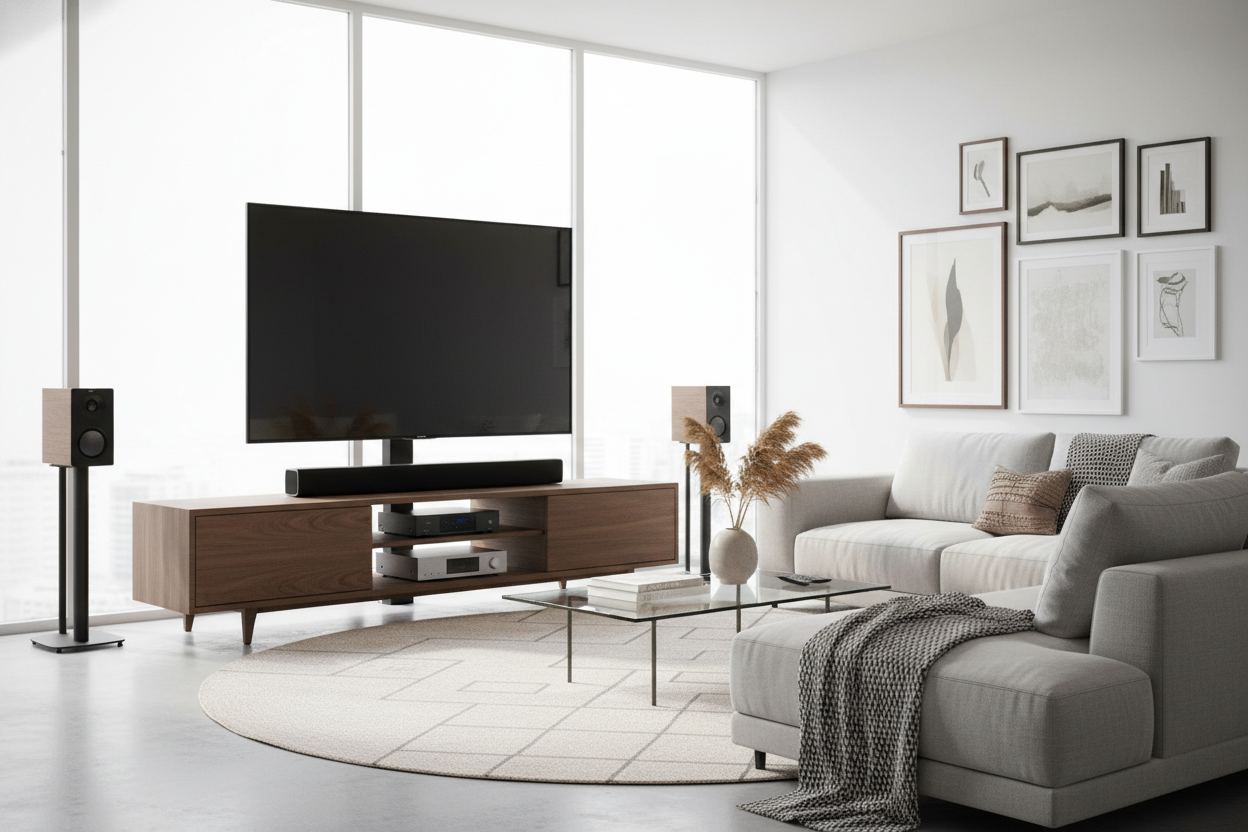
I spent three hours unboxing my new OLED only to realize the manufacturer-provided feet were about two inches tall. My soundbar? Three and a half inches. For two weeks, I lived with a chunky black speaker blocking the bottom of my screen, cutting off subtitles and making every movie feel like it was wearing a high-collared sweater. It was a cluttered, expensive mess.
I eventually realized that a tv stand mount was the only way out of this ergonomic nightmare. It’s that middle-ground solution for people who don’t want to drill holes in their rental walls but can't stand the 'squashed tech' look of a TV sitting directly on a cabinet. By lifting the screen, you finally give your gear room to breathe.
- Lifting your screen creates a dedicated 'garage' for your soundbar.
- Swivel functions mean you can actually see the screen from the kitchen.
- Heavy steel bases are way more stable than the flimsy plastic legs included in the box.
- It mimics a wall-mounted look without the drywall repair bill later.
The Awkward 'Squished Soundbar' Dilemma
Most modern TVs come with those 'duck feet'—thin plastic legs at the far edges of the frame. They’re fine for stability, but they leave zero vertical clearance. If you have a premium soundbar, you're forced to either shove it behind the TV (muffling the audio) or place it in front, where it blocks the remote sensor and the bottom of the picture.
It’s a design failure. We’re buying bigger screens and better audio gear, yet the furniture interface hasn't caught up. I tried propping my TV up on a couple of coffee table books, but it looked like a college dorm project. It was unstable, and one accidental bump from the dog would have sent $1,200 of glass onto the floor. You need a real tv table mount to fix the geometry of your living room.
Why a TV Table Mount Stand is the Real Solution
A hybrid tv support stand replaces those factory legs with a single, central pillar. It bolts into the VESA holes on the back of your TV—the same ones you’d use for a wall mount—and connects to a heavy tempered glass or steel base. The result is a screen that 'floats' at whatever height you choose.
When you stop resting your TV on TV stand surfaces, you suddenly gain about 5 to 10 inches of vertical breathing room. It’s not just about the audio gear; it’s about the physics of the room. A tv table mount stand allows you to tuck the soundbar right under the chin of the TV, creating a cohesive unit rather than a pile of disconnected electronics.
Reclaiming Your Console's Surface Area
Once the TV is hovering, the top of your media console is no longer a 'no-fly zone.' You can actually put things there. I’m talking about a small tray for remotes, a candle, or even a low-profile plant. It stops looking like a Best Buy display and starts looking like a home. Most people forget that the surface of your furniture is prime real estate for decor, but you can't use it if a 65-inch screen is hogging every square inch.
If you're using something like the Tv Cabinet Table Modern With Storage Fufugaga, the combination is a total win. You get all that hidden storage for your PS5 and cables, while the tv table holder keeps the top surface clear for styling. It’s the easiest way to make a $300 setup look like a $2,000 custom built-in unit. The visual weight of the room shifts upward, making the whole ceiling feel higher.
Finding the Best TV Stand Mount for Heavy Audio Gear
Not all mounts are created equal. If you’re rocking a heavy screen and a massive soundbar, you need a tv center stand mount with a high weight rating. Look for cold-rolled steel construction. If the base feels light, the whole thing will wobble every time someone walks past it. I've seen cheap ones that literally bow under the weight of a standard 55-inch screen.
Check your VESA pattern—that’s the distance between the four holes on the back of your TV. Most tv table mount bracket options are universal, but it’s worth double-checking the specs. I always look for a model that offers at least 15 degrees of swivel. Being able to angle the screen toward the dining table for a quick lunch-break show is a luxury I didn't know I needed until I had it.
The Ultimate Loophole for the 'Floating' Look
Wall mounting is a chore. You have to find studs, drill massive holes, and then figure out how to hide the wires inside the wall. A tv table mount gives you that sleek, elevated aesthetic without the permanent commitment. It’s the ultimate rental hack for anyone who wants their tech to look integrated rather than just 'placed.'
When you browse for new TV stands, don't feel limited to the ones with built-in poles. You can buy a standalone mount and pair it with almost any flat surface. It’s a flexible, modular way to build a media center that actually fits your gear, rather than forcing your gear to fit the furniture. You get the height, the style, and zero landlord drama.
My Honest Mistake: The 'Forward Lean'
The first mount I bought was a $25 bargain-bin find. Big mistake. My TV was within the weight limit, but the neck of the stand was too thin. Over two days, the screen started to tilt forward like it was bowing to me. I had to take the whole thing apart and buy a heavy-duty version with a wider pillar. Don't cheap out on the thing holding up your most expensive piece of tech; it's worth the extra $20 for the heavy-duty steel.
FAQ
Will this mount fit any TV?
Most are universal and fit screens from 32 to 75 inches. Just make sure your TV has VESA mounting holes on the back—almost all modern flat screens do. Just check the weight limit on the mount before buying.
Can I adjust the height later?
Usually, yes, but it’s not as easy as a computer monitor. You typically have to unscrew a few bolts on the back, move the brackets up or down, and re-tighten. It's best to set it once and leave it.
Is it safer than the original legs?
Often, yes. The heavy base of a tv support stand is much harder to tip over than the wide, spindly legs that come in the box, especially if you have a narrow console or curious cats.


Leave a comment
This site is protected by hCaptcha and the hCaptcha Privacy Policy and Terms of Service apply.