










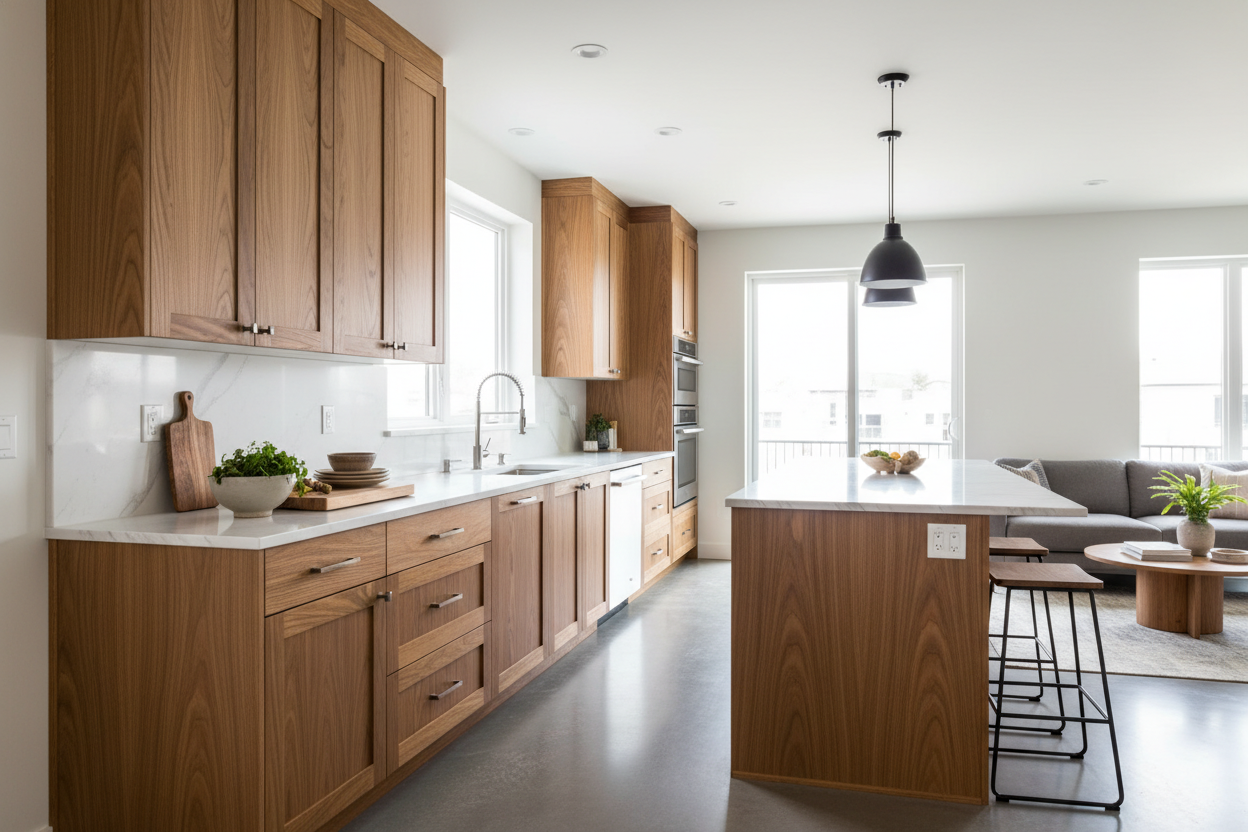
I spent five years in a custom millwork shop where we wouldn't even let a piece of particle board through the front door. We were purists. We talked about 'heirloom quality' and used hand-rubbed oils on walnut slabs that cost more than my first car. But then I bought a fixer-upper with a kitchen that looked like it had been through a literal war, and suddenly, my 'custom-or-nothing' attitude hit the reality of a dwindling bank account.
I found myself standing in the kitchen aisle at 9 PM on a Tuesday, squinting at the cabinet wood lowes keeps in stock. I expected to find glorified cardboard. What I actually found was a confusing mix of 'run away immediately' and 'wait, this is actually decent.' If you are staring at those same brown boxes wondering if they’ll fall apart the second you boil a pot of pasta, here is the unfiltered truth from someone who knows where the screws are hidden.
Quick Takeaways
- Most stock boxes are 'furniture board' (high-density particle board), which is fine for dry areas but a disaster near leaky sinks.
- The 'Diamond Now' line is the sweet spot for DIYers, offering plywood upgrades that actually hold a screw.
- Face frames on mid-to-high tier options are genuine hardwood, providing the structural integrity you actually need.
- Never buy the bottom-tier 'Project Source' for a kitchen you plan to live in for more than two years.
Confession: I Used to Hate Big Box Store Lumber
For a long time, I viewed big-box cabinetry as the fast fashion of the home world. I’d seen too many 'wood' cabinets that were actually just MDF wrapped in a contact-paper-style vinyl that peeled off the moment things got steamy. There’s a specific kind of heartbreak that comes from spending a weekend installing a kitchen, only to realize the 'wood' grain is a repeating pattern printed by a giant inkjet printer.
But the market has shifted. People are tired of disposable furniture, and the big retailers have had to step up their material game to compete with direct-to-consumer brands. I decided to take a crowbar to a few floor models (okay, I just inspected the floor models very aggressively) to see if the wood kitchen cabinets lowes sells could actually survive a real family. I was looking for joinery, core density, and species quality—not just a pretty finish.
What Exactly Is the Cabinet Wood Lowes Uses for the Boxes?
When you buy an off-the-shelf cabinet, the 'box'—the sides, back, and bottom—is rarely the same material as the door. In the Lowe's aisles, you're mostly looking at three tiers of core material. First, there’s the standard furniture board. It’s essentially sawdust and glue compressed under high pressure. It’s heavy as lead and perfectly flat, but if it gets wet, it swells like a cheap sponge. I once installed a particle board vanity in a rental, and a slow leak from the P-trap turned the bottom shelf into a pile of wet oatmeal within a month.
Then you have the plywood-box upgrade. This is what I’d actually recommend. It’s usually a 1/2-inch or 3/4-inch furniture-grade plywood. It’s lighter, handles moisture significantly better, and—most importantly—it holds a wood screw. If you try to re-hang a door on a particle board box after the hinge rips out, you’re in for a world of wood-filler pain. Plywood gives you a second chance.
Finally, there’s the MDF (Medium Density Fiberboard) used for painted doors. Purists hate it, but I’ll be honest: for a painted finish, MDF is actually superior to solid wood. It doesn’t expand and contract with the seasons, meaning your paint won’t crack at the joints when the heater kicks on in November. Just don't let it sit in a puddle.
The Honest Verdict on the Solid Wood Cabinets Lowes Stocks
The term 'solid wood' is thrown around a lot in big-box stores, but you have to read the fine print. Usually, when you see solid wood cabinets lowes promotes, they are referring to the face frames and the door stiles. The panels in the middle of the doors are often veneered MDF to prevent warping. Is that a dealbreaker? Not necessarily.
If you're comparing these to a custom shop, the difference is in the species and the 'select' grade. A custom shop will hand-match the grain of your drawer fronts. At a big-box store, you get what’s in the box. You might have one door with a beautiful straight grain and the one next to it looks like a Rorschach test of knots. It’s a bit of a lottery. You can learn more about what designers actually think about solid wood storage and why the 'all-wood' label can sometimes be a marketing shield for mediocre construction.
Wait, are the face frames actually real hardwood?
Yes, usually. Even on the mid-range stock units, the face frames—the part the doors actually attach to—are typically solid oak, maple, or poplar. This is the 'skeleton' of the cabinet. Having a solid wood frame is vital because it provides the rigidity needed to keep the whole row of cabinets level. If the frame were particle board, the weight of a granite countertop would eventually crush the life out of it. I’ve checked the Diamond and Shenandoah lines specifically; they use pocket-hole joinery on solid wood frames, which is exactly how I’d build them in my own shop. It’s sturdy, predictable, and takes a beating.
How Wood Kitchen Cabinets Lowes Sells Compare to Custom Prices
Let’s talk numbers, because that’s why anyone shops at a big-box store in the first place. A local custom cabinet maker is going to charge you anywhere from $800 to $1,500 per linear foot for a fully installed kitchen. That gets you dovetail drawers, soft-close everything, and a perfect fit. The wood kitchen cabinets lowes stocks generally land between $150 and $400 per linear foot. For a standard 10x10 kitchen, we’re talking about a $10,000 difference.
Is the custom cabinet five times better? Honestly, no. It’s maybe twice as good. You’re paying for the labor of making things fit your specific, probably-not-square walls. When you buy stock, you’re the one who has to deal with the 'filler strips'—those awkward pieces of wood used to gap the space between the cabinet and the wall. It’s a trade-off. You save enough money to buy a professional-grade range, but you spend your weekend swearing at a shim. It’s worth knowing what furniture stores won't tell you about solid wood costs: a huge chunk of that 'custom' price is just the overhead of a showroom and high-end marketing.
When to Buy Off-the-Shelf (And When to Buy Real Furniture)
I’ve reached a point where I’m okay with big-box cabinets for utility. If you’re doing a laundry room, a basement bar, or a 'budget' kitchen refresh, the cabinet wood lowes offers is a fantastic value. It’s a tool for a job. But if you’re looking for a statement piece for your dining room, please, for the love of all things holy, don't just screw a bunch of kitchen base cabinets together and put a board on top.
Kitchen cabinets are designed to be built-in. They have unfinished sides and look 'heavy' because they lack feet or a decorative toe kick. For a dining space or an entryway, you want a piece of furniture that was designed to be seen from all angles. Instead of hacking together a DIY sideboard from stock uppers, you're almost always better off buying an elegant solid wood modern sideboard. It will have the finished back, the proper proportions, and the joinery that doesn't rely on being screwed into a wall stud to stay upright.
FAQ
Is Lowe's 'Project Source' line real wood?
The frames are often solid wood or very dense MDF, but the boxes and shelves are almost always particle board with a laminate wrap. They are 'disposable' cabinets—great for a garage or a temporary fix, but I wouldn't put them in a forever home.
Can I stain the unfinished cabinets at Lowe's?
Yes, and that’s actually a great way to get a custom look on a budget. They are usually raw oak or maple. Just be prepared to do a lot of sanding; the factory sanding is usually hit-or-miss, and stain will reveal every swirl mark if you aren't careful.
Do the cabinets come with a warranty?
The higher-end lines like Diamond offer limited lifetime warranties, while the stock stuff usually has a one-year warranty. Just remember: the warranty usually covers the material, not the ten hours of labor you spent installing it.

Leave a comment
This site is protected by hCaptcha and the hCaptcha Privacy Policy and Terms of Service apply.