










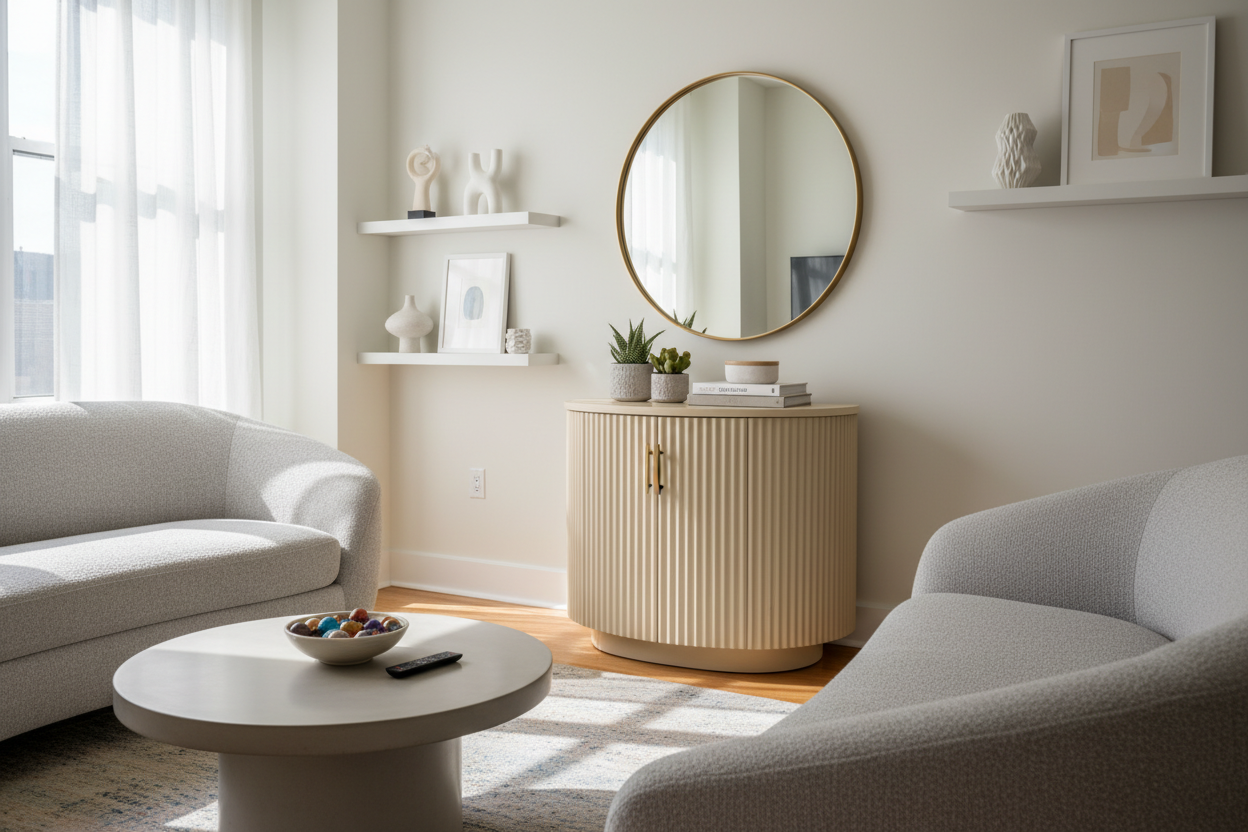
I spent three hours last night measuring my hallway, trying to figure out why it felt like a game of Tetris gone wrong. My 60-inch TV is a rectangle, my rug is a rectangle, and my sofa is basically three rectangles glued together. It was stiff, uninviting, and honestly, a little claustrophobic.
Adding a **round accent cabinet** was the only thing that broke the spell. Most of us buy furniture based on how it looks in a vacuum, but we forget that we actually have to walk around it. If your home feels like an obstacle course of sharp corners, you don't need a bigger room; you need fewer right angles.
Quick Takeaways
- Curves break up the visual 'stiffness' of standard rectangular furniture.
- Circular designs prevent 'hip-bumps' in high-traffic areas like hallways.
- Rounded pieces naturally guide the eye and foot traffic around a space.
- You sacrifice about 15% of internal shelf space for significantly better room flow.
The 'Box Effect' (And Why Your Living Room Feels Stiff)
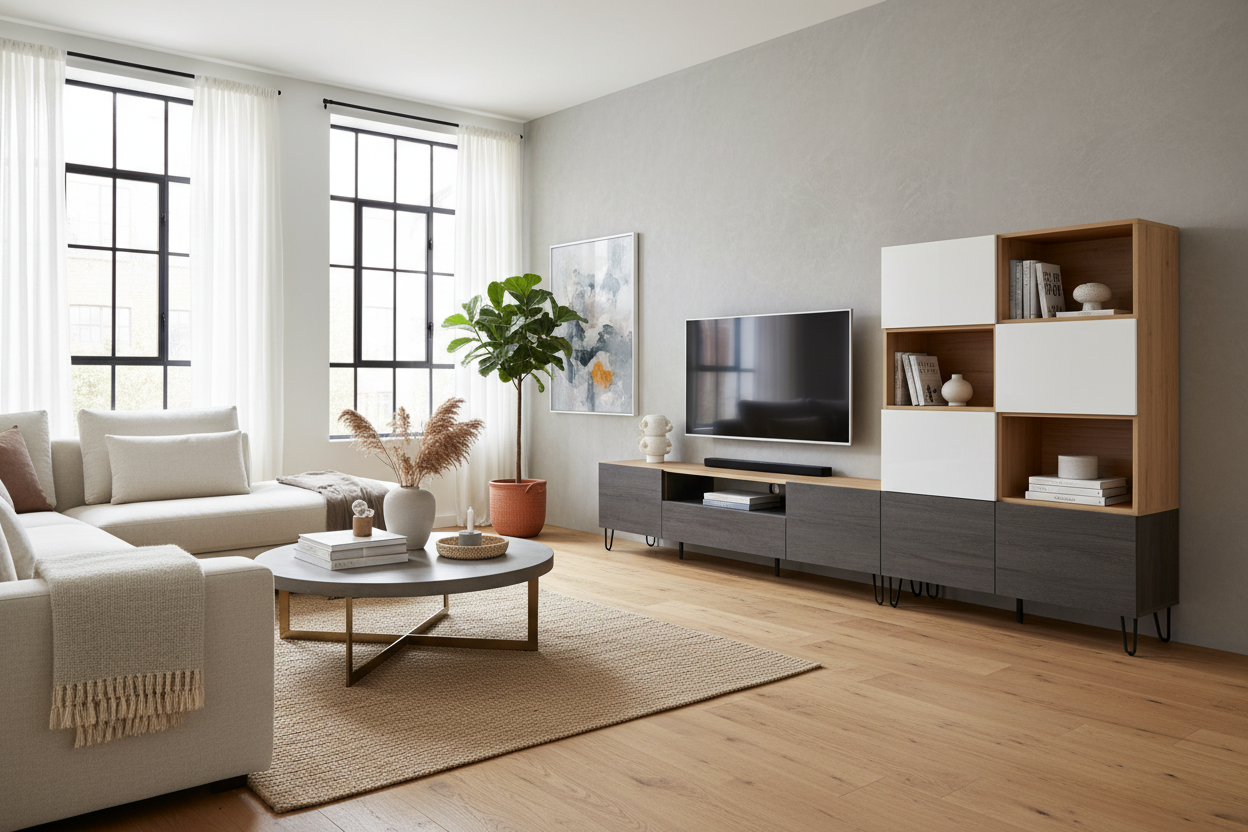
Most modern homes are built on a grid. We have square rooms, rectangular windows, and we fill them with boxy sectionals and flat-screen TVs. Architects call this 'geometry,' but I call it the Box Effect. When every piece of furniture has a 90-degree angle, the room starts to feel like a hospital waiting room rather than a home.
I’ve seen dozens of living rooms where the owner spent $5,000 on a high-end sofa with 2.0 lb/ft³ HR foam—the kind that lasts a decade—only to ruin the vibe with a chunky, square side table that blocks the path. The eye needs a place to rest, and sharp corners don't provide that. They create tension.
A **rounded accent cabinet** acts as a visual 'reset.' It breaks that relentless line of rectangles. It’s the difference between a room that looks like a showroom and one that feels curated. When you introduce a curve, you're telling the eye it's okay to wander. It softens the architecture of the room without requiring a full renovation.
Why a Round Accent Cabinet is the Ultimate Traffic Cop
Let’s talk about the 'hip-bump.' You know the one—where you’re walking through a darkened room and catch the corner of a console table right on the pelvic bone. It hurts, it leaves a bruise, and it happens because square furniture is a bully. It demands you walk in straight lines and make sharp pivots.
A circular or drum-style cabinet is the ultimate traffic cop. It doesn't block; it redirects. Because there are no corners, your body naturally glides around the piece. In a tight hallway or a small apartment, this is a literal life-saver. I’ve swapped out 18-inch deep rectangular consoles for 16-inch round cabinets and felt like I gained two feet of walking space.
It’s not just about physical space, though. It’s about 'visual clearance.' A rounded piece feels lighter. Even if it has the same footprint as a square one, the lack of corners makes it appear smaller, which keeps a room from feeling crowded. If you have a 12x14 living room, every inch of perceived space matters.
The 3 Best Spots to Put a Rounded Accent Cabinet
The first place I always suggest is the 'swing zone' in an entryway. If your front door opens and nearly hits a piece of furniture, a rounded cabinet is your best friend. It allows the door to swing wider and gives you a soft landing spot for keys without creating a bottleneck. It’s often a better choice than traditional vertical storage that actually fits in narrow spots because it doesn't feel like a wall closing in on you.
Second, look at the transition between your dining area and living room. In open-concept layouts, these zones often bleed together awkwardly. A round cabinet placed at the edge of the rug acts as a soft boundary. It defines the space without acting like a barricade.
Finally, the 'dead corner.' We all have that one corner next to a bulky armchair where a square table just looks cramped. A rounded cabinet tucked into that spot feels intentional. It fills the void without looking like you tried to jam a square peg into a round hole. It’s the perfect spot for a small bar setup or a place to hide the router and messy cables.
Styling the Top Without Clashing with the Curves
Once you get your cabinet home, don't just throw a rectangular tray on top and call it a day. That defeats the purpose. To really style it for a high end look, you need to play with organic shapes. Think of the top of your cabinet as a mini-stage.
I like to use a single, large asymmetrical object—like a heavy ceramic vase or a piece of driftwood—to one side. Then, balance it with something vertical, like a slim lamp. Avoid centering everything perfectly; it looks too formal and stiff. Instead, let some greenery, like a trailing Pothos, drape over the curved edge. The way the leaves follow the bend of the wood is incredibly satisfying.
If you must use a tray, go for a circular or oval one. It mimics the silhouette of the furniture and keeps the 'soft' theme going. And please, skip the tiny knick-knacks. On a curved surface, one bold 'hero' object looks much more expensive than five small ones that just look like clutter.
Is the Storage Trade-Off Actually Worth It?
I’ll be honest with you: you are going to lose some storage. If you try to put square board game boxes inside a round cabinet, you’re going to have 'dead air' in the corners. If your primary goal is to store a massive collection of vinyl records or a stack of encyclopedias, a black cabinet with glass doors might be a more practical, high-capacity choice.
However, for most of us, that lost 15% of corner space is a small price to pay for a room that actually flows. I use my round cabinet for things that don't need a grid: table linens, extra candles, or my 'junk drawer' baskets. It’s about quality of life over quantity of cubic inches.
If you truly need to maximize every single millimeter of storage, you're better off with a wide accent cabinet with stone patterned glass doors. But if you want a room that feels breathable, expensive, and easy to move through, the curve wins every single time. It’s a design choice that prioritizes the human experience over the storage of stuff.
My Personal Experience: The 'Faceted' Mistake
A few years ago, I bought what I thought was a beautiful rounded cabinet online. When it arrived, it wasn't actually curved; it was 'faceted.' It had about twelve flat panels joined together to *look* like a circle from a distance. Up close, it looked like a low-resolution 3D model from 1998.
It was made of cheap 1/2-inch MDF with a paper thin veneer that started peeling at the joints within a month. Now, I only look for steam-bent plywood or solid wood construction. If you're buying a round piece, check the weight. A quality 30-inch round cabinet should have some heft—if it’s under 40 pounds, it’s probably hollow and won't survive a move.
Frequently Asked Questions
Can I put a TV on a round accent cabinet?
Technically yes, but it looks weird. The rectangular TV overhangs the curves in a way that feels top-heavy. Keep the round cabinets for lamps, art, and drinks.
Are round cabinets harder to assemble?
Actually, they are often easier because they usually come 90% pre-assembled. Since the 'drum' shape is structural, manufacturers can't easily flat-pack them like they do with square cabinets.
Do they work in mid-century modern designs?
Absolutely. Curves were a staple of MCM design. Look for tapered dowel legs to really lean into that 1950s aesthetic.

Leave a comment
This site is protected by hCaptcha and the hCaptcha Privacy Policy and Terms of Service apply.