










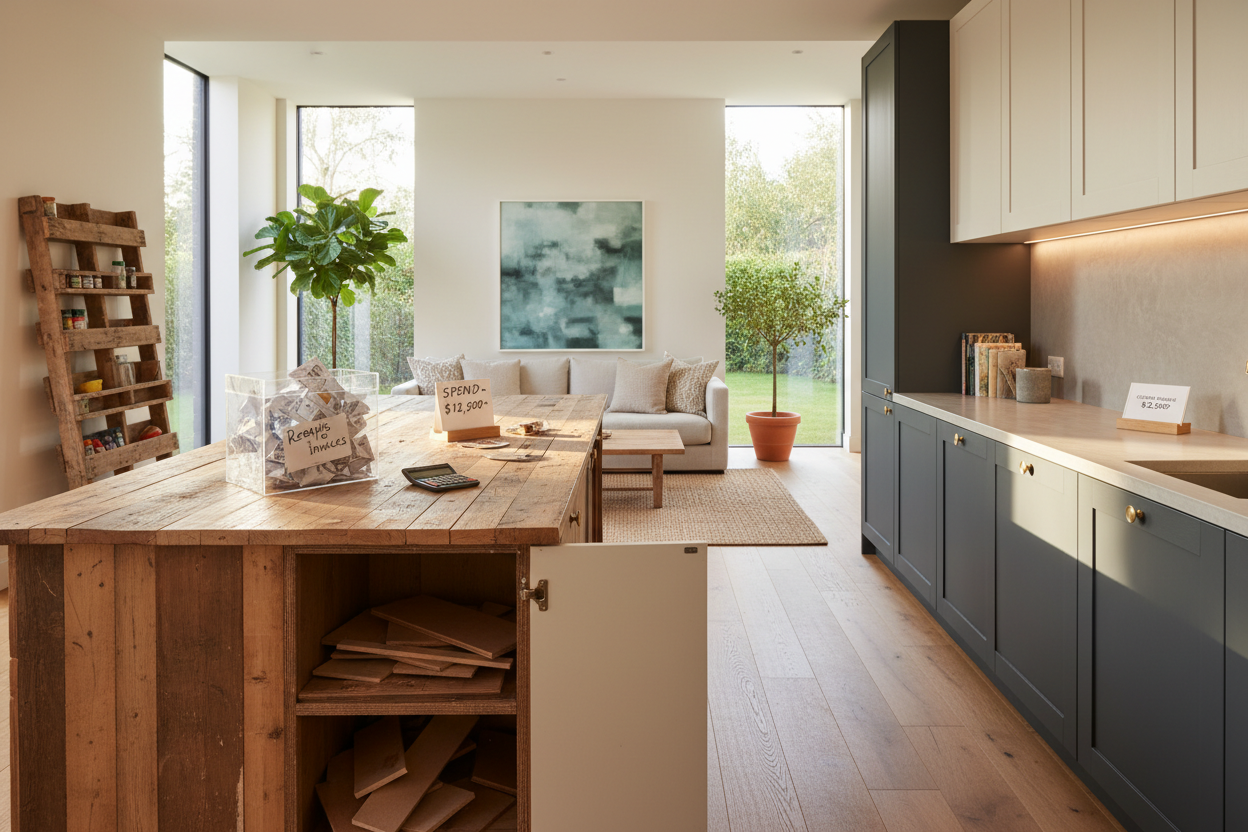
I spent three weeks with a fine layer of sawdust coating my morning coffee and a permanent crick in my neck from shimming uneven floors. I was convinced I was outsmarting the system. I’d seen the TikToks where someone buys basic flat-pack boxes, slaps on some decorative trim, and calls it high-end. I thought I could dodge the price of custom design kitchen cabinets by being 'handy.'
Instead, I ended up with a kitchen that looked like a middle school woodshop project and a credit card statement that made me want to weep. By the time I bought the fourth 'essential' router bit and realized my ceiling was two inches out of level, the dream died. It turns out, faking a high-end look is often more expensive—and significantly more stressful—than just buying the real thing from the jump.
- The Tool Trap: You’ll spend hundreds on specialized saws and jigs you’ll never use again.
- Material Waste: One wrong cut on a $90 sheet of oak plywood and your 'savings' vanish.
- The Finish Gap: You cannot replicate a factory-grade conversion varnish finish with a foam roller in your garage.
- Resale Value: Homebuyers can smell a 'hack' from the driveway; real custom work pays for itself.
The Lure of the 'Built-In Hack'
The plan was simple, or so the internet told me. I’d buy mass-produced boxes, line them up, and then use MDF filler panels to create a 100% bespoke look. I wanted every inch of my awkward 102-inch wall covered. I figured that by adding my own crown molding and a few 'customised cupboard' features like a pull-out spice rack, I’d save at least five grand. I was high on DIY adrenaline and the false confidence that comes from watching a thirty-second montage of someone else doing the work.
I spent hours measuring, but here is the thing: houses are never square. My 1940s bungalow has walls that lean like they’ve had one too many martinis. Standard boxes are rigid and unforgiving. Trying to force a stock unit to behave like made to measure cabinets requires a level of carpentry wizardry I simply didn't possess. I spent four days just trying to get three boxes to sit flush against a wall that curved like a banana, wasting lumber and my own sanity in the process.
The Hidden Costs of Faking It
Let’s talk about the receipts. To make these cheap boxes look like custom made kitchens, I had to buy a table saw, a miter saw, and a pocket-hole jig. That’s $800 before I even bought a single hinge. Then came the 'trim.' To hide the gaps between the stock units and the walls, I bought premium maple filler strips at $45 a pop. I went through six of them because I kept miscalculating the bevel cuts. I originally thought I was getting quality without the designer markup, but my 'savings' were being eaten alive by trips to the hardware store for $80 saw blades and $15-a-can cabinet primer.
Then there was the time cost. I’m a writer; my time has a dollar value. I spent forty hours trying to build one 'customised cupboard' for my trash pull-out that wouldn't wobble. If I’d spent those forty hours working my actual job, I could have paid for a professional installer twice over. By the time I added up the specialized paint, the high-end brass hardware to distract from the wonky doors, and the sheer amount of wasted MDF, I was only $400 shy of what a local shop quoted me for a fully installed professional job.
When the Math Stopped Mathing
The breaking point came when I tried to install a pantry. I bought a standard 84-inch tall unit and tried to 'build it in' with a custom base and top trim. It looked like a refrigerator box wearing a tuxedo. It was bulky, the proportions were completely off for the room, and the particle board backing started to crumble the second I tried to screw it into a stud. I threw my tape measure across the room and sat on the floor. I realized my DIY route was bleeding money and providing zero of the functionality I actually needed.
I finally called a pro. I showed them my mess, and they pointed out that a properly engineered kitchen pantry cabinet set would have fit the corner perfectly without any of the hacking I was attempting. Seeing a real 3/4-inch plywood box compared to my flimsy 'hacked' units was a wake-up call. The real custom design kitchen cabinets didn't need layers of caulk to hide gaps because they were built to the actual dimensions of my crooked kitchen.
What I Wish I Knew Before Picking Up a Saw
I used to think custom made kitchens were an indulgence for people with too much money. I was wrong. They are a logistical solution for people who don't want to waste their lives fighting with 1/8-inch gaps. When you order made to measure cabinets, you aren't just paying for wood; you're paying for the engineering that ensures the drawers don't rub and the doors hang straight for the next twenty years. You should definitely read this before paying a dime for a DIY kit if you value your weekend sanity.
The biggest lesson? Precision is expensive because it's hard. A factory-finished door is cured in a dust-free environment with industrial equipment. My 'DIY' doors had cat hair and dust motes embedded in the paint despite my best efforts. If you want a kitchen that actually adds value to your home, the 'hack' is rarely the way to go. You’ll end up replacing the DIY version in five years when the hinges sag, effectively paying for your kitchen twice.
Why I'll Only Ever Buy the Real Deal Now
The relief I felt when the professional crew arrived with made to measure cupboards was immense. They leveled everything in three hours—a task that took me three days. The lines were crisp, the soft-close drawers actually worked, and there wasn't a single blob of wood filler in sight. I stopped trying to be a carpenter and went back to being a person who enjoys their kitchen.
If you're staring at a Pinterest board of 'easy cabinet hacks,' do yourself a favor: put down the wood glue. Get a quote for real custom design kitchen cabinets first. You might find that once you factor in the cost of your time, the tools, and the inevitable mistakes, the 'expensive' custom route is actually the cheapest way to get the job done right the first time.
Is custom cabinetry actually better than high-end stock?
Yes, because it eliminates the need for 'filler strips.' In stock cabinetry, if you have a 33-inch space and only 30-inch cabinets exist, you lose three inches to a dead piece of wood. Custom uses every half-inch for actual storage.
How long do custom cabinets usually take?
Expect 8 to 12 weeks. It’s longer than a trip to the big-box store, but you aren't spending those weeks swearing at a circular saw in your driveway, so it's a net win for your mental health.
Can I just buy custom doors for cheap boxes?
You can, but you're still putting a 'lipstick on a pig' situation together. The boxes are the structural heart of the kitchen. If the box is cheap particle board, your expensive custom doors will eventually pull the hinges right out of the frame.

Leave a comment
This site is protected by hCaptcha and the hCaptcha Privacy Policy and Terms of Service apply.