










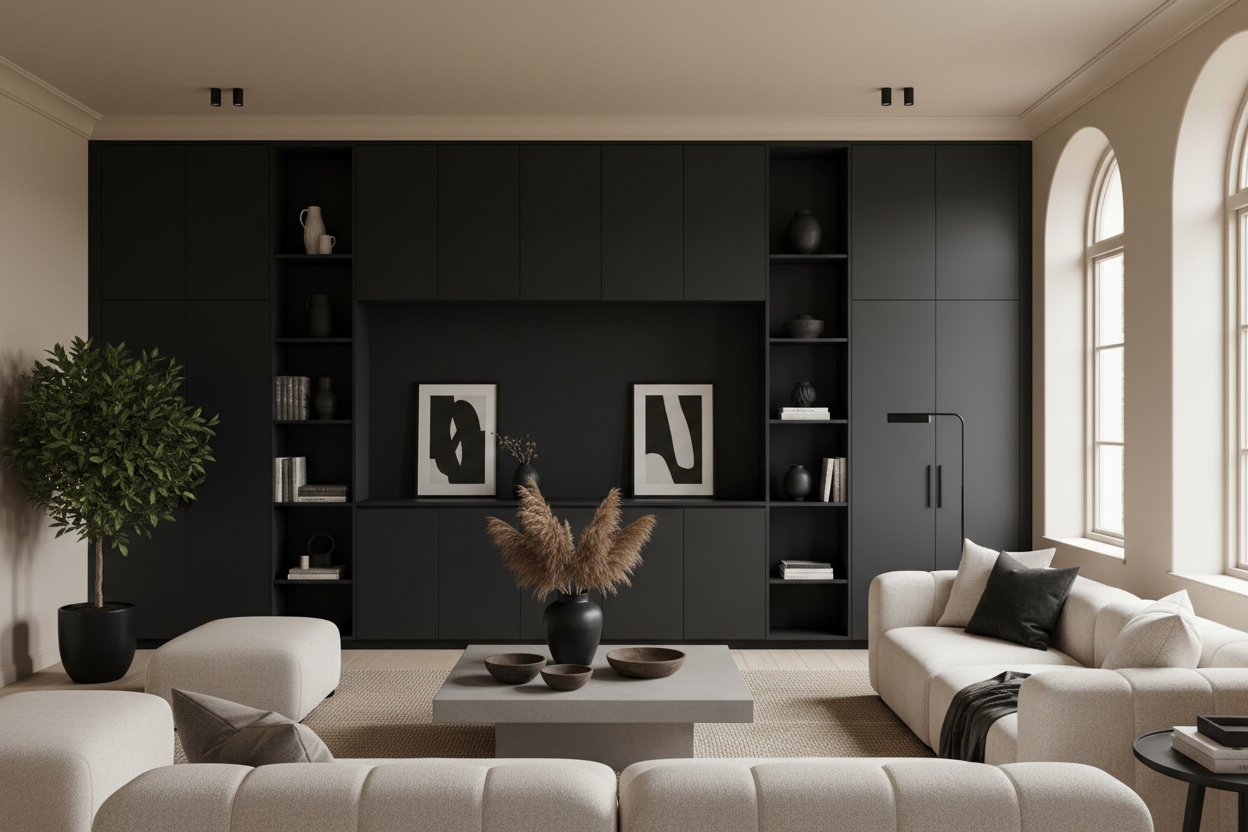
I spent three years painstakingly curating what I thought was the perfect living room. It was a sea of 'greige' linen, white oak, and cream wool. I thought it was sophisticated, but one rainy Tuesday, I looked around and realized I was living inside a lukewarm bowl of oatmeal. Everything was the same visual weight, the same tone, and frankly, the same level of boring.
The room felt like it was floating away because nothing was anchoring it to the floor. That is when I realized I didn't need another neutral throw pillow; I needed a heavy, moody piece of black cabinets for living room storage to finally give the space some backbone. Adding a dark element was the only thing that made my expensive light furniture actually pop instead of blending into the drywall.
Quick Takeaways
- Black furniture provides 'visual weight' that grounds airy, light-colored rooms.
- Dark finishes hide the unsightly gaps and seams common in budget-friendly assembly.
- Texture is vital—choose fluted wood or glass to prevent the piece from looking like a 'black hole.'
- Repeat the black accent at least twice elsewhere (frames, lamps) so the cabinet feels intentional.
The Day I Realized My Living Room Looked Like a Bowl of Oatmeal
We’ve all been there. You scroll through Pinterest and see those ethereal, all-white Scandinavian lofts and think, 'Yes, that is the vibe.' But in a real house—one with kids, pets, and actual shadows—an all-beige room just looks flat. My white oak coffee table was beautiful, but against my light oak floors and my sand-colored sofa, it just disappeared. There was no 'rest' for the eye because there was no contrast.
I realized that a room without a dark element is like a drawing without shadows. It lacks three-dimensionality. I was terrified that a black piece would feel too 'goth' or heavy, but the second I dragged a dark sideboard into the corner, the entire room suddenly had a focal point. The beige sofa didn't look washed out anymore; it looked intentional. It turns out, you need the dark to appreciate the light.
Why Black Cabinets for Living Room Storage Are the Ultimate Fix
In fashion, there is a concept called the 'wrong shoe theory'—the idea that adding a slightly unexpected or 'tough' shoe to a feminine outfit makes it look cooler. Interior design has a similar rule. If your room feels too precious or floaty, a heavy piece of living room storage in a matte black finish acts as the 'wrong shoe' that pulls everything together.
It provides a hard stop for the eyes. When you use black living room storage cabinet units, you are creating a boundary. It tells the viewer where the room ends and where the style begins. I’ve found that even in small 12x12 apartments, one tall black cabinet actually makes the ceilings feel higher because it creates such a strong vertical line against pale walls.
The Magic of a Black Living Room Storage Cabinet
Here is a secret from someone who has assembled way too much flat-pack furniture: white and light wood cabinets are unforgiving. If the doors are even 2 millimeters out of alignment, you see that dark shadow gap instantly. If the MDF edges aren't perfectly finished, it looks cheap. However, a black living room storage cabinet is a master of disguise. It camouflages seams, hides slightly uneven door hinges, and generally looks about $500 more expensive than it actually is.
I spent weeks looking for a storage cabinet modern enough to house my board game collection without looking like a plastic bin. The black finish naturally recedes, making the bulk of the cabinet feel less intrusive than a bright white one would. It’s the ultimate 'quiet luxury' move for people who have a lot of stuff to hide.
How to Stop It From Looking Like a Giant Black Hole
The biggest fear people have with dark furniture is that it will 'suck the light out of the room.' It can, if you’re not careful. My first mistake was placing a black cabinet on a dark charcoal rug. It looked like a void. The trick is to create a 'sandwich' of light and dark. If you have dark floors, you need a light rug under that cabinet to create a border.
You also need to style the top of the piece with intention. Don't put a black lamp on a black cabinet. Use white ceramic vases, brass trays, or stacks of colorful books to break up the silhouette. If you are worried about a floor-standing unit feeling too heavy, consider a modern wall cabinet that floats off the floor. Seeing the floor underneath the piece instantly lightens the visual load while still giving you that punch of contrast.
The Texture Rule for a Black Living Room Cabinet
Flat, smooth black laminate can sometimes look a bit 'dorm room.' If you want your black living room cabinet to look like a high-end designer piece, you need texture. I’m a huge advocate for fluted details, reeded glass, or a visible wood grain. These textures catch the light and create highlights and shadows on the black surface, which prevents it from looking like a flat silhouette.
I recently helped a friend pick out a solid wood modern sideboard in a charcoal stain rather than a painted black. Because it was real wood, you could still see the organic movement of the grain. The brass hardware acted like jewelry against a black dress. That little bit of shimmer is what makes the difference between a piece that looks 'heavy' and a piece that looks 'expensive.'
Balancing the Rest of the Room (Because Dark Furniture Needs Friends)
The biggest mistake you can make is buying one piece of living room storage black furniture and leaving it to fend for itself. It will look like a mistake. You have to 'thread' the black throughout the room. You don't need much—just a few 'echoes' of the color. I usually suggest the 3-point rule: if you have a black cabinet, add a black picture frame on the opposite wall and maybe a black metal floor lamp or a tray on the coffee table.
This creates a visual triangle that moves the eye around the space. It makes the black cabinet feel like part of a cohesive 'story' rather than a random intruder. When I finally added a few black-and-white prints in thin black frames above my sofa, the whole 'bowl of oatmeal' living room finally felt like a finished, professional space. It wasn't about changing my style; it was just about finally giving it some definition.
FAQ
Do black cabinets show more dust?
Yes, let's be honest: black is a magnet for dust and fingerprints. If you hate cleaning, go for a textured wood grain or a matte finish rather than high-gloss. A quick swipe with a microfiber cloth once a week is usually enough to keep it looking sharp.
Will a black cabinet make my small living room look smaller?
Actually, no. Because dark colors recede, a black cabinet can often make a wall feel further away, especially if the rest of the room is light. It adds depth that a white cabinet simply can't provide.
Can I mix a black cabinet with brown wood furniture?
Absolutely. In fact, you should. Mixing black with warm wood tones like walnut or oak keeps the room from feeling too sterile or 'themed.' It makes the space feel collected over time rather than bought from a single showroom page.


Leave a comment
This site is protected by hCaptcha and the hCaptcha Privacy Policy and Terms of Service apply.