










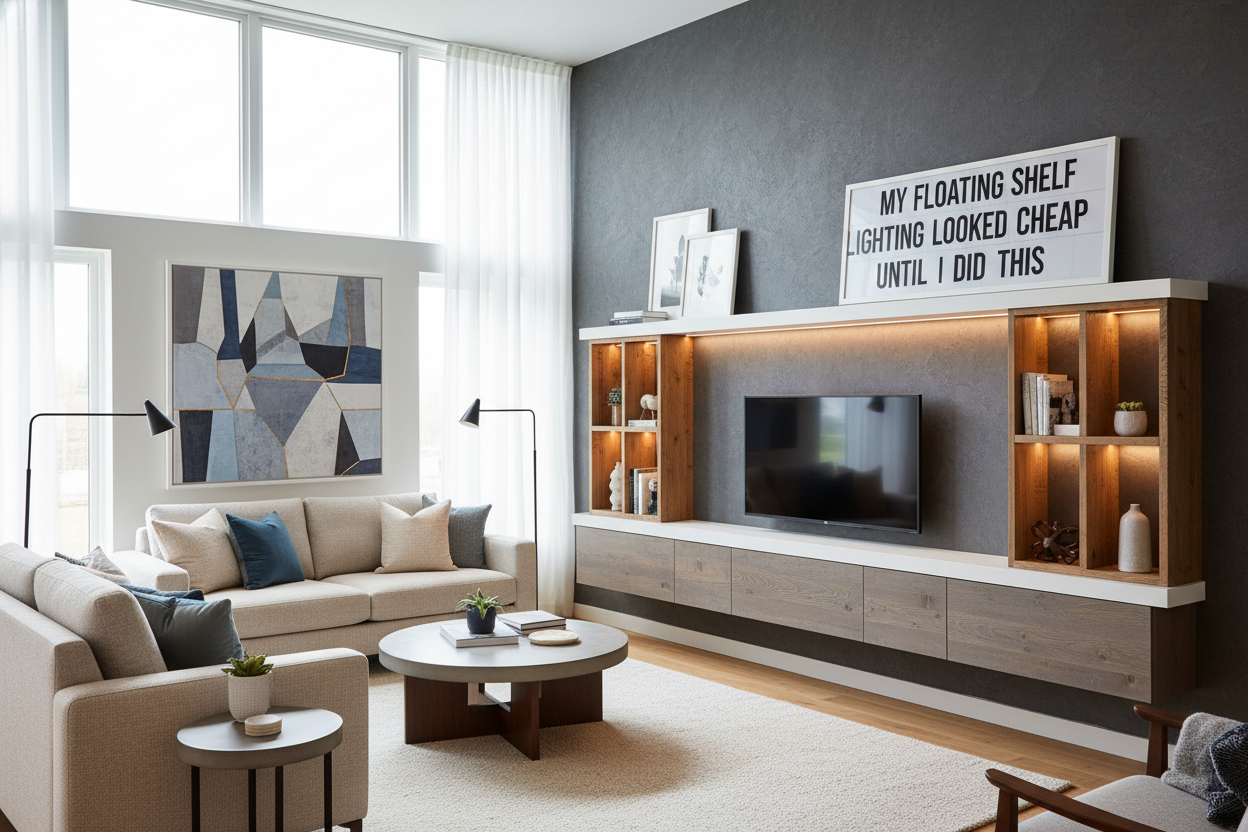
I spent three weekends sanding and staining the perfect reclaimed oak planks, only to have my floating shelf lighting project end up looking like a discount electronics store. I thought I could just slap some adhesive LED strips on the bottom and call it a day. I was wrong. The result was a series of harsh, blinding dots reflected against my white walls and a tangled mess of black wires that made my minimalist dreams look like a science project gone wrong.
If you're tired of the 'dorm room' aesthetic, you aren't alone. Most people buy a floating shelf with lights thinking it will look like a boutique hotel, but without the right diffusion and placement, it just looks tacky. I had to rip everything down and start over to get that soft, high-end glow that actually makes a room feel expensive.
Quick Takeaways
- Never leave LED beads exposed; always use a frosted diffuser.
- Stick to 2700K color temperature for a warm, residential feel.
- Battery-powered pucks are great for rentals, but hidden strips look more custom.
- Recessing the light source into the shelf is the only way to truly hide the hardware.
The 'Dorm Room' LED Mistake (And Why I Made It)
When I first installed my shelving with lights, I made the amateur mistake of sticking raw LED strips directly onto the underside of the wood. The issue? Most LEDs are 'point sources.' This means you see every individual tiny bulb reflected on your wall or your countertops. It’s distracting, ugly, and cheapens the wood you spent good money on. I felt like I was living in a PC gaming rig rather than a living room.
The fix is simple but often ignored: diffusers. You need an aluminum channel with a frosted plastic cover. This spreads the light evenly, creating a continuous bar of glow rather than a dotted line. I also realized that mounting the floating shelf led light too close to the wall creates a 'hot spot' of light. If you pull the light source about two inches away from the wall, the beam has room to breathe, resulting in a much softer wash of light that makes your floating shelves with lights look professional.
Hardwired vs. Battery: The Wire-Hiding Reality Check
Let’s be real—hiding wires is the hardest part of any floating shelf with led lights project. If you are doing a full renovation, hardwiring to a wall switch is the gold standard. But for most of us, that means tearing up drywall and hiring an electrician. I wasn't ready for that kind of commitment. I initially tried to hide a power cord behind a picture frame, but it looked sloppy. It reminded me of the struggle I had when I replaced my bulky console with a floating wooden TV shelf and realized that 'floating' only works if the cables don't exist.
If you can't go behind the wall, look for led floating shelves that use rechargeable lithium-ion battery packs. The technology has actually gotten decent. You can get slim, magnetic packs that tuck behind the front lip of the shelf. I get about three weeks of nightly use out of mine before I have to plug them in for a recharge. It’s a small price to pay for not having a black cord dangling down your pristine wall. For a wall shelf with led lights, the battery pack is usually the only way to maintain that 'magic' floating look without a major construction project.
Three Ways to Actually Hide the Light Source
To get that high-end 'hidden shelf lighting' look, you have to be clever about where the hardware sits. If you can see the strip when you’re sitting on your sofa, you’ve failed. My favorite method is using a router to cut a 1/2-inch deep channel directly into the bottom of the wood. You drop the led strip lights for floating shelves into that groove, and suddenly the light is integrated, not just attached. It looks like the wood itself is glowing.
If you don't own a router, don't panic. You can add a small 'apron' or lip to the front of the shelf. A simple 3/4-inch trim piece glued to the front edge creates a shadow box effect that hides the led wall shelves hardware from view. The third option is using angled aluminum tracks. These mount in the corner where the shelf meets the wall, directing the light downward and outward at a 45-degree angle. This is particularly effective for kitchen shelves with lights where you need actual task lighting on the counters below.
The Color Temperature Rule You Can't Break
Nothing kills the vibe faster than 'daylight' LEDs. I once bought a set of wall shelf lights that were 5000K, and my living room looked like a hospital operating room. It was cold, sterile, and physically uncomfortable to sit near. When you're looking for lighted wood shelves, check the Kelvin (K) rating on the box. You want 2700K to 3000K. This mimics the warm, amber glow of traditional incandescent bulbs.
Using the wrong temperature can make your carefully curated decor look like a retail display in a mall. You want your home to feel like a home, not a showroom for sneakers. Warm white light brings out the natural grain in wood floating shelves with lights and makes your books and pottery look inviting. If your light up wall shelf has a remote, check if it has a dimming function. Being able to drop the brightness to 20% at night is what separates 'functional lighting' from 'mood lighting.'
When to Skip the DIY and Just Buy Pre-Lit
I’m a big fan of DIY, but sometimes it’s a massive headache. If you’re trying to illuminate heavy items—like a full home bar or a massive book collection—retrofitting floating shelves with built in lights can compromise the structural integrity of the shelf. I once tried to route a channel into a shelf holding twenty bottles of bourbon, and let's just say I'm lucky I didn't end up with a floor full of broken glass. The wood just got too thin to support the weight.
In those cases, I’d honestly suggest looking at a tall bookcase with built-in LED light strips. The wiring is already managed, the shelves are reinforced, and you don't have to worry about a battery pack dying mid-party. For a bar area, a dedicated wine bar cabinet with integrated lighting is often a better move than floating shelves. It handles the weight of the bottles and gives you that backlit floating shelves look without the risk of the whole thing ripping out of your studs. Sometimes, the best DIY is knowing when to let the professionals handle the wiring.
FAQ
Can I use battery lights for floating shelves in a rental?
Absolutely. Look for rechargeable LED strips with magnetic adhesive backings. You can stick the metal plate to the shelf and pop the light off whenever it needs a charge. No holes, no permanent damage, and you can take them with you when you move.
How do I hide the wires if I don't want to cut into my walls?
The best trick is using plastic cord covers that are paintable. You run the wire down the corner of the room or alongside a door frame, paint it the exact same color as your wall, and it virtually disappears. It's not perfect, but it's 90% better than a loose cable.
What is the best brightness for shelf lighting?
You don't need a searchlight. Look for strips that offer 200 to 300 lumens per foot. Anything brighter than that will be overwhelming in a living room. If the lights are for task work, like under kitchen shelves, you can go a bit higher.


Leave a comment
This site is protected by hCaptcha and the hCaptcha Privacy Policy and Terms of Service apply.