










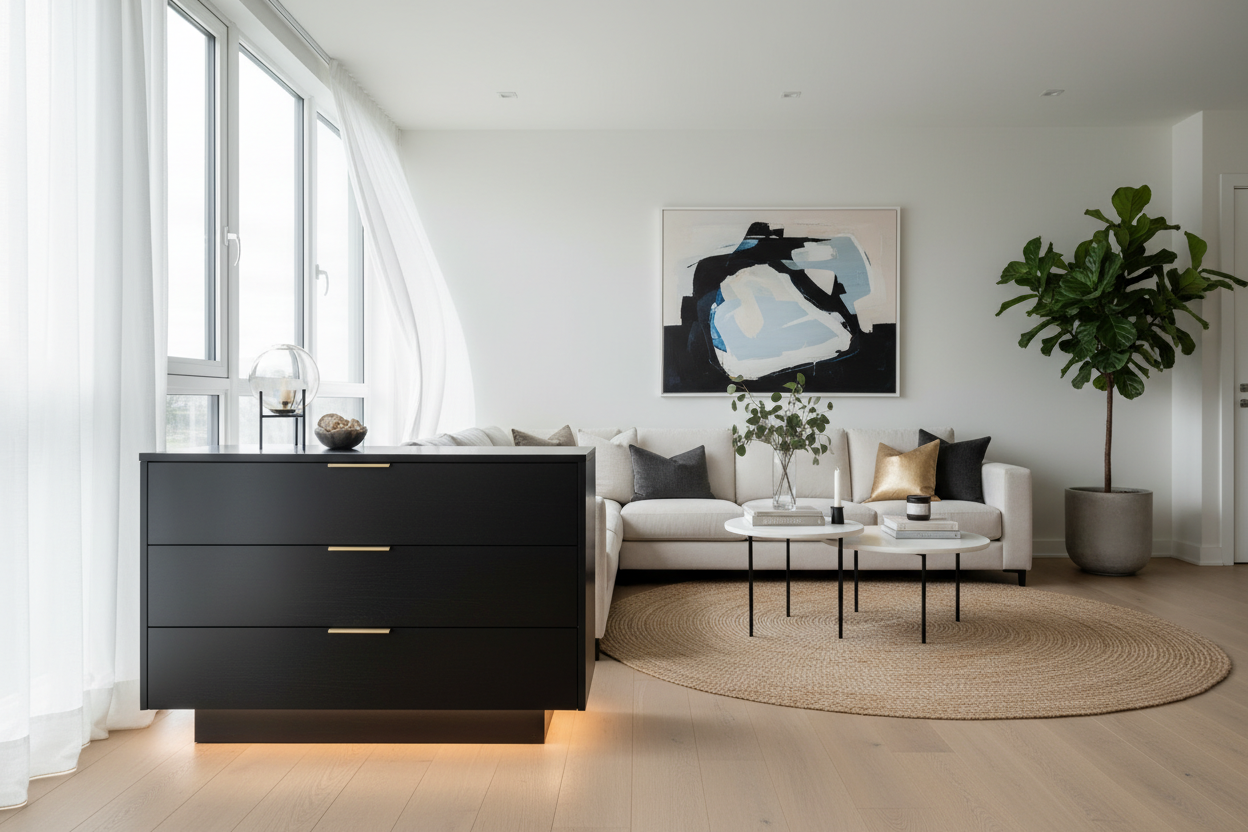
I sat in my living room for six months feeling like everything was about to drift away. I had a light oak coffee table on skinny legs, a sofa on skinny legs, and two rattan chairs on—you guessed it—skinny legs. It wasn't a room; it was a furniture showroom for mid-century modern enthusiasts who hate gravity. I finally realized I didn't need more 'airy' pieces; I needed a living spaces black dresser to actually pin the floor down.
The realization hit when I saw my reflection in a window and realized my space had no soul because it had no weight. Adding a heavy, dark piece isn't about making a room feel small. It's about giving your eyes a place to land. Without that anchor, your brain just keeps scanning the perimeter like a nervous cat. Here is how I fixed my 'helium room' once and for all.
- Visual weight is the secret to making an open-concept room feel intentional.
- Black furniture acts as a 'neutral plus'—it goes with everything but demands respect.
- Dressers offer significantly better storage depth than standard media consoles.
- Mixing leg styles (solid bases vs. spindly legs) creates a balanced, lived-in look.
The 'Helium Room' Problem (Why Spindly Legs Are Ruining Your Vibe)
We've all fallen for it. You scroll through Pinterest and see these beautiful, light-filled spaces where every piece of furniture looks like it's tiptoeing. But when you replicate that in your actual living room, it often feels ungrounded and visually anxious. If every piece of furniture has 8 inches of clearance underneath it, your floor looks like a parking lot.
This 'helium effect' makes a room feel temporary. It lacks the permanence that a home should have. When I looked at my space, there was no contrast. The light wood blended into the light floors, which blended into the white walls. I needed something that said, 'I live here, and I am heavy.' I needed to break the cycle of buying things just because they looked 'light.'
Enter Visual Gravity: The Living Spaces Black Dresser Pivot
I started looking for pieces that sat directly on the floor—no legs, no gaps. The living spaces austen dresser was exactly what I needed. The austen dresser has this chunky, commanding presence that immediately fixed the proportions of my wall. It’s not just a box; it’s an architectural element that provides a dark horizon line for the rest of the decor.
Black furniture is often misunderstood as 'heavy' in a bad way. In reality, a black dresser living spaces style provides the necessary contrast to make your lighter pieces actually pop. Instead of everything being a wash of beige, the black wood creates a frame. It makes the room feel finished, rather than just 'furnished.' It’s the difference between a sketch and a framed painting.
Why I Chose a Dresser Over a Standard TV Stand
Most media consoles are too shallow. They are designed for a DVD player from 2004 and maybe a stray remote. I opted for a living spaces 3 drawer dresser because I needed a place to hide the chaos. A dresser gives you deep drawers for blankets, board games, and all the tech junk that usually clutters up a console table.
I’m a firm believer that Your Living Room Needs a Living Spaces Dresser, Not a Console. The height is usually better for a wall-mounted TV—putting the screen at a comfortable eye level—and the storage capacity is triple what you get with a standard media unit. It’s a functional win that happens to look like a high-end design choice.
How to Style a Black Dresser Without Making the Room Feel Tiny
The fear of black furniture is that it will 'eat the light.' To avoid this, you have to layer. I swapped the standard knobs on my black dresser living spaces piece for aged brass hardware. It’s a five-minute DIY that makes the dresser look like a $2,000 antique. The gold reflects light and breaks up the dark surface.
On top, I leaned an oversized piece of neutral art. This draws the eye upward and connects the dark base to the lighter walls. Add a textured table lamp—maybe something in cream ceramic or stone—and a green plant. The organic green against the matte black is a classic combo that never feels dated or heavy. It’s about creating a vignette that feels intentional, not just a place to set your keys.
Ready for Heavy Furniture? Don't Fear the Dark
If you're tired of your furniture feeling like it's about to float away, embrace the weight. A living spaces dresser black finish is a bold move, but it’s one that pays off in character. It forces you to be more intentional with your other colors, which usually leads to a much better-designed room. You stop buying 'safe' things and start buying things that actually look good together.
If you aren't ready for pure black, you can still get that grounding effect with a modern chest of 9 drawers wood dresser in a deep espresso or charcoal. The goal is to find something with a solid base that anchors the room to the ground. Stop buying furniture on stilts; your floor will thank you for the company.
Personal Experience: My First-Time Fail
I'll be honest: I originally tried to 'fix' my room by buying a cheap, black MDF unit from a big-box store. It was a disaster. Within three months, the top bowed under the weight of my books, and the 'black' finish started peeling at the corners to reveal light brown cardboard. It looked like a college dorm room. When I finally upgraded to the solid wood Living Spaces pieces, the difference was night and day. Don't cheap out on the heavy stuff; you need the actual density of real wood to get that 'grounded' feeling.
FAQ
Will a black dresser make my small room look smaller?
Actually, no. Because black recedes, a dark dresser against a wall can sometimes make the wall feel further away. It's the spindly, cluttered pieces that make a room feel cramped, not the solid ones.
Is the Austen dresser hard to assemble?
Most Living Spaces dressers come mostly assembled, which is a lifesaver. You might have to attach the feet or the hardware, but you aren't spending six hours with an Allen wrench and a manual that looks like a Rorschach test.
How do I keep dust off a black dresser?
I’m not going to lie—it shows dust more than oak. Use a microfiber cloth once a week. If you hate dusting, go for a matte finish rather than high-gloss; it hides fingerprints much better and looks more modern.


Leave a comment
This site is protected by hCaptcha and the hCaptcha Privacy Policy and Terms of Service apply.