











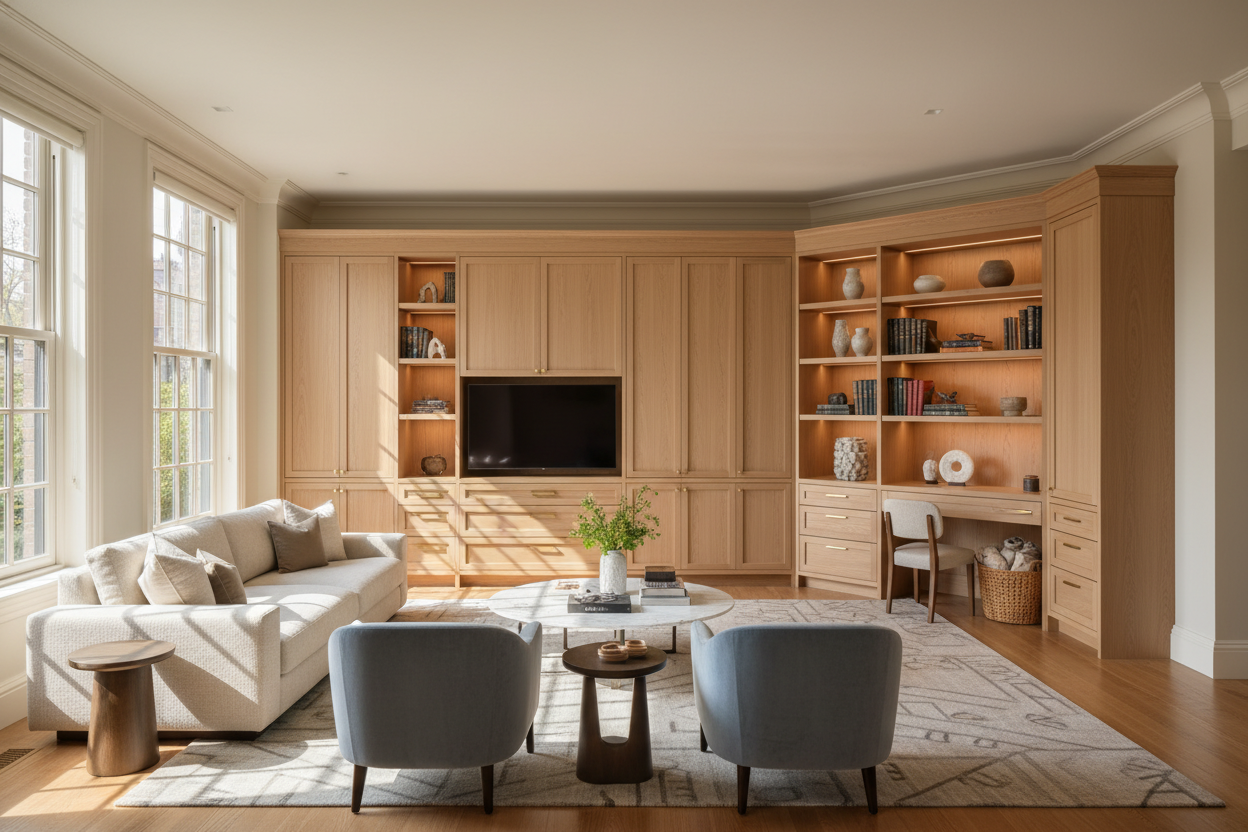
I spent my 20s thinking a tape measure was just a suggestion. I would see a 72-inch alcove, buy a 70-inch shelf, and then spend three weekends wondering why those two inches of dead space looked like a total trash magnet. If you live in a house built before 1990, you know the pain: walls that lean at a 2-degree angle, floors that slope toward the kitchen, and corners that aren't actually 90 degrees.
After years of trying to make big-box furniture work, I finally caved and looked into customizable storage cabinets. It wasn't about being fancy; it was about survival. I was tired of losing my car keys in the 'gap of despair' between my wardrobe and the wall. Once you stop trying to force a square peg into a slightly-trapezoidal hole, your entire home starts to breathe differently.
- No Wasted Inches: You use 100% of your wall, not 92%.
- Built-in Look: Custom sizing makes cheap materials look expensive and expensive materials look permanent.
- Structural Integrity: Real custom pieces usually bypass the cam-lock and particle board nightmare of flat-pack kits.
- ROI: It adds actual value to the home because it looks like part of the architecture.
The Years I Wasted Trying to Hack Off-the-Shelf Furniture
I used to be the king of the 'filler strip.' I’d buy basic storage cabinets from the local big-box store, get them home, and realize they were just a fraction too short or too wide. I’d spend my Saturdays at the hardware store buying trim, caulk, and paint to try and bridge the gap. It always looked like exactly what it was: a desperate attempt to hide a mistake.
The problem with standard units is that they are designed for a perfect world that doesn't exist. My current living room has a baseboard that is nearly an inch thick. Most mass-produced cabinets don't have a deep enough toe-kick to clear that, so the cabinet sits three inches away from the wall. It’s a dust trap. I once spent four hours trying to scribe a cabinet side to a wavy plaster wall only for the laminate to chip off in giant, ugly flakes. I realized then that I was spending more on 'fix-it' materials and therapy than I would have spent on a piece that actually fit.
Why Quirky Architecture Demands Customizable Storage Cabinets
Old houses hate you. They specifically hate your desire for symmetry. I have a guest room with a sloped ceiling that starts at six feet and ends at eight. Trying to find a large standalone wardrobe that didn't hit the ceiling or look like a lonely monolith in the corner was impossible. Standard furniture depths are usually 12, 18, or 24 inches. But what if your alcove is 21 inches? You either have a cabinet sticking out into the walkway or you lose three inches of storage space.
This is where customization becomes a necessity. When you can specify the height to the half-inch, you can actually utilize the vertical space that usually goes to waste. I’m talking about taking cabinets all the way to the ceiling. It makes the room look taller and gives you a place to hide the Christmas decorations you only touch once a year. If you're dealing with a radiator or a weirdly placed outlet, a custom piece can be designed with the right cutouts from the jump, rather than you attacking a finished piece with a jigsaw and a prayer.
The Curse of the 87-Inch Wall
Let’s do the math on a common nightmare. You have an 87-inch wall. Standard cabinets usually come in 24, 30, or 36-inch widths. If you buy two 36-inch units, you have 15 inches of awkward emptiness. If you try to squeeze in three 30-inch units, you’re three inches over and crying in the parking lot. You end up buying the two 36s and putting a fake plant in the gap. It looks cluttered, it collects cat hair, and it’s a waste of prime real estate. A custom solution lets you just... make them 43.5 inches each. Problem solved.
Pricing Out a Custom Storage Cabinet (Spoiler: It's Not That Bad)
People hear 'custom' and assume they need to hire a master carpenter who only works in reclaimed walnut. In reality, ordering a custom storage cabinet through a modular system is often only 20-30% more expensive than a high-end off-the-shelf version. When you factor in the cost of the trim, the paint, the specialized tools, and the eight hours of your life you’ll never get back from trying to 'hack' a cheap unit, the custom piece is actually cheaper.
Think about the materials, too. A standard 2-drawer base cabinet from a budget retailer is usually 1/2-inch particle board. A decent custom-ordered unit will use 3/4-inch plywood or high-density MDF that won't sag the moment you put a few heavy books on it. You aren't just paying for the size; you're paying for the fact that the drawers won't fall off their tracks in two years. I’ve found that the 'cost per year' of custom furniture is significantly lower because you aren't replacing it every time you move or get bored of the gaps.
Where I Still Use Off-the-Shelf (And Where I Don't)
I’m not a total snob. I still use a standard glass display cabinet in my entryway because that wall is huge and the cabinet doesn't need to be wall-to-wall to look good. It’s a statement piece, not a structural one. If the piece is 'floating' in the middle of a wall, go ahead and buy the standard size. Save your money.
But for kitchens, home offices, and mudrooms? That’s where I insist on custom made storage cabinets. These are the high-traffic zones where every half-inch of counter space or shelf depth matters. I once tried to use a standard desk in a 50-inch nook. I had two inches on either side—just enough for pens to fall down and disappear forever. I replaced it with a custom-width surface, and suddenly the room felt intentional rather than accidental. If it touches two walls, make it custom. You won't regret it.
FAQ
Is custom furniture harder to assemble?
Usually, it’s easier. Because it’s made to order, the pieces are often cut with higher precision than mass-produced stuff. The holes actually line up, and the instructions aren't just vague pictograms drawn by someone who hates you.
How do I measure for a custom cabinet if my walls are crooked?
Measure the width at the top, the middle, and the bottom. Use the smallest measurement. It’s much easier to fill a tiny 1/8-inch gap with a bead of caulk than it is to sand down a cabinet because your wall bulges in the middle.
Can I take custom cabinets with me when I move?
If they are truly built-in, no. But modular custom cabinets can be unscrewed from the wall just like any other furniture. The catch is they might not fit the 'quirks' of your next house quite as perfectly, but the build quality usually survives the move better than flat-pack stuff.


Leave a comment
This site is protected by hCaptcha and the hCaptcha Privacy Policy and Terms of Service apply.