










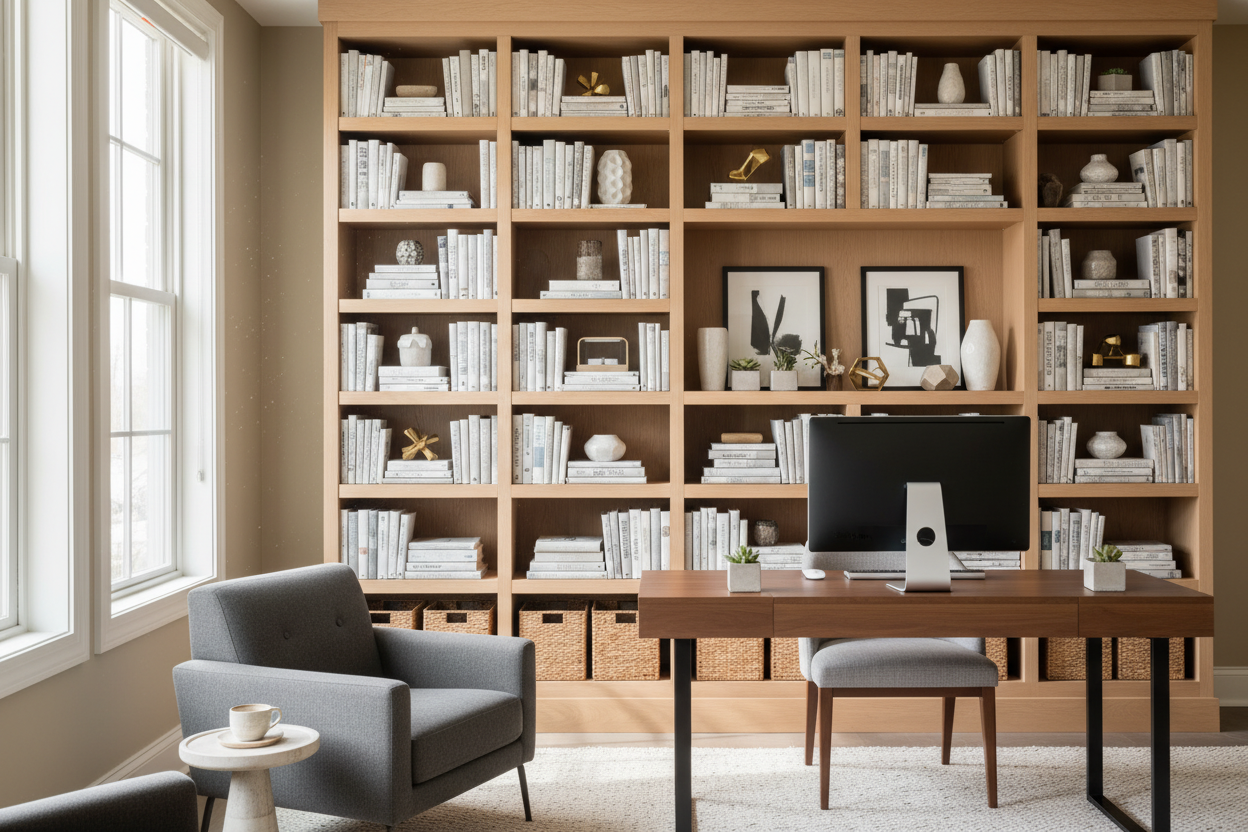
There is a distinct psychological shift that happens when you sit down at a desk facing a chaotic wall of paper and clutter versus a curated vignette of knowledge and art. As an interior designer, I often find that the biggest barrier to productivity isn't the desk chair—it's the visual noise surrounding it. Office bookshelf organization is rarely just about storage; it is about creating a backdrop that commands respect while fostering creativity. Whether you are working with built-in millwork or a freestanding mid-century modern unit, the goal is to transform your vertical storage into a focal point that serves both your workflow and your aesthetic sensibilities.
The Designer’s Checklist for Shelf Styling
- Visual Weight Distribution: Anchor the unit by placing larger books, storage bins, and darker colors on the bottom shelves.
- The 60/30/10 Rule: Aim for 60% books, 30% decor/accessories, and 10% negative space (empty space).
- Texture Variance: Mix smooth book spines with tactile elements like woven baskets, metallic bookends, or organic greenery.
- Functional Grouping: Categorize items by frequency of use—keep daily reference materials at eye level and archives up high.
The Foundation: Material Integrity and Scale
Before we discuss placement, we must address the vessel itself. When clients ask how to organize office shelves, I first look at the material quality. If you are working with particle board or thin veneer, you must be wary of sagging. Solid wood (like walnut or oak) or high-grade plywood with a solid wood edge banding offers the structural integrity required for heavy legal tomes or design catalogues.
Scale is equally critical. A common error is filling deep shelves (12-14 inches) with small paperback books, pushing them all the way to the back. This creates a shadow cavern that looks gloomy. Instead, pull books forward to align with the front edge of the shelf to create a uniform, custom-built appearance.
Layout Strategy: The "Zig-Zag" Method
To properly organize office shelves without them looking static or library-like, you need rhythm. I employ the "Zig-Zag" method. Imagine a 'Z' shape running down your bookshelf. Place your heaviest visual elements (like a stack of horizontal magazines or a large ceramic vase) along this imaginary line.
This technique forces the eye to travel dynamically across the entire unit rather than getting stuck on one shelf. Alternate between vertical rows of books and horizontal stacks. This not only adds architectural interest but horizontal stacks also serve as excellent pedestals for small sculptural objects.
Integrating Hidden Storage
Let’s be honest: not everything in an office is beautiful. Printer paper, cables, and client files are necessary but unsightly. To maintain a luxury aesthetic while organizing office shelves, invest in high-quality storage boxes. I prefer linen-wrapped boxes or leather file holders. These conceal the clutter while adding a layer of texture that elevates the room's sophistication.
My Personal Take on Office Bookshelf Organization
I learned a hard lesson early in my career while styling a home office for a high-profile client in Manhattan. We sourced this stunning, high-gloss lacquer shelving unit—absolutely beautiful, sleek, and modern. I spent hours arranging the books by color (a trend I have since moved away from, as it often hinders finding what you actually need).
The mistake wasn't the layout; it was the lighting interaction. I hadn't accounted for the under-shelf LED strips I installed. Once turned on, they highlighted every single micro-scratch on the lacquer and the dust that had settled on the horizontal book stacks within 24 hours.
From that project, I learned two things: First, matte finishes are far more forgiving for horizontal surfaces in high-traffic offices. Second, never stack books horizontally on a shelf above eye level unless you plan to dust them daily. Now, when I style my own studio, I prioritize vertical storage for anything above shoulder height to minimize dust collection and keep the visual lines clean.
Conclusion
Your office shelves tell a story about your work ethic and your personal style. By balancing negative space with functional storage and mixing textures, you turn a utilitarian object into a piece of architecture. Take a moment this weekend to clear your shelves and rebuild them with intention—your peace of mind during the workday is worth the effort.
Frequently Asked Questions
How much empty space should I leave on my shelves?
Negative space is crucial for preventing a cluttered look. I recommend leaving at least 10-15% of each shelf empty. This gives the eye a place to rest and allows the featured items to stand out, rather than blending into a wall of noise.
Should I organize books by color or subject?
While color-coding looks striking on Instagram, it is rarely practical for a working office. As a designer, I recommend organizing by subject or author for functionality. However, you can wrap unsightly dust jackets in uniform craft paper or vellum for a cohesive aesthetic without losing the logical order.
How do I handle deep shelves with small items?
If your shelves are deep (over 12 inches), avoid pushing items to the back wall. Align books with the front edge of the shelf. You can use the space behind the books to store rarely used items or cables, effectively using the books as a façade to hide clutter.

Leave a comment
This site is protected by hCaptcha and the hCaptcha Privacy Policy and Terms of Service apply.