










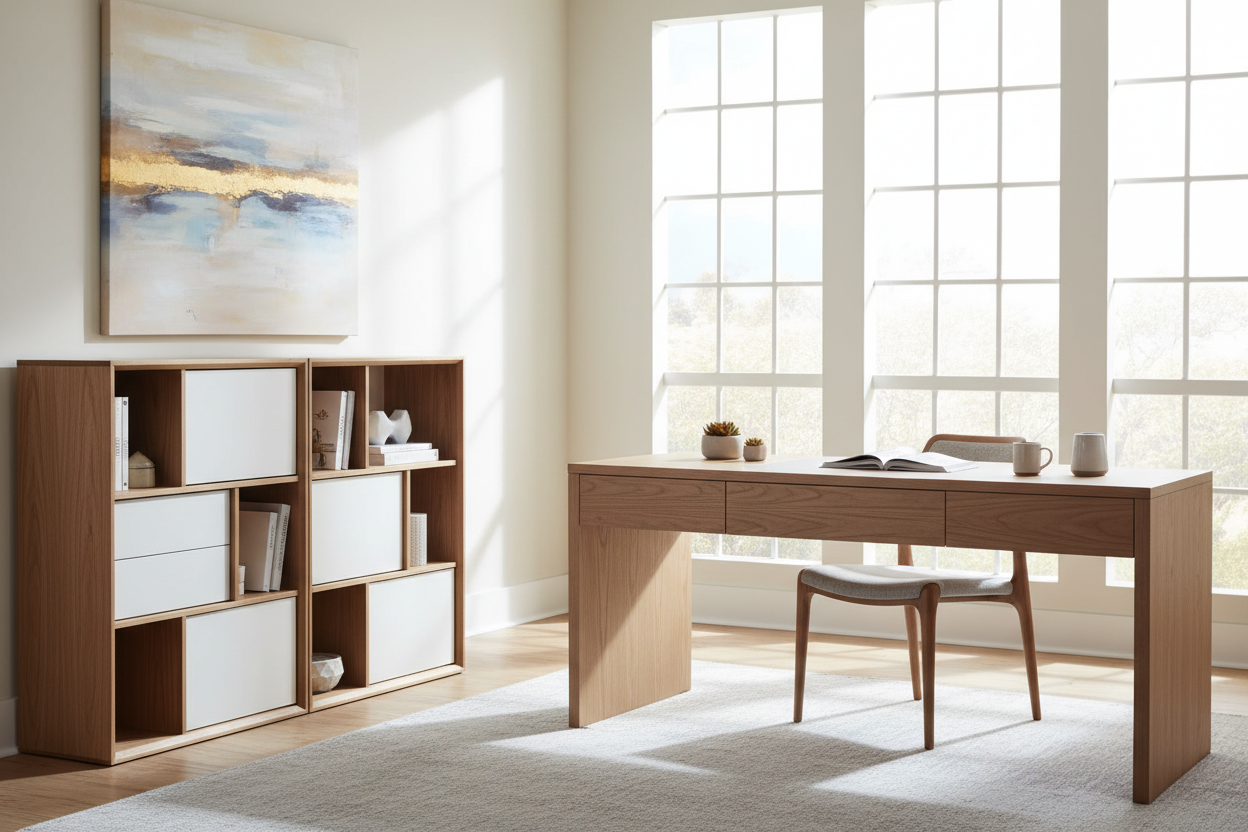
There is a specific kind of frustration that comes from a workspace that lacks containment. You have the surface area, but the visual noise of paperwork, tech peripherals, and stationery destroys your focus. This is usually the moment clients come to me asking for a solution that hides the chaos without resembling a sterile corporate cubicle. The answer is often a well-designed desk with cupboard storage, but selecting one is not as straightforward as picking a finish you like.
Key Features to Look For
- Door Swing Clearance: Ensure the cupboard door can open fully without hitting your chair or knees.
- Internal Cable Routing: Look for pre-drilled grommets inside the cupboard to hide PC towers or printers.
- Hinge Quality: Soft-close hinges prevent slamming and increase the furniture's longevity.
- Visual Weight: Ensure the desk doesn't look too bulky for the room; legs vs. full pedestal bases matter.
- Adjustable Shelving: Fixed shelves often fail to accommodate taller binders or modern hardware.
Balancing Visual Weight and Material
When you introduce a desk with a cupboard into a room, you are adding significant "visual weight." Unlike a parson’s desk or a glass trestle table, a desk with integrated cabinetry anchors the room. If your space is small, opting for a dark mahogany or solid walnut piece can make the room feel claustrophobic. In these instances, I advise clients to look for "floating" cupboard designs—where the storage unit is lifted off the floor by legs—or lighter oak veneers that reflect ambient light.
Material integrity is equally critical. Since the cupboard door will be opened and closed thousands of times, the connection point between the hinge and the frame is the weak link. Solid wood or high-grade plywood holds screws tight for decades. Particleboard, conversely, often fails at the hinge point after a year of heavy use, resulting in that dreaded "sagging door" look.
Ergonomics and The "Knee-Knock" Factor
A common design flaw in cheaper desks is the encroachment of the cupboard into the legroom. Standard ergonomic guidelines suggest a minimum of 24 to 30 inches of width for your legs. If the cupboard unit is too wide, you will find yourself sitting off-center to the monitor to avoid banging your knees, which wreaks havoc on your spinal alignment.
Configuring the Interior
What goes inside matters as much as the exterior finish. If you plan to house a CPU tower, ventilation is non-negotiable. A closed cupboard acts as an oven for electronics. Look for designs with an open back or mesh inserts. If the cupboard is for documentation, verify that the internal depth accommodates A4 or foolscap binders; standard consumer desks are often an inch too shallow for professional filing systems.
Lessons from My Own Projects
I learned the hard way about "hardware intrusion" during a home office renovation in a tight city apartment. I specified a beautiful, custom-built desk with a cupboard on the right-hand side. It looked stunning in the plan.
However, once installed, I realized I hadn't accounted for the specific handle depth. The client had an ergonomic chair with adjustable armrests. Every time they swiveled to the right to open the cupboard, the chair's armrest would catch on the protruding brass knob of the desk door. It was a maddening, repetitive friction point. We ended up having to swap the hardware for recessed pulls to salvage the usability. Now, I always check the profile of the handles against the turning radius of the office chair. It’s a millimeter-level detail that defines the daily experience.
Conclusion
Investing in a desk with a cupboard is about reclaiming your mental space as much as your physical floor plan. By prioritizing hinge quality, ergonomic clearance, and proper internal ventilation, you elevate a simple piece of furniture into a command center that serves you. Don't settle for storage that fights against your workflow.
Frequently Asked Questions
Can I switch the cupboard from left to right?
Most modular office desks allow for reversible assembly, but solid wood heirloom pieces are usually fixed. Always check the "assembly instructions" PDF before purchasing if your room layout requires a specific orientation.
How do I prevent electronics from overheating inside the cupboard?
If the desk doesn't have a ventilated back panel, you can use a hole saw to cut a discrete opening in the rear for airflow. Additionally, installing a small USB-powered fan inside the cabinet can keep air circulating around a CPU.
What is the ideal depth for a desk with storage?
Aim for a depth of at least 24 inches (60cm). Anything shallower often means the cupboard will be too small for standard equipment, and your monitor will be too close to your face.

Leave a comment
This site is protected by hCaptcha and the hCaptcha Privacy Policy and Terms of Service apply.