











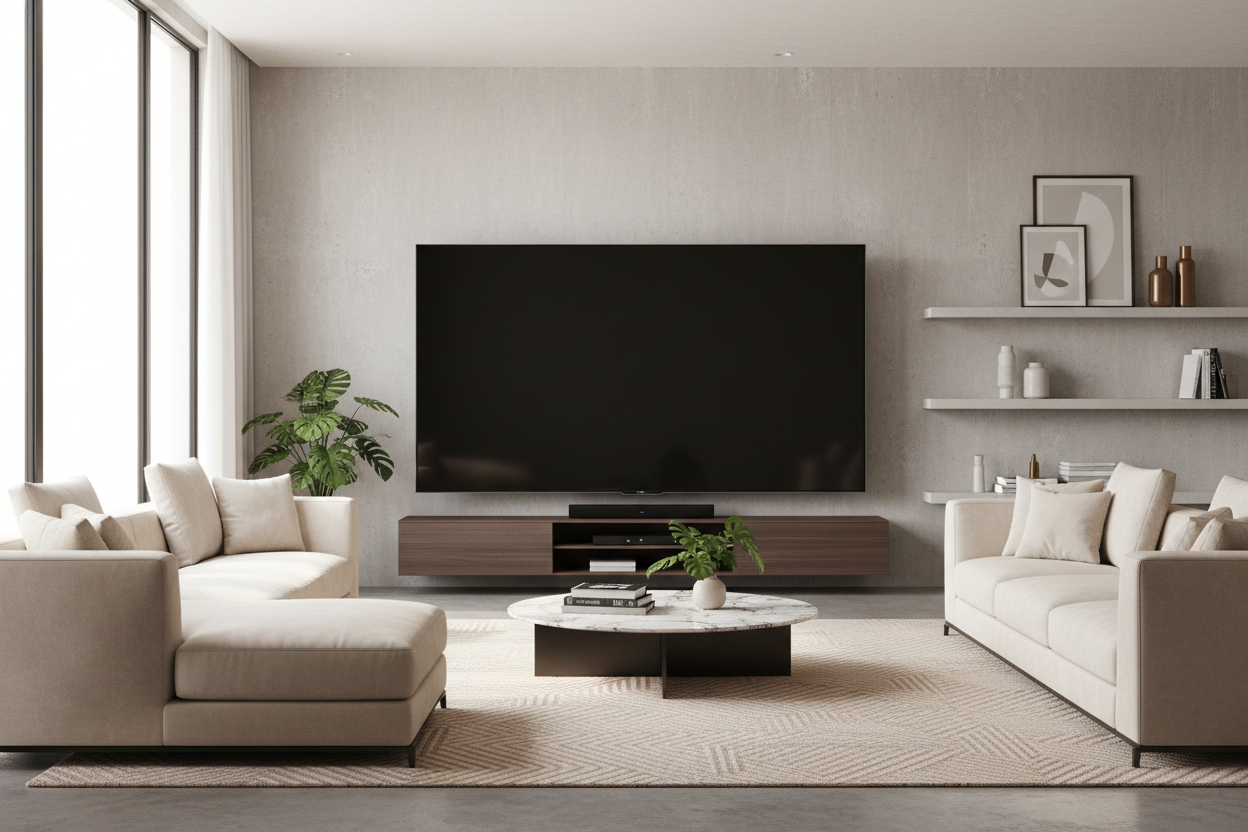
I remember the day my 85-inch beast arrived. I had measured the wall twice, but I hadn't actually considered the physics of the situation until the delivery guys left. There I was, staring at a two-thousand-dollar screen overhanging the edges of my old media unit like a teeter-totter in a windstorm. Finding the right tv stands for large tvs isn't just about matching your rug; it is about preventing a very expensive tipping disaster.
- Aim for a console at least 8 to 12 inches wider than the actual screen.
- Always verify the depth of the TV feet, not just the panel thickness.
- Look for a weight capacity that exceeds your TV by at least 20 percent.
- Prioritize solid wood or reinforced steel over thin particle board.
The Terrifying Reality of Screen Overhang
There is a specific kind of anxiety that comes with watching a massive flat screen wobble every time your dog runs through the living room. When you shop for a tv stand big tv, you are fighting against a high center of gravity. Most modern screens are thin, but they are heavy, and if the stand is too short, the visual weight makes the whole room feel top-heavy and cramped. It is a design fail that also happens to be a safety hazard.
Why Depth Matters Just as Much as Width
We all look at the width first, but depth is the silent killer. Many manufacturers have moved toward 'wide-set' feet—those V-shaped legs at the very edges of the screen. I have seen people buy beautiful standard TV stands only to realize their new 75-inch screen has a footprint 16 inches deep while the stand is only 14 inches. You do not want your expensive tech literally hanging off the edge of the furniture. Always measure the distance between the front and back of the TV legs before you click buy.
The Golden Ratio for a Stand for Big Screen TV Setup
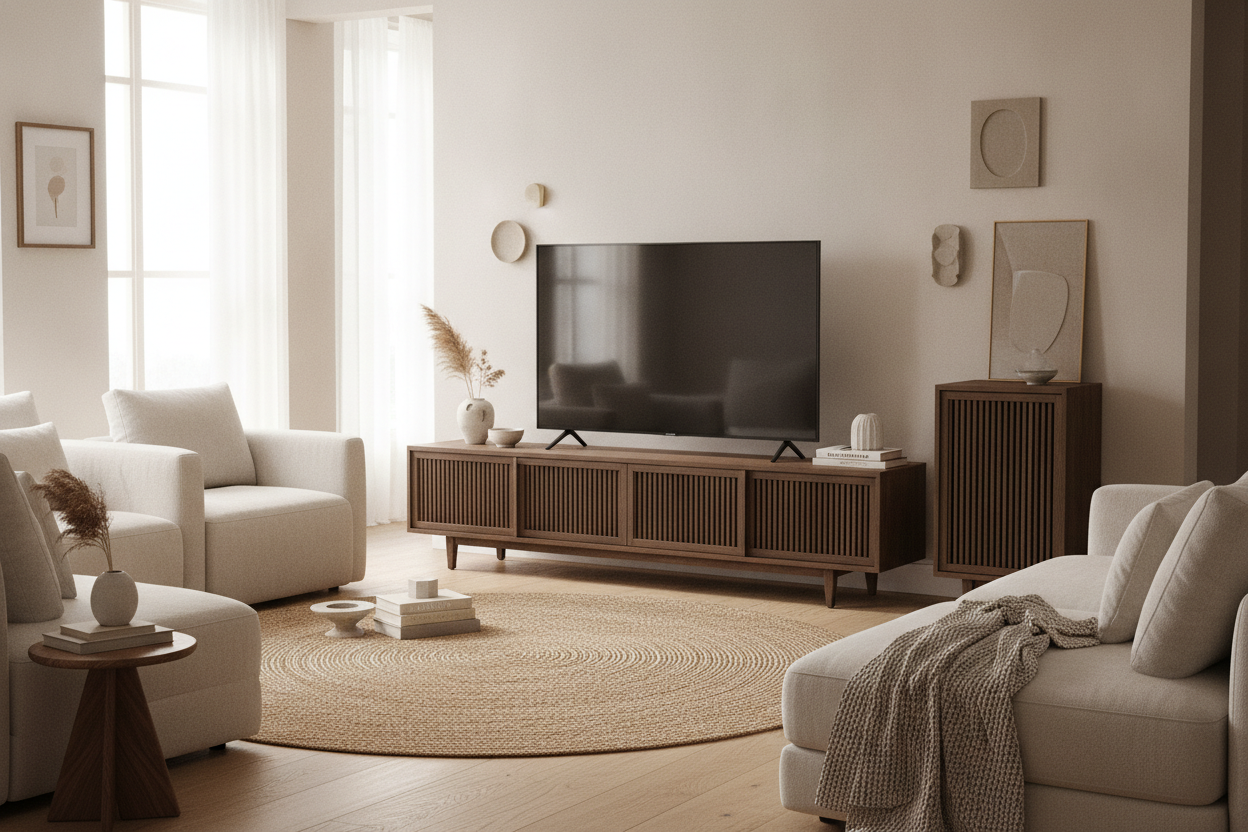
To make a room look balanced, your furniture needs to act as an anchor. The math is simple: find the width of your TV and add at least 4 to 6 inches of breathing room on either side. If you have a 75-inch screen (which is usually about 65 inches wide), you should be looking at a console that is at least 74 to 77 inches long. A TV bench large entertainment center is a great example of a piece that provides that necessary horizontal runway so the screen does not look like it is suffocating the furniture.
Weight Limits Are Not Suggestions (Trust Me)
I once watched a cheap MDF console slowly 'smile'—the middle sagged about an inch over six months because of a heavy plasma screen. It was not pretty. Large screen television stands need to be built like tanks. If you are putting 80+ pounds of glass and metal on a surface, you need kiln-dried hardwood or a metal frame. A large TV cabinet with spacious storage often includes a fifth or sixth support leg in the center, which is a non-negotiable feature for anything over 65 inches.
Stop Cluttering the Console Surface
Once you have the right large screen tv stand, the temptation is to fill those extra inches of surface space with decor. Resist that urge. A giant screen already dominates the visual field. If you start surrounding it with tiny TV unit decoration items, it creates a messy, fragmented look that distracts from what you are trying to watch. Keep the surface clean and let the furniture's lines do the work. Use the internal cabinets for the clutter and keep the top deck clear for the main event.
My Biggest Mistake
I once tried to save a few bucks by using a console that was exactly the same width as my TV. It looked like a giant lollipop. Not only was it a nightmare to cable manage because I couldn't reach behind it, but it made my living room feel half its actual size. I eventually swapped it for a low-profile stand that was nearly 20 inches wider than the TV, and the entire room suddenly felt 'expensive' and intentional. Don't skimp on the width.
FAQ
Does my TV stand have to be wider than the TV?
Yes. From both a safety and a design perspective, a stand that is narrower than the screen creates a tipping risk and looks unbalanced. Always aim for at least 3-5 inches of clearance on each side.
What is the best height for a large TV stand?
For large screens, lower is better. You want the center of the screen to be at eye level when you are seated. Usually, this means a stand height between 18 and 24 inches.
Can I put a 75-inch TV on a 60-inch stand?
No. Most 75-inch TVs are about 65-66 inches wide. The legs will likely hang off the edges, and the weight distribution will be unstable. You need a stand at least 70 inches wide.

Leave a comment
This site is protected by hCaptcha and the hCaptcha Privacy Policy and Terms of Service apply.