










The commanding position is arguably the single most important concept in practical feng shui—a principle so fundamental that mastering it alone can transform your experience in any space. Whether you're positioning a bed, desk, or primary seating, the commanding position creates an energetic advantage that translates into tangible improvements in sleep quality, productivity, security, and overall wellbeing. Yet despite its critical importance, the commanding position is often misunderstood, imperfectly applied, or ignored entirely in favor of purely aesthetic arrangements.
This comprehensive guide explores every dimension of the commanding position—what it is, why it works, how to achieve it in different rooms and situations, and what to do when perfect positioning isn't possible. Understanding this principle deeply allows you to make empowered decisions about furniture placement that support rather than undermine your goals in every area of life.
What Is the Commanding Position?
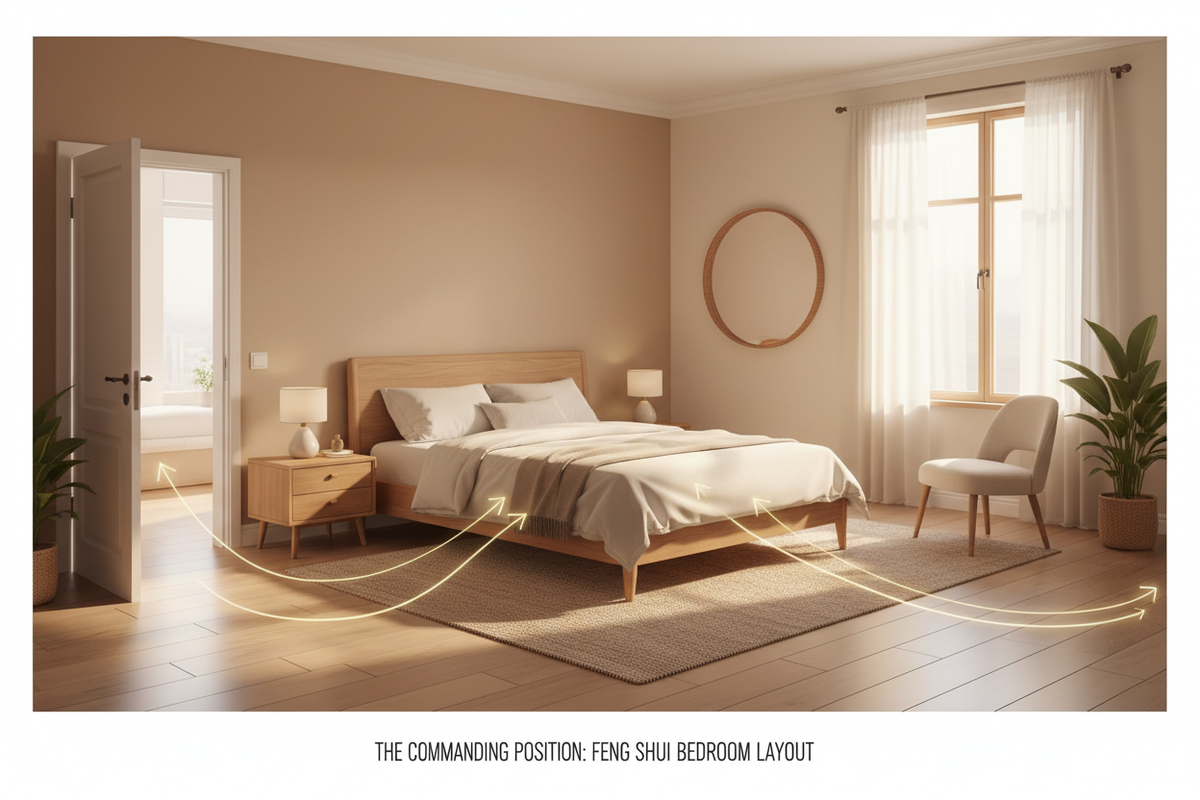
The commanding position is a furniture placement principle that positions you to see the entrance to a room while occupying important furniture (bed, desk, or primary seating), without being directly in line with the door. This strategic positioning creates visual awareness, psychological security, and energetic advantage.
The Three Core Elements:
1. Door Visibility: You can see the room's main entrance while in your primary position (lying in bed, sitting at your desk, or seated in main furniture). You don't need to see the entire door or have an unobstructed view—you simply need to be aware of the entrance and able to see people approaching or entering.
2. Diagonal or Angled Positioning: You're positioned at an angle or diagonally from the door rather than directly facing it head-on or having your back completely to it. The ideal commanding position typically places you in the corner diagonally opposite the entrance, or along the wall furthest from the door.
3. Not in Direct Alignment: You're not positioned directly in line with the door where energy (chi) rushes straight at you. Being in the direct path between the door and a window, another door, or the room's far wall creates what feng shui calls a "chi highway"—energy moves too quickly through this path to be nourishing.
Visual Representation:
Imagine standing at your bedroom or office door looking into the room. The commanding position is typically:
- In the far corners diagonally opposite the door
- Along the far wall between these corners
- Positioned to have a three-quarter or side view of the entrance
- Far enough from the door to create buffer space but close enough for comfortable awareness
Why the Commanding Position Works: Psychology and Energy
The commanding position isn't arbitrary tradition or superstition—it's rooted in deep human psychology, evolutionary biology, and energetic principles that affect everyone, regardless of whether they consciously believe in feng shui.
Evolutionary Psychology and Spatial Awareness
For hundreds of thousands of years, human survival depended on spatial awareness and the ability to see approaching threats. Our ancestors who positioned themselves where they could monitor entrances while maintaining safe distance were more likely to survive encounters with predators, enemies, or other dangers. This survival advantage became hardwired into human neurology.
Your brain still operates on these ancient patterns. When positioned where you cannot see the entrance to your space, your nervous system maintains a low-level vigilance, constantly monitoring for potential threats approaching from blind spots. This vigilance operates below conscious awareness—you may not realize you feel anxious or unsafe, but your body knows, and it diverts mental and physical resources to maintain this background monitoring.
Conversely, when you can see the entrance while maintaining safe distance, your nervous system relaxes. Your subconscious knows you're positioned advantageously and can respond to anything entering before it reaches you. This relaxation frees mental energy for the task at hand—sleeping deeply, focusing on work, or engaging fully in conversation.
The Authority and Power Dynamic
Throughout history, people in positions of authority have instinctively claimed commanding positions. Kings placed thrones where they could see approaching courtiers. Military commanders positioned themselves with visibility and protective backing. Corporate executives place desks where they can see their office doors while visitors must approach across open space.
This isn't coincidence or mere status display—the commanding position genuinely creates psychological advantage. When you occupy the commanding position, you:
- Set the terms of interaction (people approach you on your territory)
- Maintain information advantage (you see them before they fully see your space)
- Project confidence and control (you're positioned advantageously)
- Feel secure and grounded (your position is defensible)
When you occupy a non-commanding position—back to the door, squeezed in a corner, unable to see approaching people—you unconsciously feel vulnerable, defensive, or powerless. Even in safe, modern environments, these spatial dynamics affect your psychological state.
Energy Flow and Chi Dynamics
In feng shui terms, chi (vital energy) enters spaces primarily through doors and windows, then flows through the room along natural pathways. The commanding position places you where you can interact beneficially with this entering chi without being overwhelmed by it.
Chi enters through the door: When you're positioned too close to the entrance or directly in line with it, you receive the full force of entering chi before it has space to disperse and calm. This can feel energetically overwhelming—manifesting as difficulty settling down, feeling "on edge," or experiencing constant interruption.
Chi needs to circulate: When you're positioned in a room's far corner or pressed against walls in ways that block circulation, chi cannot flow around you properly. Stagnant chi creates feelings of being stuck, blocked, or unable to move forward.
The commanding position balances these dynamics: By positioning yourself with visibility of the entrance while maintaining distance and allowing circulation space, you interact with chi at optimal intensity—receiving its benefits without being overwhelmed or starved.
The Vulnerability Factor
Different furniture pieces have different vulnerability levels that make commanding position more or less critical:
Beds (Highest Vulnerability): During sleep, you're completely unconscious and defenseless. The commanding position is absolutely critical here because your subconscious never sleeps—it continuously monitors your environment. Poor bed placement creates chronic, unresolvable subconscious anxiety that undermines sleep quality.
Desks (High Vulnerability): While working, you're focused and mentally absorbed, making you less aware of your surroundings. Deep work requires feeling secure enough to fully engage without maintaining environmental vigilance. The commanding position allows this full engagement.
Primary Seating (Moderate Vulnerability): While relaxing or conversing, you're more conscious and able to adjust to your environment. Commanding position still matters but is slightly less critical than for beds and desks. You can tolerate some compromise here that would be unacceptable for sleeping or working.
The Commanding Position in the Bedroom
Bed placement in the commanding position creates the foundation for restorative sleep, healthy relationships, and the vitality that flows from proper rest.
Identifying the Bedroom Commanding Position
Stand at your bedroom door (the main entrance from the hallway, not closet or bathroom doors). The commanding position for your bed is:
Ideal primary locations:
- The corner diagonally opposite the door on the left
- The corner diagonally opposite the door on the right
- Along the wall furthest from the door, centered or offset
Key requirements:
- You can see the door while lying in bed without turning more than 45 degrees
- Your headboard rests against a solid wall (not under a window)
- You're not directly in line with the door ("coffin position")
- You're as far from the door as the room reasonably allows
What Commanding Position Feels Like in Bed:
When your bed occupies the commanding position, you'll notice:
- Immediate sense of comfort and safety upon getting into bed
- Ability to relax and release the day's tension quickly
- Easier falling asleep without racing thoughts or restlessness
- Deeper sleep with fewer wakings throughout the night
- Feeling refreshed and restored upon waking
- The bedroom feeling like a true sanctuary rather than just another room
- For couples: both partners feeling equally secure and comfortable
Common Bedroom Commanding Position Challenges:
Challenge 1 - Large Windows on the Far Wall: If your ideal commanding position wall is dominated by windows, you face a choice between commanding position visibility and solid wall backing. Wall backing typically takes priority. Choose the best wall with solid backing, even if it compromises door visibility slightly. Then use a mirror to see the door's reflection, providing the awareness your mind needs.
Challenge 2 - Room Layout Forces Back to Door: If your only solid wall positions force you to face away from the door, use a strategically placed mirror that reflects the entrance. Position the mirror on a dresser, wall, or nightstand where you can see the door's reflection while lying in bed.
Challenge 3 - Bathroom Wall is the Best Wall: If your only commanding position option backs onto a bathroom wall (especially near a toilet), this is problematic as water element drains chi. Choose a secondary wall position if possible. If you must use the bathroom wall, place your headboard away from the actual toilet location and hang a substantial piece of art or a mirror on the bedroom side to create energetic separation.
Challenge 4 - Room Too Small for Ideal Distance: In very small bedrooms, you may only be able to position the bed a few feet from the door. This isn't ideal but is workable. Focus on achieving door visibility and wall backing even if distance is compromised. Add a small table, plant, or object between the door and bed to slow entering chi.
Bedroom Commanding Position Checklist:
✓ Can see door while lying down
✓ Not directly aligned with door
✓ Headboard against solid wall
✓ As far from door as room allows
✓ Wall is not shared with bathroom
✓ Not under window, beam, or ceiling fan
✓ Space on both sides for access (relationship balance)
✓ Feels secure and comfortable when lying in bed
The Commanding Position in the Home Office
Desk placement in the commanding position profoundly affects productivity, focus, professional confidence, and career trajectory.
Identifying the Office Commanding Position
Stand at your office door (the main entrance you use, not closet doors). The commanding position for your desk is:
Ideal primary locations:
- The corner diagonally opposite the door
- Along the wall furthest from the entrance
- Positioned to face into the room with the door visible in your peripheral or direct vision
Key requirements:
- You can see the door while seated at your desk working
- A solid wall is behind your seated position (supporting your career)
- You're not facing directly into a wall or corner
- You face into the room with an open view rather than a blocked perspective
The Desk Power Position:
When your desk occupies the commanding position, you'll experience:
- Easier focus and concentration without subconscious distraction
- Feeling in control of your work and professional life
- Increased confidence during video calls and virtual meetings
- Fewer interruptions and better boundary maintenance
- Enhanced creativity and problem-solving ability
- Stronger sense of professional authority and competence
- Opportunities seeming to find you more readily
What NOT to Do with Office Desks:
Don't face the wall: Positioning your desk to face a blank wall directly in front of you creates blocked, limited energy. You face a barrier all day, which can manifest as feeling blocked in your career, unable to see opportunities, or experiencing limited perspective.
Don't sit with your back to the door: This is the most common and most problematic office arrangement. Your subconscious maintains constant vigilance about who might approach from behind, preventing the deep focus necessary for best work. You may startle easily when people enter, experience difficulty concentrating, or feel vulnerable and unsettled without recognizing why.
Don't sit directly in line with the door: Having the door directly behind you or directly in front of you puts you in the path of rushing chi. This manifests as feeling constantly interrupted, unable to settle into deep work, or experiencing your work energy being pulled away before you can fully engage.
Common Office Commanding Position Challenges:
Challenge 1 - Windows on Commanding Position Wall: If windows occupy your ideal desk wall, you have better options than in bedrooms. Desks facing windows can work if you maintain some wall space behind you—perhaps position the desk offset from the window rather than centered on it. This provides view and natural light while maintaining some backing.
Alternatively, position your desk perpendicular to windows (windows to your side) to get light benefits without backing concerns.
Challenge 2 - Small Office with Limited Options: In very small offices or bedroom corners serving as offices, achieving perfect commanding position may be impossible. Prioritize door visibility over perfect backing if forced to choose. Use a substantial desk chair with a high back to create symbolic backing, and place a bookshelf or substantial furniture behind your desk even if it's not a full wall.
Challenge 3 - Shared Office Spaces: When sharing an office, both people need commanding position consideration. Avoid arrangements where one person has commanding position and the other doesn't—this energetic inequality often manifests in professional relationship dynamics. Position desks so both people can see the door, even if neither position is perfect.
Challenge 4 - Open Plan or Cubicle Offices: In open offices without doors, identify your zone's "entrance"—the direction from which people typically approach your desk. Position yourself to see this approach direction. Use desktop privacy screens, plants, or strategic furniture placement to create some sense of defined space and backing even without walls.
Home Office Commanding Position Checklist:
✓ Can see door while seated at desk
✓ Not facing blank wall directly ahead
✓ Wall or substantial furniture behind seated position
✓ Face into room with open view
✓ Not directly aligned with door
✓ Natural light from side or front (not behind causing glare)
✓ Adequate distance from door for buffer space
✓ Feels confident and focused while working
The Commanding Position in Living Spaces
Primary seating in living rooms, family rooms, and conversation areas benefits from commanding position awareness, though with slightly more flexibility than beds or desks.
Identifying the Living Room Commanding Position
The commanding position for main seating (typically the sofa) follows similar principles with some adaptations:
Ideal sofa placement:
- Against a solid wall (providing support and backing)
- Facing toward the main room entrance with visibility
- Positioned to facilitate conversation and room viewing
- Not directly in the path of entering chi
Living Room Commanding Position Flexibility:
Living rooms allow more variation because:
- You're conscious and socially engaged, not vulnerable as in sleep or deep focus
- Multiple seating pieces create multiple "commanding" positions
- The room serves multiple functions requiring different orientations
- Social dynamics benefit from varied seating perspectives
However, the primary sofa should still:
- Have solid wall backing (not floating without support)
- Allow occupants to see the main entrance
- Feel secure and comfortable rather than exposed
- Serve as the anchoring piece for the conversational grouping
Creating Multiple Commanding Positions:
In living rooms with multiple seating pieces, aim for a conversational arrangement where:
- The primary sofa occupies the strongest commanding position
- Additional chairs are positioned so occupants can see the entrance peripherally
- No seat has its back completely to the door
- The arrangement creates an inclusive circle or U-shape
- Everyone can see everyone else comfortably
Living Room Commanding Position Mistakes:
All seating facing one direction: When all furniture faces a TV or fireplace with backs to the entrance, no one occupies commanding position. This arrangement prioritizes media consumption over human connection and creates energetic vulnerability.
Sofa floating without backing: Despite design trends favoring floating furniture, sofas without wall backing create insecurity. If you must float a sofa, place a substantial console table behind it to provide symbolic backing.
Primary seat with back to entrance: If the most comfortable, "claimed" seat in the room (often a recliner or "dad's chair") has its back to the entrance, whoever occupies it sits in vulnerable position while guests or other family members occupy better positions. This can create subtle power dynamics or make the primary occupant feel defensive.
Advanced Commanding Position Concepts
Once you understand the basics, these advanced concepts allow more sophisticated application.
The Continuum of Commanding Positions
Not all commanding positions are equally powerful. There's a continuum from optimal to acceptable to problematic:
Optimal Commanding Position:
- Clear door visibility while in primary position
- Solid wall backing
- Maximum distance from door within room constraints
- Diagonal position (approximately 135-degree angle to door)
- Open view into room/office/space
- Adequate circulation space on all sides
Acceptable Commanding Position:
- Partial door visibility (can see entrance with slight head turn)
- Solid backing but with minor compromises (narrow wall section, not centered)
- Moderate distance from door
- Position along far wall rather than true diagonal
- Some view constraints but generally open feeling
Workable But Compromised Position:
- Door visible only via mirror reflection
- Backing from furniture rather than wall
- Closer to door than ideal
- Position requires more than 45-degree turn to see door
- Some visual obstructions between position and door
Problematic Position:
- No door visibility even with mirror
- No backing (floating) or unstable backing
- Direct alignment with door
- Back completely to entrance
- Blocked or trapped feeling
Aim for optimal when possible, accept workable when necessary, and always remedy truly problematic positions.
Commanding Position in Rooms with Multiple Doors
When rooms have multiple entrances, apply these principles:
Prioritize the main entrance: Position for commanding view of the door used most frequently—typically the main entrance from the hallway or living areas.
Acknowledge secondary doors: While you can't achieve commanding position for all doors simultaneously, remain aware of all entrances. Keep secondary doors closed when possible to simplify energy flow.
Hierarchy of door importance:
- Main room entrance from primary living areas
- Entrances from hallways or other regularly used spaces
- Bathroom doors
- Closet doors
Position for the highest-priority door and make peace with compromises on secondary entrances.
Commanding Position and Room Function
Different room functions modify commanding position priorities:
Sleep spaces (highest priority): Commanding position is critical due to complete vulnerability during sleep. Accept almost no compromise here—if you cannot achieve commanding position, use mirrors and remedies until you can remodel or move.
Work spaces (high priority): Commanding position significantly affects productivity and focus. Prioritize this strongly, using creative solutions when perfect positioning isn't available.
Social spaces (moderate priority): Primary seating should follow commanding position principles, but secondary seating can be more flexible. Social consciousness allows adjustment to less-than-ideal positions.
Transitional spaces (lower priority): Entryways, hallways, and spaces you occupy briefly don't require commanding position attention. Focus your energy on rooms where you spend significant time.
The Psychological Distinction: Awareness vs. Staring
The commanding position requires awareness of the entrance, not constant staring at it. This distinction matters:
Awareness: Peripheral or occasional consciousness of the door location and anyone entering. You know the entrance is there and can see it with a comfortable glance, but you're not fixated on it.
Staring: If positioned to face the door head-on, you may find yourself unconsciously watching it, becoming distracted by hallway activity, or feeling unable to focus on anything else. This is too much awareness—it prevents engagement with work or sleep.
The optimal position allows comfortable awareness without compelling your attention to the entrance continuously.
Temporary vs. Permanent Commanding Position
Your need for commanding position varies with time spent in a location:
Permanent residences: Full commanding position consideration essential. You spend years in these spaces—the cumulative effect of good or poor positioning compounds dramatically.
Long-term rentals: Even if you'll move eventually, apply commanding position principles fully. One year of poor sleep or compromised work focus is still significant.
Short-term stays: In hotels, temporary housing, or guest rooms, commanding position still matters but you can tolerate more compromise. Do what's reasonable with moveable furniture, but don't stress about fixed elements.
Very brief occupancy: Conference rooms, waiting areas, or spaces you occupy for minutes don't require commanding position concern. Though subconsciously you'll still feel more comfortable in commanding positions even briefly.
When Perfect Commanding Position Isn't Possible: Solutions and Remedies
Real-world spaces often present obstacles to ideal commanding position. Here's how to work with challenging situations.
The Mirror Solution (Most Common Remedy)
When you cannot position furniture to see the door directly, mirrors provide visual awareness through reflection:
How to implement:
- Place a mirror where you can see the door's reflection from your primary position
- Position and angle it specifically to show the entrance, not randomly
- Size should be adequate to show approaching people clearly
- Can be wall-mounted, freestanding on furniture, or incorporated into decor
Mirror placement examples:
- Bed: Mirror on dresser facing the bed, angled to reflect the door
- Desk: Small mirror on desktop, wall mirror ahead of you, or mirror on side wall
- Seating: Mirror on wall within view, or mirrored decorative object on nearby table
Limitations: While helpful, mirrors are remedies, not perfect solutions. Direct door visibility is always preferable, but mirror reflection provides the subconscious awareness needed when direct sightlines are impossible.
The Furniture Barrier Solution
When forced to position your back toward the door, substantial furniture between you and the entrance creates symbolic protection:
Examples:
- Tall bookshelf behind a desk
- Console table behind a floating sofa
- Room divider or decorative screen
- Large plant or furniture arrangement
This solution provides:
- Psychological sense of backing and protection
- Physical barrier that announces approaching people (they must navigate around it)
- Visual definition of your space as separate from the entrance zone
The Crystal Ball Solution
Hanging faceted crystal balls disperses and calms rushing chi when you're positioned in direct alignment with the door:
Implementation:
- Hang a 30-40mm faceted crystal ball in the direct path between door and your position
- The crystal should catch light and create rainbows
- Position it to interrupt the straight chi flow from door to you
- This slows and scatters the energy before it reaches you
Best for: Situations where your bed, desk, or seating is unavoidably in the door's direct sightline but you can't reposition due to room constraints.
The Strategic Placement of Other Elements
When commanding position is compromised, strategic placement of other objects provides partial remedy:
Plants: A substantial plant between you and the door provides living energy barrier that softens vulnerability. The plant catches and calms entering chi.
Lighting: A lamp positioned between you and the entrance creates energetic buffer and draws chi toward it rather than straight at you.
Furniture: Any substantial object—a chair, ottoman, trunk—placed in the direct path between door and your position interrupts straight chi flow.
Art or Decor: A large, beautiful object between you and the entrance gives entering chi something to engage with before reaching you.
Psychological Reframing
Sometimes the limitation is truly immovable—architectural realities, rental restrictions, or household member constraints mean perfect commanding position isn't achievable. In these cases, conscious psychological reframing helps:
Acknowledge the limitation explicitly: "I understand my desk position isn't ideal, but given my space constraints, this is the best available option."
Implement whatever remedies you can: Even imperfect solutions help—mirror reflection, furniture barriers, crystal balls, or plants.
Make a conscious choice to feel safe: Tell yourself clearly: "I choose to feel secure and focused in this space despite the imperfect positioning. I release anxiety about this and trust that I'm doing my best with what I have."
Focus on other feng shui elements: Perfect commanding position with terrible clutter, harsh lighting, and neglect is worse than imperfect commanding position with excellent organization, beautiful aesthetics, and loving care. Optimize everything you can control.
This reframing works because much of commanding position's power operates through subconscious signals. When you consciously acknowledge, accept, and make peace with limitations, you reduce the subconscious anxiety those limitations might otherwise create.
Commanding Position and Modern Technology
Modern life introduces new considerations for commanding position, particularly around technology and remote work.
Video Conference Commanding Position
When your desk positioning affects how you appear in video calls:
Background considerations: Your commanding position placement determines what appears behind you on camera. Ideally, this shows:
- A solid, professional wall (reinforcing your backing)
- Attractive bookshelf or artwork
- Tidy, organized space
- Appropriate lighting without windows behind you causing backlighting
Camera angle: Position your camera so you're not looking up (feels submissive) or down (feels condescending) but approximately straight on at eye level.
Door visibility on camera: If possible, position so the door is not in your camera frame. Appearing with your back to a visible door on video creates subconscious discomfort for viewers, even if you can see it yourself.
Multiple Monitor Commanding Position
Modern work often requires multiple screens:
Primary monitor placement: Your main screen should be directly in front of you, with the door visible to its side rather than behind it.
Secondary screens: Additional monitors should not block your door visibility or force you to turn away from the commanding position to use them.
Curved vs. linear arrangements: Curved monitor setups wrap around you, potentially blocking peripheral door awareness. Linear arrangements preserve better commanding position awareness.
Standing Desks and Commanding Position
Standing desks introduce new dynamics:
When standing, you're taller: This changes your sightlines and may improve door visibility even from less ideal positions.
Movement is easier: Standing allows easier turning and awareness than seated positions, making imperfect commanding positions more workable.
However, the principles still apply: Standing doesn't eliminate the need for commanding position—position your standing desk with the same door visibility and backing considerations as traditional desks.
Teaching Commanding Position Awareness
Understanding commanding position allows you to make empowered choices anywhere, not just in your home.
Noticing Commanding Position Everywhere
Once aware of this principle, you'll notice commanding position dynamics everywhere:
Restaurants: Notice which seats at a table feel most comfortable—typically those with wall backing and visibility of the entrance. Observe who naturally claims these seats (often the unconscious leader or most security-conscious person).
Meeting rooms: Watch where different people sit—leaders and confident individuals gravitate toward commanding positions, while less confident people accept exposed positions.
Public spaces: In waiting rooms, cafes, or lobbies, observe which seats fill first—typically those with backing and entrance visibility.
Friend's homes: When visiting, notice whether hosts offer you commanding position seats (showing respect and hospitality) or keep them for themselves.
Applying Commanding Position in Public
Use commanding position awareness to improve your experience in any space:
Choose strategic seats: When eating out, request tables against walls rather than in the middle of dining rooms. Within your group, take the seat facing the room if you're sensitive to positioning.
Conference and meeting rooms: Arrive early to claim commanding position seats if the meeting's politics warrant it, or consciously choose less commanding positions to appear less threatening if appropriate.
Waiting rooms: Select seating with backing and door visibility to feel more comfortable during potentially stressful waits.
Airplanes and trains: Window seats provide backing, while aisle seats near front allow easier door visibility. Choose based on your priorities.
Understanding Social Dynamics Through Commanding Position
Commanding position awareness reveals subtle social dynamics:
Who claims the power seat? In group settings, whoever takes the commanding position (often unconsciously) typically leads or dominates the interaction.
Offering commanding positions: Hosts who offer guests the commanding position seats demonstrate generosity and hospitality. Those who keep commanding positions for themselves signal ownership and control.
Power dynamics in relationships: In couple's homes, observe who consistently occupies commanding positions. Inequality in position often mirrors inequality in the relationship.
Workplace hierarchy: Office positioning reflects and reinforces hierarchy—executives get commanding position offices, lower-status workers get exposed positions.
Commanding Position Troubleshooting
Common questions and challenges when implementing commanding position principles.
"My room is so small I can barely fit my furniture. How can I achieve commanding position?"
Prioritize the principles in order of importance:
- Door visibility (use mirrors if necessary)
- Solid backing for bed/desk
- Avoiding direct alignment with door
- Maximum distance from door within your constraints
Even in tiny rooms, you can usually manage the first three. Accept compromise on distance if forced to choose.
"I've lived with my back to the door for years and never noticed any problem. Does commanding position really matter for me?"
You may have adapted to poor positioning, but that doesn't mean it's optimal. Try repositioning to commanding position for two weeks and track your sleep quality, work focus, or stress levels. Many people don't realize how much their positioning affected them until they experience the improvement.
Some people are naturally less sensitive to spatial dynamics, but even then, commanding position creates subtle advantages worth claiming.
"My partner and I disagree on bed positioning. How do we compromise?"
Test both positions for one week each, tracking sleep quality, dreams, and morning energy for both partners. Often the difference is clear enough to convince the skeptical partner.
If compromise is needed, prioritize:
- Solid wall backing (non-negotiable)
- No one's back completely to door
- As much door visibility as possible for both
- Equal access and space on both sides
Sometimes one partner is more sensitive—in those cases, the sensitive partner's needs should guide positioning.
"I can see the door from my current position, but I still feel uncomfortable. What's wrong?"
Door visibility alone doesn't guarantee commanding position. Check:
- Do you have solid backing? (floating or window-backed positions feel unstable)
- Are you too close to the door? (insufficient buffer space)
- Are you directly aligned with the door? (rushing chi)
- Is there something overhead? (beams, fans, fixtures)
- Is the area cluttered or chaotic? (blocks energy flow)
The commanding position is one element of good feng shui, but not the only one.
"In my culture, we have different beliefs about bed positioning. Should I follow feng shui or my cultural tradition?"
Your personal beliefs and cultural traditions matter deeply. Feng shui offers one framework, but it's not the only valid approach. Consider:
- Which system feels more aligned with your beliefs?
- Can you integrate both approaches?
- What does your direct experience tell you works?
Some people blend systems—following cultural traditions for directional orientation while incorporating commanding position awareness for placement. Trust your intuition and lived experience.
"I fixed my commanding position but still have sleep problems. What else should I check?"
Commanding position is foundational but not comprehensive. Also evaluate:
- Mattress and pillow quality (physical comfort)
- Room temperature and air quality
- Light and noise control
- Electronics in the bedroom
- Stress management and bedtime routines
- Medical issues requiring professional consultation
Feng shui supports wellbeing but doesn't replace medical care, quality equipment, or healthy habits.
Conclusion
The commanding position is feng shui's most practical, immediately applicable principle—a concept that bridges ancient wisdom and modern psychology to create tangible improvements in daily life. By positioning yourself to see entrances while maintaining protective backing and appropriate distance, you tap into deep human needs for security, awareness, and spatial advantage that affect everything from sleep quality to professional success.
Understanding the commanding position transforms how you interact with every space you occupy. You become conscious of how positioning affects your comfort, security, and effectiveness. You recognize when spaces support or undermine you. You make empowered choices about furniture arrangement that honor your psychological and energetic needs rather than defaulting to purely aesthetic or conventional arrangements.
The beauty of the commanding position is its simplicity and universality. You don't need to understand complex feng shui theories, calculate personal kua numbers, or hire consultants. You simply need to notice where the entrance is, position yourself to see it while maintaining backing and distance, and pay attention to how this shift affects your experience. The improvements often manifest quickly—better sleep within days, improved focus within a week, a subtle but real shift in how you feel in your space.
Start with your bed—the highest-priority commanding position that affects roughly one-third of your life. Then address your desk if you work from home. Then consider primary seating in living areas. Each optimization compounds, gradually transforming your home into a space that genuinely supports rather than undermines your wellbeing.
When perfect commanding position isn't possible, remember that something is better than nothing. A mirror reflection provides awareness even without direct sightlines. Furniture barriers create symbolic protection even without perfect positioning. Conscious acknowledgment and acceptance of limitations reduces anxiety even when you can't change physical realities.
The commanding position reminds us that we're still physical beings with ancient nervous systems responding to spatial dynamics, even in modern, safe environments. By honoring these deep human needs for security, awareness, and advantageous positioning, we create spaces where we can truly relax, focus, and thrive. Your improved sleep, enhanced productivity, and the subtle but real sense of being more secure and in control of your life will be proof that this ancient principle remains profoundly relevant in the modern world.

Leave a comment
This site is protected by hCaptcha and the hCaptcha Privacy Policy and Terms of Service apply.