










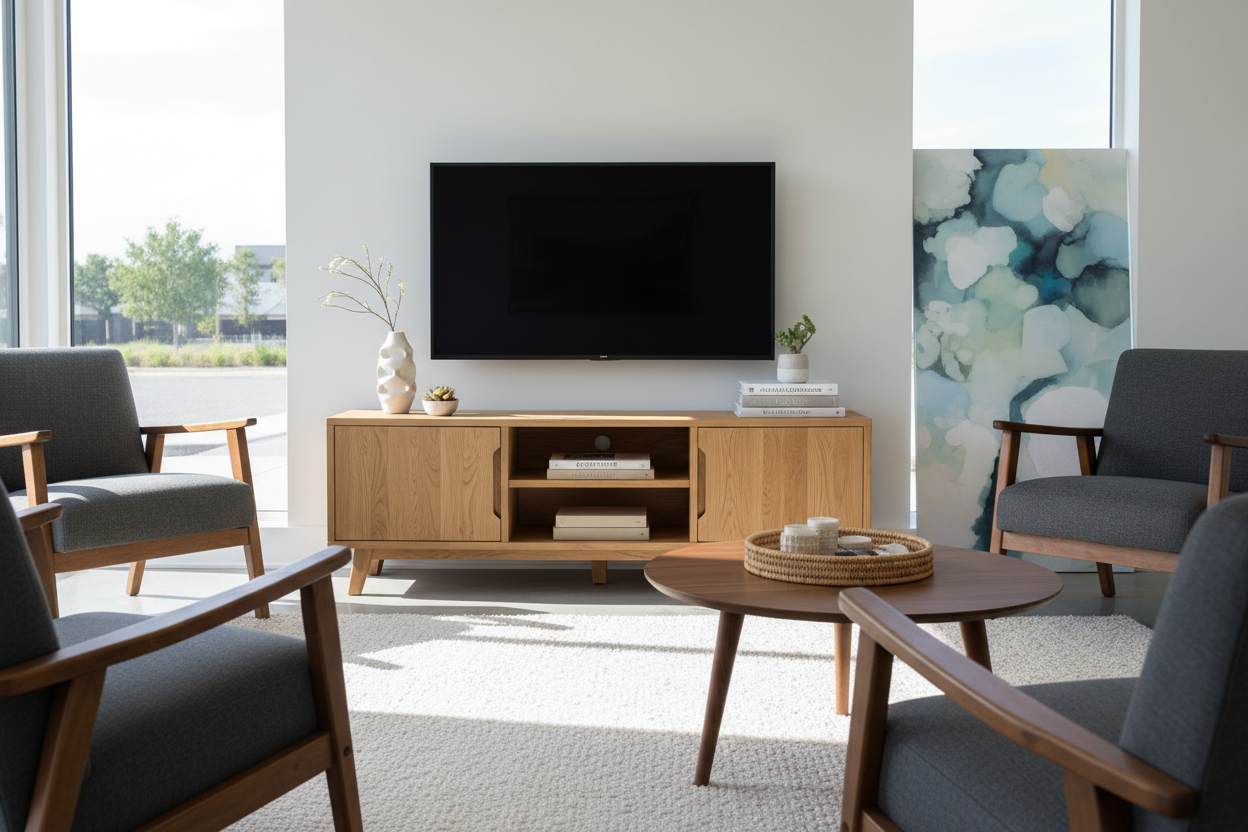
I have spent far too many nights staring at forty-seven open browser tabs, trying to figure out if a $300 console is actually a steal or just a glorified cardboard box. We have all been there: the photos look like a high-end showroom, but the price tag screams 'this will sag in six months.' Finding a quality wood tv stand amazon sells is a legitimate skill, mostly because the algorithm wants you to buy the cheapest, easiest-to-ship particleboard on the planet.
- Check the shipping weight—real wood is heavy; MDF is surprisingly light.
- Zoom in on the edges; if it’s a sticker, the corners look like they are peeling.
- Search for specific species like 'Solid Acacia' or 'Mango' rather than just 'Wood.'
- Swap the included hardware for heavy brass to instantly look like you spent $500 more.
The 'Solid Wood' Search Trap Every Buyer Falls Into
The Amazon marketplace is essentially the Wild West of furniture marketing. When a seller uses the word 'wood,' they are often technically referring to 'wood products'—which is a polite way of saying sawdust mixed with glue and topped with a photo of a tree. I have seen listings titled 'Solid Wood TV Stand' that, upon a deep dive into the 1-star reviews, turn out to be hollow-core MDF with a plastic veneer.
Sellers rely on the fact that most people won't return a 70-pound box once it is half-assembled on their living room floor. They use phrases like 'natural finish' or 'wood-look' to dance around the truth. If the price seems too good to be true for a 70-inch console, it is. Real timber costs money to harvest, dry, and ship. If you are looking at a massive unit for $140, you are buying compressed paper. Trust the weight listed in the 'Product Information' section more than you trust the title.
My 3-Second Rule for Spotting Fake Wood in Photos
You can usually spot the fakes before you even scroll to the reviews. Look for repeating grain patterns. On a cheap veneer, you will see the exact same knot or swirl repeat every twelve inches. Nature doesn't copy-paste. Also, look at the corners. Real wood has end-grain or mitered joints that show the thickness of the board. Fake wood has edges that look like a sticker folded over a sharp corner.
Finishes are another dead giveaway. A cheap, flat-painted surface is usually hiding MDF because it is perfectly smooth and takes paint easily. However, a high-quality painted black wood TV stand will still show the subtle, organic texture of the grain beneath the pigment. If the surface looks as smooth as a smartphone screen, it is plastic. Real wood has pores, tiny imperfections, and a depth that contact paper just cannot replicate.
The Search Terms You Actually Need to Be Using
Stop typing 'wood tv stand' into the search bar. You are just inviting the algorithm to dump 5,000 identical particleboard units into your feed. Instead, search for specific species that are known for being used in solid furniture construction. 'Solid Acacia TV stand,' 'Solid Mango Wood,' or 'Rubberwood' are your best bets. These materials are sturdy, sustainable, and much harder to fake with a sticker.
When you see the price jump from $150 to $450, you have to ask yourself if a solid wood TV stand worth it for your home. In my experience, yes. A solid piece can be sanded, refinished, and moved five times without the cam-locks ripping out of the side panels. These specific search terms act as a natural filter, weeding out the brands that specialize in 'disposable' furniture meant for dorm rooms rather than real homes.
When to Abandon the Marketplace Roulette
Sometimes, the endless scrolling just isn't worth the headache. If you have spent three hours reading reviews about missing hardware and cracked 'wood' panels, it is time to step away from the marketplace roulette. Amazon is great for many things, but their search engine is designed to show you what sells fastest, not what is built best. You can easily fall into a cycle of 'sponsored' listings that are all the same low-quality factory model rebranded under different nonsensical names.
When the fatigue sets in, I usually stop looking for the 'cheapest' option and start looking for brands with a track record. If you want to skip the guesswork entirely, browsing a selection of curated TV stands from a dedicated furniture source is often the better move. You get a guarantee on materials, and you don't have to worry about whether 'Walnut' refers to the tree or just the color of the paint used on the MDF.
If You Do Buy One, Please Do This Immediately
If you find a diamond in the rough and pull the trigger, there is one trick to make it look twice as expensive: throw the hardware in the trash. Most budget Amazon finds come with lightweight, hollow plastic or zinc pulls that feel terrible to the touch. Go to a hardware store and buy solid brass, heavy steel, or matte black iron knobs. The tactile experience of opening a cabinet with a heavy handle tricks the brain into thinking the entire piece is high-end. It is the cheapest 'renovation' you will ever do.
How can I tell if a listing is actually solid wood?
Check the 'Material' section in the product details, but then verify it by looking at the item weight. A 60-inch solid wood stand should weigh at least 60-80 pounds. If it is 40 pounds, it is hollow or particleboard.
Is 'Engineered Wood' the same as real wood?
No. Engineered wood is a marketing term for MDF, particleboard, or plywood. While high-quality plywood is great, most 'engineered wood' on Amazon is the cheap stuff that swells and ruins if you spill a glass of water on it.
Why is acacia wood so common on Amazon?
Acacia is a fast-growing hardwood that is relatively affordable to produce. It is incredibly dense and durable, making it the 'gold standard' for finding actual timber at a reasonable price point on the site.

Leave a comment
This site is protected by hCaptcha and the hCaptcha Privacy Policy and Terms of Service apply.