










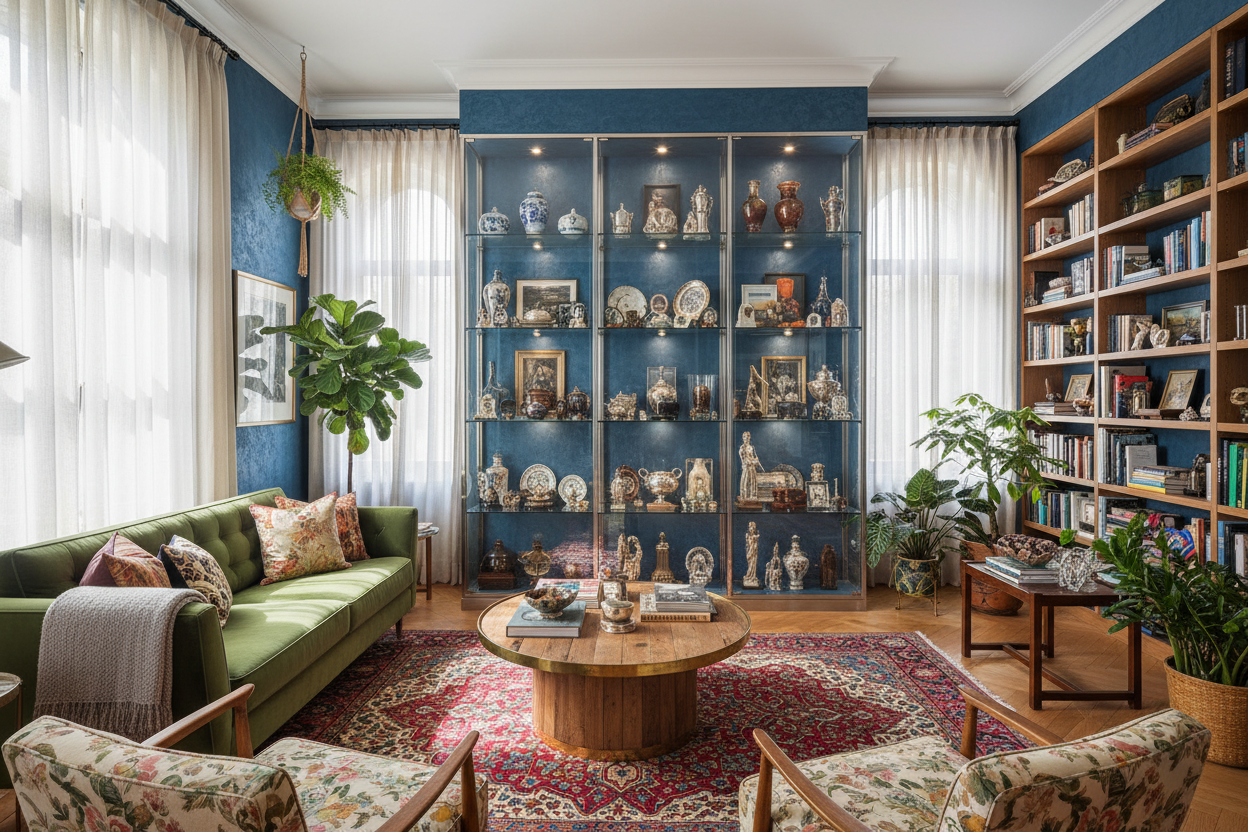
We have all been there: you finally find that vintage display case at a flea market or order a sleek modern one online, and then it arrives. You realize it is roughly the size of a small refrigerator and about twice as heavy. In the showroom, it looked airy and sophisticated; in your living room, it looks like a massive glass coffin for your Lego sets or ceramic collection.
Quick Takeaways
- Avoid 'The Wall of Doom'—never shove a massive cabinet into the darkest corner of the room.
- Use glass as a room divider to maintain sightlines in open-concept spaces.
- Position cabinets perpendicular to windows to kill glare and highlight the items inside.
- Match the frame color to your trim or wall color to make the piece 'disappear.'
- Built-in lighting is non-negotiable for large units.
The 'Antique Mall' Trap: Why Large Cabinets Usually Look Terrible
The most common mistake I see is the 'Antique Mall' trap. This happens when you take a big glass display case and shove it flat against the back wall of a room, usually between two other pieces of heavy furniture. Because glass reflects light, putting it in a dark or crowded spot makes it look like a murky void. Instead of seeing your collection, you just see a dark, heavy silhouette that eats up the room's visual square footage.
Visual weight is a real thing. A solid wood wardrobe feels heavy, but a glass display case should feel light. When you cram it into a corner, you lose that transparency. It stops being a window into your collection and starts being a roadblock. To avoid this, you need to give the piece breathing room—at least 6 to 12 inches from adjacent furniture—so the eye can actually travel 'through' the glass.
Float It: Using Glass Cases for Display as Room Dividers
If you have an open-concept living and dining area, stop trying to put all your furniture against the walls. A glass case is the ultimate room divider. Because it is transparent, it creates a 'zone' without the claustrophobia of a solid wall. I have used a glass case to separate a home office from a bedroom, and it worked wonders for making the room feel organized without losing the natural light from the single window.
When you float a cabinet away from the wall, the quality of the material matters more than ever. I spent a long time testing glass versus acrylic for this exact purpose. While acrylic is lighter, glass has a structural stability and a clarity that you need when a piece is sitting in the middle of a high-traffic area. Glass doesn't bow over time, which is crucial when you're displaying heavy books or sculpture in a unit that people can see from 360 degrees.
Don't Starve Your Glass Case of Natural Light
Light is the lifeblood of any glass display case. If you place your cabinet parallel to a window (directly across from it), you are going to spend all day looking at a reflection of your own window treatments rather than your collection. It is frustrating and makes the items inside look dull.
The pro move is to place the cabinet perpendicular to your primary light source. This allows the sun to wash across the shelves without creating a blinding glare on the front pane. If you have a big glass display case, this side-lighting creates depth and shadows that make your items look like they are in a high-end gallery rather than a storage unit.
When to Actually Rely on a Corner Layout
I usually hate corner furniture because it feels like an afterthought, but there are exceptions. If you have an L-shaped living room or an awkward alcove created by a chimney breast, a standard rectangular glass case will look clunky if you try to angle it. It leaves a weird, triangular 'dust zone' behind the cabinet that is impossible to clean.
In these specific architectural scenarios, you should opt for a dedicated corner display case. These units are built with a 90-degree back, meaning they sit flush against both walls. It utilizes the 'dead' space of a corner while keeping the center of your room open. It is a spatial-planning hack that makes a small room feel significantly larger because you aren't cutting off the flow of the floorboards.
Match the Frame Color to Your Baseboards or Walls
If you are worried about a 72-inch tall cabinet overwhelming your room, use the 'camouflage' trick. If your walls are white and your trim is white, buy a tall white curio cabinet. By matching the frame of the glass case to the room's architecture, the frame visually recedes, leaving only the glass and your items visible.
This is especially effective in rooms with wainscoting or heavy crown molding. When the colors match, the cabinet starts to look like a custom built-in rather than a piece of freestanding furniture you just dragged in. It’s a cheap way to get a high-end, architectural look without hiring a contractor.
Why Your Glass Display Case Needs Its Own Lighting
The sun goes down eventually, and when it does, your glass display case can quickly turn into a dark, looming shadow. Ambient room lighting is rarely enough to penetrate through multiple glass shelves. You end up with a bright top shelf and a bottom shelf that looks like it belongs in a basement.
I learned this the hard way after trying to install battery-operated puck lights in a vintage cabinet. The wires were a nightmare, and the batteries died every three days. If you are buying new, save yourself the headache and get a display case with LED lighting already integrated. Integrated LEDs are usually hidden behind the frame, so you get a clean glow without seeing the bulbs. It turns the cabinet into a focal point at night, providing a nice bit of mood lighting for the whole room.
My Personal Experience: The Hallway Disaster
I once found a stunning, big glass display case at a warehouse sale. I was convinced it would look amazing in my narrow hallway to hold my collection of vintage glassware. I ignored the '30-inch rule' (the idea that you need 30 inches of clearance for a walkway). For three months, I bumped my shoulder on the corner of that cabinet every time I went to the bathroom at night. Not only was it a literal pain, but the piece looked crowded and desperate. I finally moved it to the living room, perpendicular to the balcony door, and it finally 'breathed.' Lesson learned: just because it fits the floor space doesn't mean it fits the room.
FAQ
How much space do I need around a display case?
Ideally, you want at least 30 inches of 'walk zone' around any freestanding piece. If it’s against a wall, try to keep at least 10 inches of clear wall space on either side so it doesn't look cramped.
Is a glass case safe for homes with kids or pets?
Only if it is tempered glass and anchored to the wall. Never skip the wall anchor—large glass cases for display are top-heavy, especially once you load up the top shelves.
How do I stop my glass case from looking cluttered?
Follow the 'Rule of Three.' Group items in sets of three with varying heights. Leave 'white space' (empty areas) on every shelf so the eye has a place to rest. If every inch is covered, it’s not a display; it’s just storage.


Leave a comment
This site is protected by hCaptcha and the hCaptcha Privacy Policy and Terms of Service apply.