










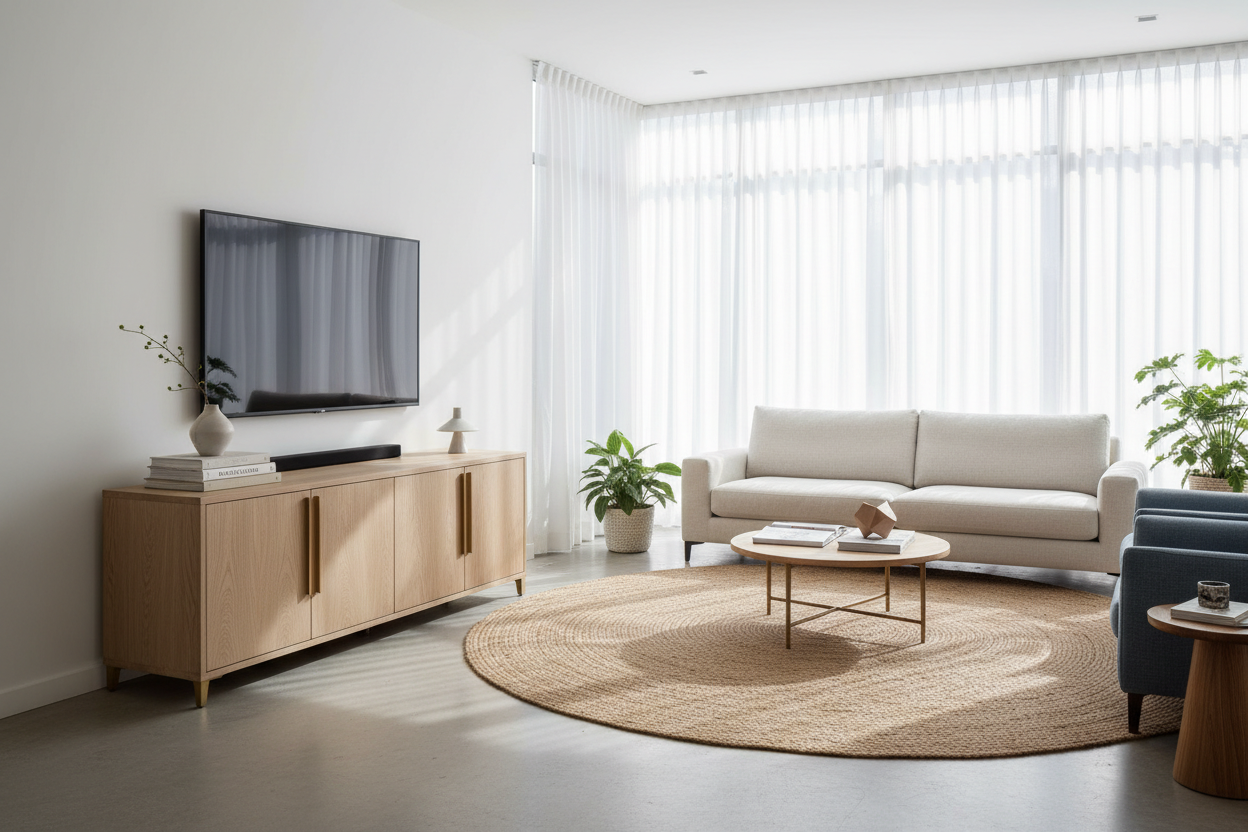
We have all seen it: a beautifully mounted flat screen that looks completely lost on a massive, empty wall. Underneath sits a tiny, inadequate cabinet overflowing with gaming consoles, tangled cords, and router boxes. It is a common design dilemma in modern North American homes, where open floor plans demand furniture with enough presence to anchor the room.
Enter the 4 door media console. More than just a place to rest a television, this piece offers the substantial visual weight needed to ground a large living space while hiding an incredible amount of everyday clutter. In this guide, we will break down exactly how to choose the right proportions, materials, and styles to make this substantial piece work in your home.
Quick Decision Guide
- Measure your wall, not just your TV: Your console should be at least 20 percent wider than your television to maintain proper visual balance.
- Check interior depths: Standard audio-visual receivers require at least 18 inches of internal depth, plus room for cable clearance.
- Consider the door style: Solid doors hide everything, while glass or slatted doors allow remote signals to pass through but require tidy interiors.
- Factor in weight limits: A fully loaded four-door cabinet can easily exceed 200 pounds; ensure your floor and the unit's legs can support the load.
Space Planning and Proportions
When you move up to a four-door design, you are dealing with a significant footprint. These units typically range from 70 to over 90 inches in length. Placing one requires deliberate space planning so it does not swallow your room whole.
Nailing the Scale
A common mistake I see is buying a massive console for a standard 8-foot ceiling room without considering the height. If your room has lower ceilings, opt for a low-profile 4 door tv stand that sits no higher than 24 inches off the ground. This preserves the negative space above the television, making the room feel taller. For vaulted ceilings or great rooms, you can comfortably move up to a 30-inch or 32-inch height to fill the vertical volume.
Clearance and Walkways
Do not forget about the doors. Depending on the design, swinging doors require at least 18 to 24 inches of clearance to open fully. If your console sits across from a coffee table or a large sectional, ensure you leave a minimum of 36 inches of walkway space. If space is tight, look for sliding doors rather than traditional hinges.
Material Quality and Construction
Because these consoles span a significant width, structural integrity is paramount. A cheap unit will eventually bow in the middle under the weight of a heavy television or an extensive record collection.
Solid Wood vs. High-Quality Veneer
While solid wood is the gold standard for durability, high-quality wood veneer over an MDF core is actually incredibly stable for long media cabinets. MDF resists warping and expansion during humid North American summers much better than solid wood slabs. Just ensure the veneer is thick and the edges are well-banded to prevent peeling.
Cable Management Realities
A beautiful silhouette means nothing if you have to drill your own holes for cords. Look for consoles with pre-cut cable management ports in every single bay, not just the center. Modern setups require routing cables from gaming systems in the left bay to power strips in the right bay.
Designer's Honest Take
A few years ago, I specified a stunning, slatted walnut console for a client's mid-century modern living room. Visually, it was a knockout. The slatted doors allowed the soundbar and remote signals to pass through seamlessly, which felt like a massive win.
However, I learned a hard lesson about maintenance. Those beautiful wooden slats turned into absolute dust traps. Within three months, the client was frustrated by the weekly chore of using a specialized duster to clean between forty individual grooves. Furthermore, because the doors were not solid, the internal glowing lights from the router and cable box bled through the slats at night, creating an annoying distraction during movie nights. It taught me to always weigh the aesthetic appeal of a piece against the daily reality of living with it. Now, I mostly recommend solid doors unless the client is explicitly hiding large speakers.
Frequently Asked Questions
How wide should my console be compared to my TV?
Your console should be noticeably wider than your television. A good rule of thumb is to add at least 6 to 8 inches of surface space on each side of the screen. This creates a stable visual foundation and prevents the setup from looking top-heavy.
Can a large console work in a small apartment?
Yes, but you need to manage the visual weight. Choose a wall-mounted floating console or one with tall, slender metal legs. Exposing the floor underneath the cabinet tricks the eye into perceiving more square footage in the room.
How do I organize the interior of a large media stand?
Use the outer bays for items you access less frequently, like seasonal decor or board games. Keep your daily tech, like streaming boxes and gaming consoles, in the center bays. Always use velcro cable ties to bundle cords together before pushing the unit against the wall.

Leave a comment
This site is protected by hCaptcha and the hCaptcha Privacy Policy and Terms of Service apply.