










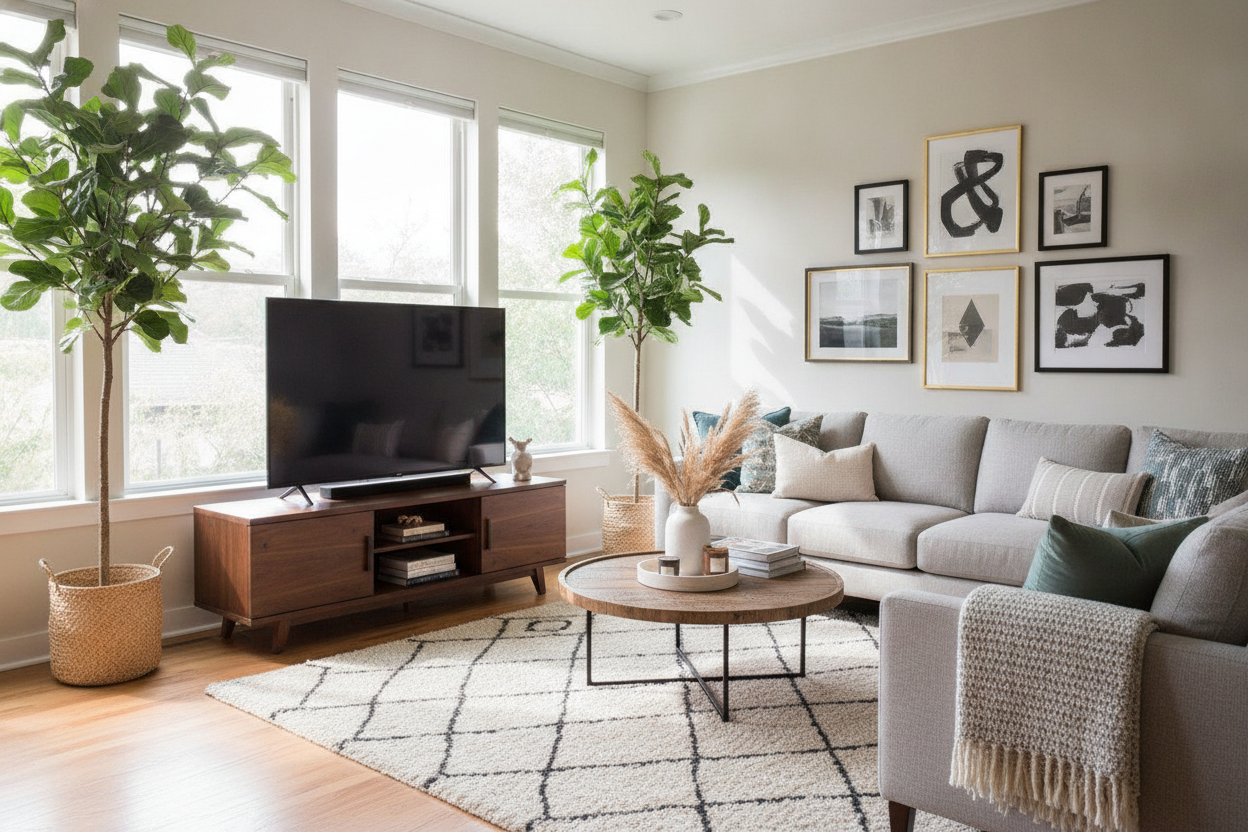
I spent three hours last Tuesday trying to align a drawer slide on a 'scandi-chic' console I bought from a trendy Instagram brand. By the time I finished, the veneer was already peeling, and the whole thing swayed if I breathed too hard near it. I’m officially done. I retired my hex keys and drove to the nearest big-box showroom to buy a furniture mart tv stand.
I’ve spent years thumbing my nose at those massive furniture warehouses, convinced that true design only lived in boutique shops or overpriced direct-to-consumer startups. I was wrong. After watching my third flat-pack unit bow under the weight of a 65-inch OLED, I realized that weight and mass actually matter more than a minimalist aesthetic that can't hold its own lunch.
- Pre-assembled units are structurally superior to anything held together by cam-locks.
- Showroom models allow you to test drawer glides and hinge tension in person.
- The delivery fee is a bargain compared to the cost of your own labor and frustration.
- Basic consoles are the ultimate blank canvas for high-end hardware swaps.
The Flat-Pack Fatigue That Finally Broke Me
There is a specific kind of rage that only comes from realizing Part H is missing when you’re on step 34 of an assembly manual. For years, I convinced myself that the trade-off was worth it. I wanted the sleek lines and the 'free shipping,' but I ignored the reality that I was paying $400 for what was essentially reinforced cardboard and some very optimistic screws.
The fatigue hit me when I noticed the sagging. Most of those internet-famous stands use a honeycomb-core particle board that has a weight limit of about 50 pounds. Put a modern TV and a soundbar on there, and within six months, you have a visible smile in the center of your console. It looks cheap because it is cheap. I wanted something that wouldn't flinch if I sat on it.
Walking into a furniture mart feels like a defeat to a design snob, but once you touch a piece made of actual kiln-dried pine or heavy-duty MDF with a real wood veneer, the 'aesthetic' of the flat-pack stuff starts to feel like a scam. I don't want to build my furniture; I want to buy it and then never think about its structural integrity again.
Surviving the Showroom: How to Pick a Winner
Walking into a 40,000-square-foot warehouse can be a sensory nightmare. It’s a sea of beige carpets and enough brown wood to build a forest. To find the diamond in the rough, you have to ignore the lifestyle staging. Those fake plastic plants and weirdly small staged TVs are designed to distract you from the actual build quality.
You need to look for the specs what furniture stores won't tell you, like whether the back panel is a flimsy piece of taped-on cardboard or a solid, screwed-in sheet. If the back is solid, the whole unit will resist racking—that side-to-side leaning that eventually kills cheap furniture. Check the corners. If you see visible glue or gaps where the miter joints meet, keep walking.
I also look for cable management that actually makes sense. A lot of the 'designer' pieces have one tiny hole in the center. A proper showroom unit usually has multiple cutouts and even some hidden channels. If you have a gaming console, a cable box, and a receiver, you need more than one 2-inch hole to keep things from looking like a bird's nest.
Rule 1: Ignore the Matching Sets
The salesperson will try to sell you the matching coffee table, the end tables, and maybe a matching bookshelf. Don't do it. This is the fastest way to make your house look like a hotel lobby. The goal is to find a sturdy base piece—the TV stand—and then mix it with other textures.
I bought a dark oak stand but paired it with a vintage marble coffee table I found on Craigslist. The contrast makes the showroom piece look like an intentional design choice rather than a 'Package Deal A' purchase. You want your room to feel curated over time, not like you bought a 'living room in a box' and called it a day.
Rule 2: The 'Shake Test' is Mandatory
When you are shopping for solid tv stands, you have to be a bit aggressive. I grab the top corner of the floor model and give it a firm shove. If it wobbles, it’s out. If it creaks, it’s out. A quality unit should feel like a single, solid block of material.
Open every drawer. Do they pull out smoothly on ball-bearing glides, or are they just wood-on-wood sliding? Check the hinges on the doors. You want European-style hidden hinges that are adjustable. If a door is slightly crooked on the showroom floor, it’s a sign that the hardware is cheap and won't hold its position after a few months of use.
How I Styled My Furniture Mart Find to Look Custom
The biggest complaint about mart furniture is that it looks 'basic.' That's actually its greatest strength. My new stand was a simple, clean-lined box in a neutral walnut finish. The first thing I did was toss the generic, brushed-nickel handles into the trash. I replaced them with heavy, unlacquered brass pulls that I found at a local architectural salvage yard.
That $40 hardware swap changed the entire look. Suddenly, the piece felt like something from a high-end boutique. I also focused on the 'top-down' styling. Instead of centering the TV, I pushed it slightly to one side to make room for a tall, sculptural lamp and a stack of oversized art books. This breaks up the horizontal line of the screen and makes the console feel like a piece of furniture rather than just a tech pedestal.
If you want to style retro furniture pieces alongside a new mart find, use lighting to bridge the gap. I placed a vintage 1970s mushroom lamp on one end. The warm glow hides the fact that the wood grain on the stand is a modern veneer and highlights the texture of the vintage lamp instead. It’s all about misdirection and layering.
The Verdict: Is the Delivery Fee Actually Worth It?
I paid $99 for delivery. In the past, I would have spent that money on a nice dinner and tried to cram the box into the back of my SUV myself. Never again. Two guys showed up, carried a 160-pound, fully assembled unit up my stairs, and placed it exactly where I wanted it. They even took the massive cardboard box with them when they left.
When you factor in the four hours of assembly time I saved—and the lack of a 'flat-pack headache'—that $99 was the best money I spent all year. The stand is level, the doors don't sag, and my TV doesn't shake when someone walks past it. I’ve realized that being a 'design snob' isn't about where you shop; it's about knowing when to prioritize actual construction over a trendy brand name.
FAQ
Is mart furniture actually solid wood?
Sometimes, but usually it is a mix. Look for 'solid wood frames' with 'wood veneer panels.' This is actually better for TV stands than 100% solid wood because it won't warp or crack near the heat generated by your electronics.
How do I know if a stand can hold my TV?
Check the weight rating, not just the screen size. A 75-inch TV might only weigh 60 pounds, but the stand needs to handle the 'point load' of the legs without the top surface bowing over time. If the top is at least 1-inch thick, you're usually safe.
Can I change the legs on a showroom stand?
Usually, yes. Most use standard M8 hanger bolts. Swapping chunky block legs for tapered mid-century style legs is an easy way to make a heavy piece feel lighter and more modern.

Leave a comment
This site is protected by hCaptcha and the hCaptcha Privacy Policy and Terms of Service apply.