










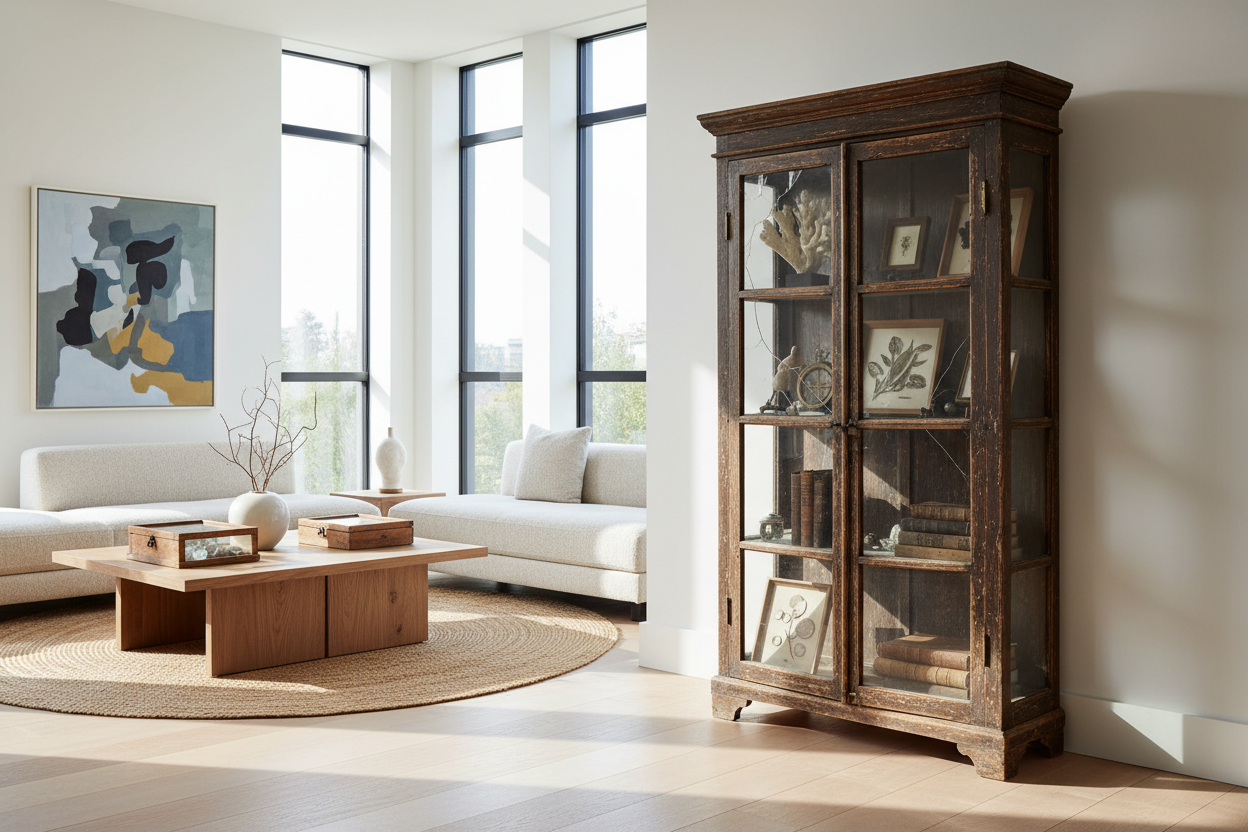
I once spent three hours in a freezing warehouse in upstate New York, haggling over a piece of furniture that looked like it had survived a Victorian-era riot. My partner thought I had lost my mind. I saw a display case antique that could hold my entire life together; he saw a 300-pound dust magnet that would never fit through the front door. We were both right, but the cabinet stayed.
The truth is, we have all been there—staring at a sterile, modern room that feels more like a dentist’s waiting room than a home. You need something with scars. If you want a room that feels like it has a story, you need the piece that actually lived one. A vintage shop display cabinet is the quickest way to kill the 'showroom' vibe and start living in a space that feels real.
Quick Takeaways
- Contrast is king: Mix old wood with modern ceramics and neon art.
- Check the glass: Original wavy glass is a treasure; cracked glass is a safety hazard.
- Smell matters: Sniff the drawers. If it smells like a damp basement, walk away.
- Negative space: Massive cabinets need room to breathe, or they swallow the room.
The 'Creepy Apothecary' Trap (And How to Avoid It)
We’ve all seen it. You walk into someone’s house and they’ve got a stunning antique store display case, but inside? It is packed with taxidermy, old doll heads, and dusty medicine bottles. Suddenly, you aren’t in a cool modern apartment; you are in a low-budget horror movie. This is the 'Creepy Apothecary' trap, and it happens when people think they have to match the contents to the era of the cabinet.
When you use old shop display cabinets, the goal is to highlight the contrast between the weathered wood and the life you live now. If you stuff a vintage wood glass display case with things that are equally old and brown, the whole thing becomes a visual black hole. It absorbs light and makes the room feel heavy. I’ve seen beautiful vintage retail display cases ruined because the owner treated them like a museum exhibit rather than a functional piece of furniture.
Instead, think of your antique general store display cabinet as a frame. You want the frame to be ornate and historic, but the 'painting' inside should be fresh. Use it to house your collection of bright, oversized art books, or that set of minimalist white dinnerware you bought last year. The juxtaposition of a centuries-old vintage store display cabinet and a sleek, modern object is what creates that high-end, designer look.
Sourcing a Vintage General Store Cabinet Without Getting Scammed
Finding a legitimate antique general store display case for sale is a thrill, but it is also a minefield. I’ve seen 'vintage shop display case' listings that were actually just cheap MDF reproductions with a distressed paint job. Real antique wooden display case construction involves joinery, not staples. Look for dovetail joints or mortise-and-tenon work. If you see Phillips-head screws holding the main frame together, it’s not an antique; it’s a weekend project from five years ago.
When you find an antique display case for sale at a flea market, the first thing you should do is check the glass. Original glass from the late 1800s or early 1900s has a distinct 'wave' to it. It’s not perfectly flat, and it often has tiny air bubbles trapped inside. This is what you want. However, if the glass is loose or rattling, you’re looking at a major repair job. Replacing glass in a vintage wood and glass display case can cost more than the cabinet itself because the channels are often custom-sized.
Don’t be afraid of a little damage, either. A vintage general store cabinet should have some wear on the base where boots kicked it for fifty years. But beware of 'active' damage. If you see tiny piles of sawdust near the legs, you might have wood-boring beetles. That is a hard pass. I once brought home a small vintage display case that turned out to be a Trojan horse for termites. Trust me, the 'character' isn't worth the pest control bill.
Rule #1: Contrast is Your Best Friend
If you have managed to snag an antique table top display case or a vintage countertop display case, don't put it on an old, rustic table. Put it on a sleek, powder-coated metal console or a floating marble shelf. The magic happens in the friction between materials. I personally use an antique countertop display cabinet in my kitchen to hold spices, but it sits on a stainless steel prep table. It looks intentional, not accidental.
The same goes for what you put inside a vintage glass showcase or a vintage trophy case. If the case is dark oak, fill it with light-colored objects. If it’s a vintage glass display with a metal frame, use it for organic textures like woven baskets or handmade pottery. I once styled a vintage counter display case with nothing but vibrant, neon-colored sneakers for a client. It sounded crazy, but the result was the most talked-about piece in their house.
Think of your antique display as a rotating gallery. Because these pieces usually have glass on three or four sides, they catch light beautifully. An antique glass display case shouldn't be a place where objects go to die. It should be a place where your favorite things get a stage. If you’re styling an antique small display case, keep the items inside limited to three or five pieces. Overcrowding is the enemy of style.
Rule #2: Give the Cabinet Breathing Room
One of the biggest mistakes people make with an antique general store display case is shoving it into a corner or flanking it with too much other furniture. These pieces were designed to be the focal point of a shop. They were meant to be walked around and admired. In a home, an antique mercantile cabinet needs 'white space' around it to look like a piece of art rather than a bulky storage unit.
If you have a massive antique shop display case that’s taking up too much visual real estate, try clearing out everything within three feet of it. If your room is just too small for a flat-wall unit, you might consider a corner display case to maximize your floor plan without losing that vintage charm. Spacing is everything. When a vintage wall display cabinet is crammed between a sofa and a bookshelf, it just looks like you’re running out of storage.
I also recommend keeping the top of the cabinet clear. People love to stack boxes on top of an antique mercantile display cases, but that just draws the eye upward to the ceiling and makes the room feel shorter. Let the silhouette of the vintage wood glass display case stand on its own. If it’s an antique wall display case, hang it a few inches higher than you think you should—it gives the piece a sense of importance.
When to Skip the Flea Market and Buy New
I love the hunt as much as anyone, but sometimes a vintage store display case just isn't practical. If you have kids or pets, 100-year-old glass is a genuine liability. It’s thin, it’s brittle, and it doesn't shatter into safe little pebbles like modern tempered glass. Furthermore, if you’re looking for a specific color or a very clean aesthetic, you might be better off with a modern piece that mimics the old shop display cabinets style but offers modern safety.
For instance, a white display case with glass doors gives you the same vertical storage and visibility as an antique, but it feels much lighter in a small room. You get adjustable shelves—which almost no antique general store cabinet has—and you don't have to worry about lead paint or mystery smells. There is also the huge benefit of dust control. Old cabinets are notoriously 'leaky,' whereas a modern unit is built to seal tight.
If you are tired of the maintenance that comes with open shelving, there is a strong case for a tall storage display cabinet that is brand new. You get the look of a vintage shop display cabinet without the splinters. I still prefer the 'soul' of a retro display case for my living room, but for a high-traffic area like a kitchen or a kid's room, I’d go with a modern reproduction every single time.
Personal Experience: The Peppermint Cabinet
Years ago, I bought an antique general store display cabinet for sale from a closing pharmacy. It was beautiful, but it had spent eighty years housing peppermint candies. For the first six months, my entire living room smelled like a candy cane factory. I tried vinegar, charcoal, and even coffee grounds to get the smell out. Eventually, I realized the scent was part of its history. Now, when I open that vintage shop display cabinet to grab a wine glass, I get a tiny hit of 1920s nostalgia. It’s a reminder that my furniture had a whole life before it met me.
FAQ
How do I clean the glass on an antique display case?
Avoid harsh chemicals. Use a mixture of one part white vinegar to four parts distilled water. Old glass can be porous, and modern blue window cleaners can actually leave a permanent tint or streak if the glass is degraded. Use a microfiber cloth, not paper towels, to avoid scratches.
Are antique general store cabinets safe for heavy items?
Usually, no. The shelves in an antique wood and glass display case are often held up by small wooden cleats or thin metal tabs. If you’re planning to store a massive collection of heavy cast-iron pots, you’ll need to reinforce the shelving or look for a vintage trophy case, which was built for weight.
Should I refinish a battered vintage wood display case?
If it’s a rare piece, refinishing it can actually tank the value. Most collectors want the 'patina'—which is a fancy word for the scratches and stains that prove it’s old. If the wood is extremely dry, just use a high-quality furniture wax to hydrate it without changing the color.


Leave a comment
This site is protected by hCaptcha and the hCaptcha Privacy Policy and Terms of Service apply.