










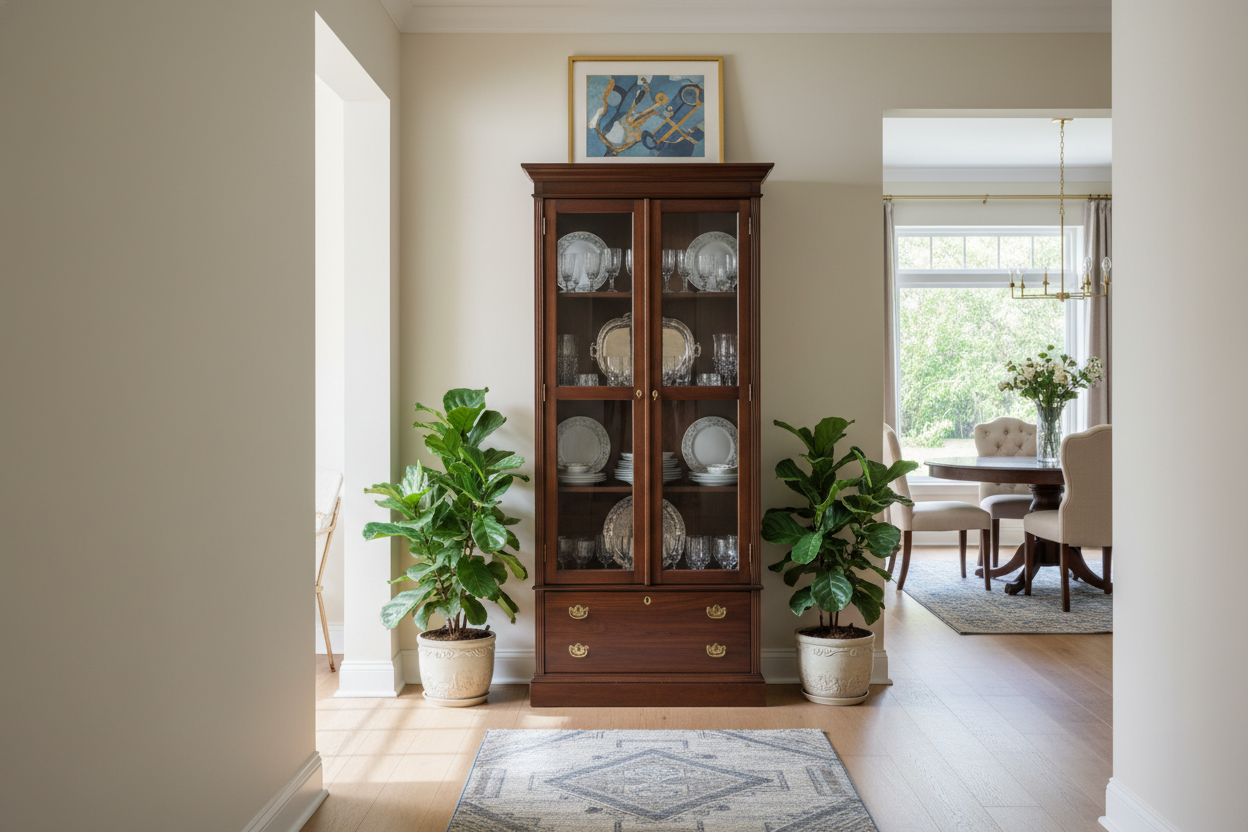
I once lived in a 1920s bungalow with a hallway so cramped I had to turn sideways just to carry a laundry basket through it. For months, I stared at a 24-inch dead zone between the bedroom door and the bathroom, wondering if I could squeeze some storage in there without it looking like a total accident. I finally gambled on a china cabinet narrow enough to fit that sliver of wall, and it changed the entire vibe of the house.
The fear is always the same: you think a tall, skinny piece of furniture will look like a stray skyscraper in a residential neighborhood. You worry people will bump their shoulders or that it will feel like the walls are closing in. But after testing dozens of these slim units in various floor plans, I’ve found that the opposite is usually true.
Quick Takeaways
- Verticality is your best friend; tall, slim pieces make low ceilings feel significantly higher.
- Stick to a width under 30 inches for 'true' narrow spaces to maintain a balanced look.
- Negative space inside the cabinet is just as important as the footprint on the floor.
- A solid base with drawers is almost always better than glass all the way to the floor for hiding 'ugly' essentials.
The Truth About Putting a Tall Skinny China Cabinet in a Walkway
Most people shy away from putting a tall skinny china cabinet in a hallway because they think it will feel claustrophobic. It’s a valid concern, but here is the trick: vertical lines actually trick the brain. When you walk into a tight space and see a piece of furniture that reaches toward the ceiling, your eye naturally follows that line upward. It makes the room feel taller, which counteracts the 'tight' feeling of the narrow walls.
I’ve found that a slim china cabinet acts more like a piece of architectural trim than a bulky wardrobe. If you choose a piece with a small footprint but significant height, it anchors the wall. It stops being a 'hallway' and starts being a 'gallery.' The key is ensuring the depth doesn't exceed 15 inches; anything deeper than that, and you actually start losing real estate for your elbows.
What Exactly Counts as a 'Narrow' Display Case?
In the furniture world, 'narrow' is a relative term that gets thrown around loosely. To me, a truly thin china cabinet is anything under 30 inches wide. Once you hit that 36-inch mark, you’re in standard territory, and the piece starts to demand its own dedicated wall. For those awkward gaps between windows or that weird 2-foot space next to the pantry, you want to aim for 18 to 24 inches.
When you’re shopping, look at the proportions of the frame. A skinny china cabinet can look spindly if the wood or metal frame is too thin. You want something with enough substance to look intentional. I always tell people to consider what designers actually look for beyond the glass doors—it’s about the ratio of glass to frame. A slightly thicker frame on a narrow piece gives it a 'built-in' feel that makes it look like it was always meant to be part of the house.
How to Style a Narrow Hutch With Glass Doors So It Isn't Chaotic
The biggest mistake I see? People treat a narrow hutch with glass doors like a junk drawer with a window. Because the footprint is small, every item inside is magnified. If you cram 20 mismatched coffee mugs in there, it’s going to look like a cluttered mess that makes the whole room feel smaller. You need to embrace negative space.
Follow the rule of threes: group three items of varying heights on one shelf, then leave the next shelf relatively sparse. I’m a big fan of using a white display case with glass doors in darker hallways. White reflects whatever light you have, and the glass keeps the visual weight low. It’s less about how much you can fit and more about how much light can pass through the piece.
Dark vs. Light Finishes in Tight Spaces
There is a lot of debate about color in small spaces. The safe bet is usually white or light oak to 'blend in' with the walls. But I’ve actually had better luck using a narrow china cabinet modern silhouette in a bold, dark finish to create a focal point. If your hallway is a boring sea of beige, a black cabinet with glass doors provides a sharp, sophisticated contrast that looks incredibly high-end.
Darker finishes ground the space. They say, 'I meant to put this here.' A light-colored cabinet can sometimes look like it’s trying to hide, which actually draws more attention to the fact that you’re trying to save space. If you go dark, just make sure you have some internal cabinet lighting or a nearby sconce so it doesn't turn into a black hole in the corner.
Do You Actually Need a Narrow China Cabinet With Drawers?
I’ve owned both: the all-glass 'curio' style and the narrow china hutch cabinet with bottom drawers. My advice? Get the drawers. Unless you are displaying a curated collection of museum-grade ceramics, you have stuff you need to hide. I use my bottom drawers for linen napkins, extra candles, and the 'good' silverware that I only pull out twice a year.
A narrow china cabinet with drawers also provides a visual 'base.' It makes the piece feel more stable and less top-heavy. From a practical standpoint, it’s also much easier to clean. Glass that goes all the way to the floor is a magnet for dog hair, dust, and vacuum cleaner scuffs. A solid wood or MDF base can take a hit; glass cannot.
Frequently Asked Questions
How deep should a hallway cabinet be?
Keep it between 12 and 15 inches. Anything more than 15 inches will likely impede your 'path of travel,' meaning you'll be bumping into it every time you walk by with a laundry basket or a grocery bag.
Will a tall cabinet tip over in a narrow space?
Yes, especially if it's narrow. Tall, skinny furniture has a high center of gravity. You must use the anti-tip wall anchors. Don't skip this—I’ve seen a cabinet go down because someone pulled a heavy drawer out too far.
Can I put a narrow china hutch in a bathroom?
Absolutely. They are great for rolled towels and fancy apothecary jars. Just make sure the room is well-ventilated so the moisture doesn't warp the wood or fog up the glass permanently.

Leave a comment
This site is protected by hCaptcha and the hCaptcha Privacy Policy and Terms of Service apply.