










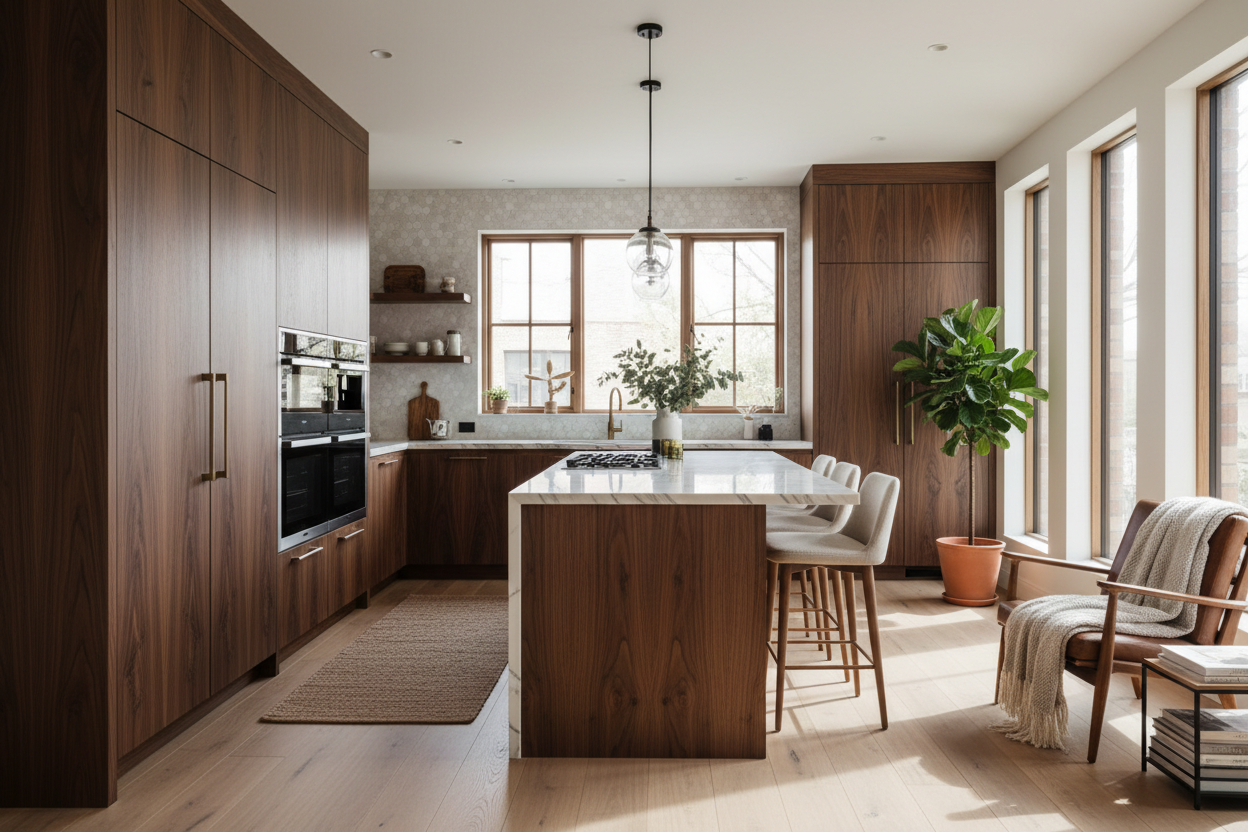
I remember the exact moment I gave up on big-box cabinetry. I was leaning against a 'high-end' kitchen island at a friend's house-warming party, and I heard a distinct, sickening crunch. It wasn't the floor; it was the side panel. Turns out, that 'luxury' finish was just a paper-thin veneer over what was essentially compressed sawdust. After years of assembling flat-pack furniture and watching hinges rip out of particleboard like a loose tooth, I made a vow: custom hardwood cabinets or nothing.
Quick Takeaways
- MDF and particleboard swell permanently when they hit water; solid wood can be sanded and refinished.
- Real custom work uses dovetail or mortise-and-tenon joinery instead of staples and hot glue.
- You can save thousands by using high-grade plywood for the 'hidden' boxes while keeping the faces solid timber.
- Custom cabinets actually fit your weird wall angles, whereas stock cabinets leave awkward gaps filled with 'filler strips.'
The Veneer Deception (What You're Usually Buying)
Most 'wood' kitchens you see in glossy brochures are actually just thin slices of timber glued to a core of MDF or furniture board. If you nick a corner while moving a chair, you aren't seeing more wood underneath—you're seeing gray, fuzzy pulp. A true custom wood cabinet is built from kiln-dried lumber that has structural integrity throughout. This isn't just about vanity; it's about physics.
When you load up a shelf with 40 pounds of stoneware, cheap materials start to 'creep' or sag over time. I’ve seen 3/4-inch particleboard shelves bow within six months. Solid wood storage cabinets handle that weight without breaking a sweat. Plus, when a hinge eventually loosens after ten thousand opens, you can actually tighten the screw into solid grain. In MDF? Once that hole is stripped, it's stripped for good.
Why a True Custom Wood Kitchen Just Feels Different
There is a specific acoustic 'thud' when a solid wood door closes that a hollow or composite door can't replicate. It feels grounded. When you opt for custom wood kitchen cabinets, you're also buying grain continuity. A skilled maker will 'bookmatch' the wood, meaning the grain pattern flows seamlessly across three or four different drawer fronts. It looks like a piece of art rather than a series of disconnected boxes.
I’m a huge advocate for species that tell a story. For instance, cherry wood cabinets are famous for their photosensitivity. They start out as a pale, warm tan and deepen into a rich, moody red-brown over the first year of exposure to sunlight. You don't get that soul from a factory-sprayed lacquer. Handmade wooden cabinets develop a patina that makes the kitchen feel like it has been there for a century, even if it was installed last Tuesday.
The Movement, The Moisture, and The Maintenance
I’ll be honest: solid timber is a bit of a diva. Unlike plastic-wrapped cabinets, a custom wood kitchen breathes. It expands in the humid summer and shrinks in the dry winter. If your carpenter doesn't understand 'wood movement,' your doors might stick in July. This is why custom cabinetry and woodworking is a specialized skill—you're working with a biological material, not a dead laminate.
You have to maintain your home's humidity between 35% and 55%. If you let the house bone-dry in the winter, you might see tiny 'unfinished' lines at the edges of your door panels where the wood has retracted. It’s not a defect; it’s proof that it’s real. To me, that’s a small price to pay for a kitchen that doesn't off-gas formaldehyde like the cheap stuff does.
Where to Splurge (And Where to Save)
You don't need to be a billionaire to afford custom wooden kitchen cabinets, but you do need to be smart. I never pay for solid hardwood on the interior boxes—that’s overkill. Use 3/4-inch maple-faced plywood for the carcasses. It’s actually more dimensionally stable than solid planks for the 'box' part of the cabinet. Save your budget for the 'show' parts: the face frames, the doors, and the end panels.
If you're looking for one big 'wow' moment, put your money into a wood kitchen island with marble countertop. It’s the workhorse of the room. A solid walnut or oak island base can take the kicks of barstools and the scuffs of vacuum cleaners for twenty years and look better for the wear. A painted MDF island will look beat-up within three.
How to Find a Maker Who Actually Builds From Scratch
Don't be fooled by showrooms that claim to sell custom wood cabinets but really just order parts from a massive factory in the Midwest. Ask them: 'Do you build your own drawer boxes?' and 'Can I see your shop?' If there isn't a pile of sawdust and a table saw somewhere in the vicinity, they aren't a maker—they're a middleman.
A real craftsman will talk your ear off about 'janka hardness ratings' and 'rift-sawn vs. plain-sawn' lumber. That’s the person you want. They’ll build you a kitchen that fits your 87.5-inch wall perfectly, without those hideous 2-inch filler strips that big-box stores use to hide their 'standard' sizing limitations.
Frequently Asked Questions
Is solid wood better than plywood for cabinets?
For the doors and frames, yes. For the interior boxes, high-grade plywood is actually better because it doesn't warp as easily and holds up better to the occasional plumbing leak under the sink.
How much more expensive are custom cabinets?
Expect to pay 40% to 100% more than 'off-the-shelf' options. However, since you won't be replacing them in 10 years when the laminate starts peeling, the 'cost per year' is significantly lower.
Do custom cabinets add home value?
Absolutely. Appraisers and savvy buyers look for 'custom' vs. 'builder-grade.' It’s one of the few renovations where you actually see a return on investment because the quality is visible the second you open a drawer.


Leave a comment
This site is protected by hCaptcha and the hCaptcha Privacy Policy and Terms of Service apply.