










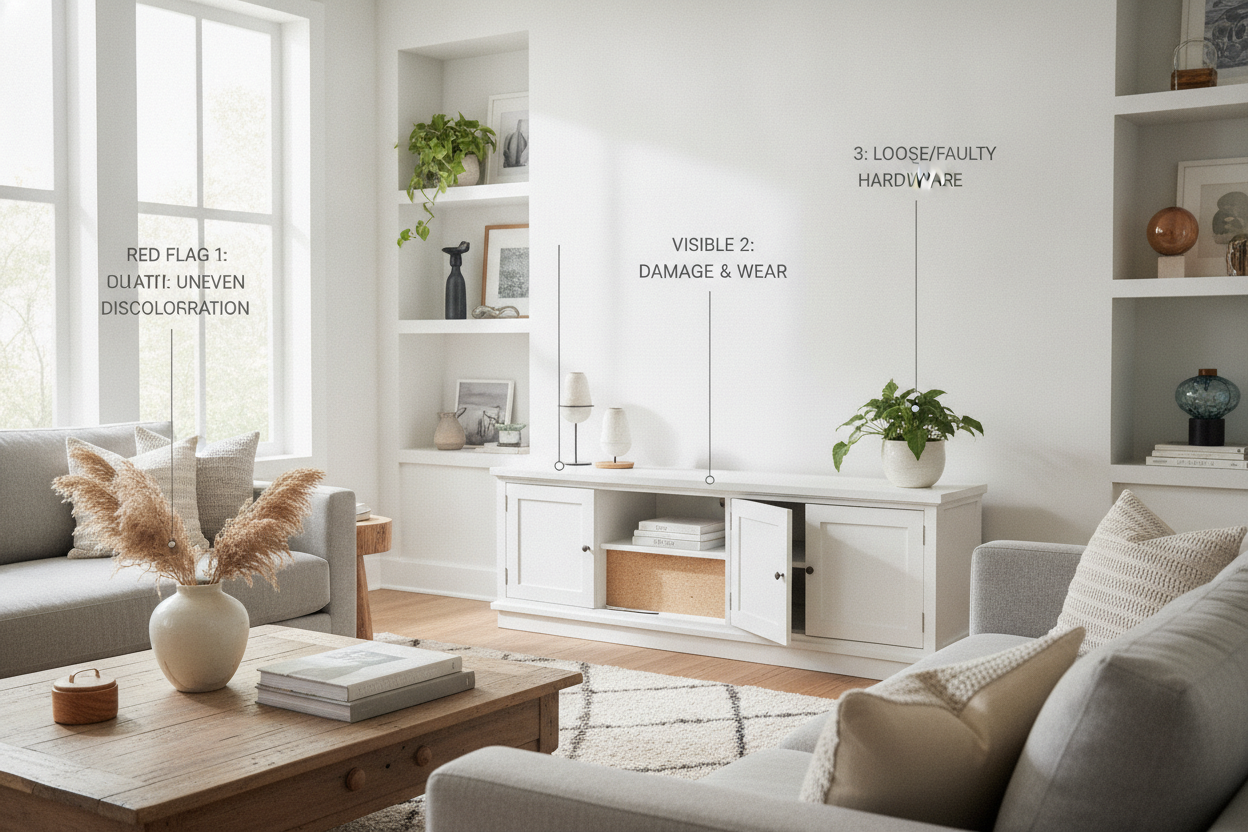
I've spent too many Saturdays in dusty garages staring at furniture that looked 'slightly off.' Usually, it's a white tv stand used that someone is trying to offload before a move. You see the thumbnail on your phone, the price is right, and you think you've scored. Then you get it into your living room, and reality hits like a bucket of cold water.
Quick Takeaways
- If the white looks 'warm' in a garage, it will look yellow in your house.
- Run your fingers along the bottom edges to find hidden water damage.
- Check the center for a structural dip; white paint makes shadows from sagging look 10x worse.
- Factor in the $60+ cost of primer and specialized cabinet paint before 'saving' money on a used unit.
Why Secondhand White Furniture Scares Me
I once drove 40 minutes for what looked like a pristine, high-gloss lacquer console. In the seller's dimly lit garage, it looked fine. I handed over my $50, hauled it up three flights of stairs, and set it under my living room lights. It was a disaster. The 'white' was actually three different shades of dingy cream, and the top was covered in micro-scratches that only appeared when the light hit them at a certain angle. This is exactly why your modern white tv stand looks cheap when it isn't maintained.
White furniture is the ultimate snitch. It tells you exactly how the previous owner lived. Did they smoke? The finish will be tacky and yellow. Did they overwater their plants? The edges will be swollen. Unlike a dark wood piece that can hide a decade of abuse under a bit of polish, white furniture demands perfection. If it isn't crisp, it looks like trash. I ended up spending more on sandpaper and spray paint than I did on the actual stand, and even then, the finish never felt 'factory fresh' again.
Red Flag 1: The Dreaded 'Sunburst' Yellowing
The biggest enemy of a used white console isn't dirt—it's the sun. Most affordable white furniture is finished with a thin layer of laminate or a cheap lacquer that has zero UV resistance. Over five years, that crisp snow-white turns into a sickly, uneven yellow. But here is the real kicker: the 'sunburst' effect. If the previous owner had a 50-inch TV sitting in the middle of that stand for years, the area under the TV stayed white while the rest of the top yellowed.
You won't notice it until you move the TV and see a bright white rectangle surrounded by aged cream. You can't just scrub that off. It’s a chemical change in the finish. While I often advocate for why a white tv stand might be perfect for brightening a dark room, that only applies if the white is actually white. If you see even a hint of 'warmth' in the seller's photos, skip it. It’s not the lighting; it’s the plastic degrading.
Red Flag 2: Water Damage Disguised as 'Distressing'
Sellers love to use the word 'shabby chic' or 'farmhouse charm' to describe what is actually structural failure. When you are looking at a white tv stand used, look closely at the very bottom where the legs meet the base. Most of these units are made of MDF (medium-density fiberboard). MDF is basically a sponge made of sawdust and glue. If the previous owner mopped with too much water or had a leaky plant pot, the MDF will swell.
On a white stand, this manifests as 'bubbling' under the paint or veneer. Once that fiberboard expands, it stays expanded. You can't sand it down because you'll just hit raw sawdust. If you see the edges of the stand looking slightly 'fluffy' or if the paint is flaking off in chunks at the base, it’s a hard pass. That isn't character; it's a ticking time bomb of mold and structural instability. I’ve seen people try to paint over this, but the texture always gives it away. It looks like a bad DIY job every single time.
Red Flag 3: The Unfixable Middle Sag
TVs have gotten lighter over the years, but people still love to pile heavy soundbars, gaming consoles, and oversized decor on their media units. Because white is so reflective, it highlights shadows in a way that black or walnut finishes don't. If a stand has even a 1/4-inch bow in the center, you will see a massive, crescent-shaped shadow right under your TV. It makes the whole room look slanted.
When you are inspecting the piece, get down on your hands and knees and look across the top surface at eye level. If it isn't a perfectly straight line, walk away. Structural sag in particle board is permanent. You can't 'un-bend' it by putting less weight on it. I’ve tried the 'reinforcement' route by adding a fifth leg in the middle, but by the time a unit is sagging, the joints are already stressed. It’s better to save your money for something that hasn't been crushed by a first-generation plasma TV.
When the DIY Fix Just Isn't Worth the Hassle
I get the appeal of a $20 Marketplace find. But let's do the math. To properly fix a scuffed, yellowed, or chipped white stand, you need a high-quality primer like Zinsser BIN ($25), a quart of decent cabinet paint ($30), and a set of foam rollers or a sprayer. You're already at $60 and a whole weekend of labor. And after all that, you still have an old piece of furniture with dated cable management and no modern features.
Sometimes, it makes more sense to just buy the features you actually want. For example, you can get a brand-new white tv stand with an electronic fireplace for less than the cost of a vintage solid-wood refinishing project. You get a clean finish, a warranty, and you don't have to spend your Saturday huffing paint fumes in the garage. If you're tired of the thrift store hunt, I suggest you browse through modern tv stands that actually fit today's tech. Your time is worth more than a 'deal' that requires a gallon of primer to look decent.
FAQ
Can I just spray paint a used white TV stand?
You can, but it usually looks terrible. Unless you use a shellac-based primer first, the old yellowing or stains will 'bleed' through the new white paint within weeks. It’s a lot more work than people realize.
How do I tell if it's real wood or laminate?
Look at the back edges or inside the cable holes. If you see a repetitive grain pattern or a 'sticker' edge peeling off, it's laminate or veneer. Real wood is rare for modern white furniture; it's usually painted MDF.
Is a little bit of yellowing okay?
Only if you plan to repaint the whole thing. If you put a 'slightly yellow' stand next to a 'true white' wall, the stand will look dirty, not 'vintage.'

Dejar un comentario
Este sitio está protegido por hCaptcha y se aplican la Política de privacidad de hCaptcha y los Términos del servicio.