










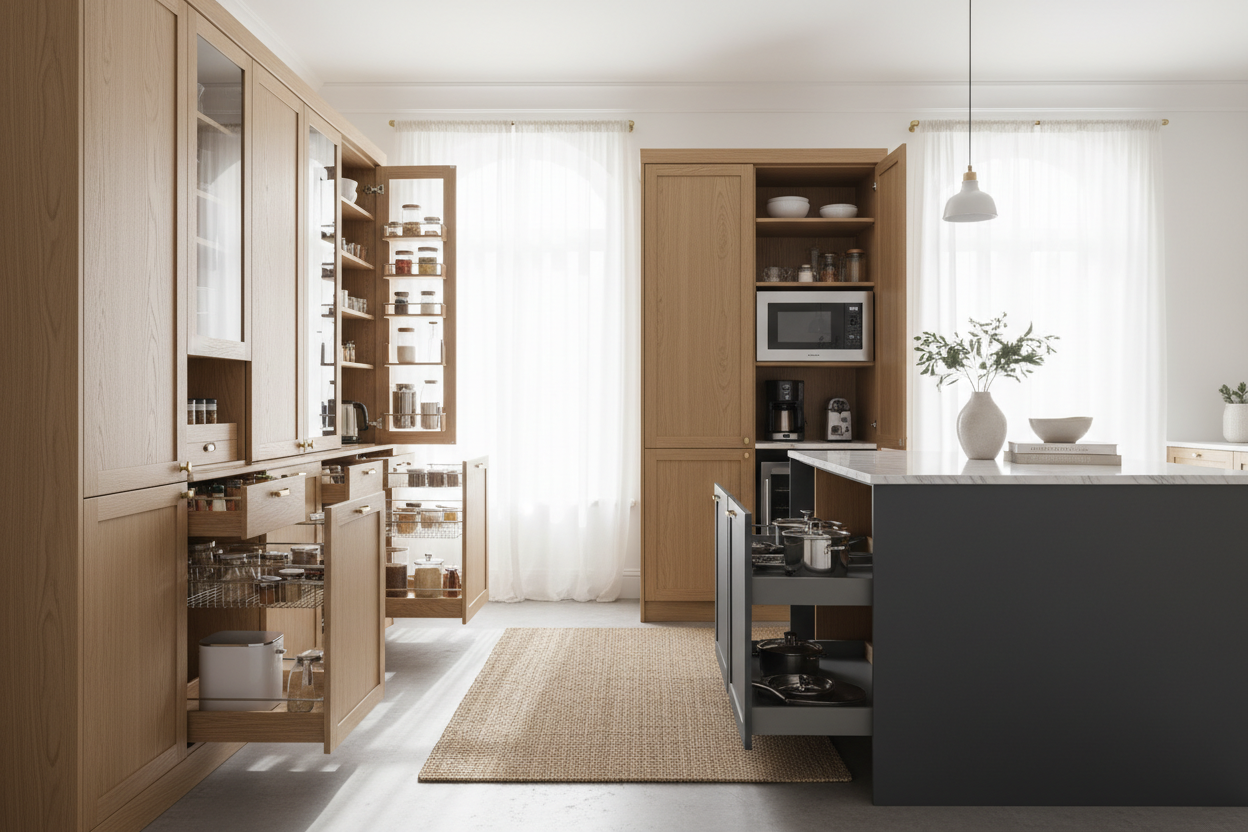
I spent twenty minutes yesterday on my hands and knees, head inside a cabinet, looking for a bag of almond flour I knew I bought in October. I found three half-empty boxes of crackers and a layer of dust, but no flour. This is the reality of the standard lower cabinet—a 24-inch deep dark hole where groceries go to be forgotten.
If you are currently staring at 47 browser tabs of kitchen layouts, let me save you the headache. Stop trying to make standard base units work for your dry goods. Investing in cabinets with pantry functionality isn't just about storage; it is about not having to do a tactical crawl every time you want to make pancakes.
Quick Takeaways
- Standard 24-inch lower units are too deep for small grocery items, leading to expired food.
- Vertical storage brings everything to eye level, which is better for your back and your budget.
- Shallow shelves (12-15 inches) actually provide better visibility than deep ones.
- Freestanding units are a legitimate fix for renters or low-budget refreshes.
The Lower Unit Graveyard (Where Groceries Go to Die)
Standard lower cabinets are 24 inches deep for a reason: they need to hold your sink and your stovetop. But using them for groceries is a recipe for disaster. Unless you have expensive pull-out drawers that cut into your vertical space, the back half of that cabinet is a graveyard. I've found cans of beans in my lowers that expired during the previous administration.
When you store cereal boxes, pasta jars, and flour bags in base units, you're constantly playing Tetris. You move the olive oil to find the honey, then knock over the salt. It's physically demanding, too. Kneeling on a hard floor to find a specific spice isn't my idea of a fun Tuesday night. If you’re a baker, the heavy lifting of 10-pound flour bags from floor level is a one-way ticket to a sore back.
We've been conditioned to think we need more counter space, so we pack everything below the waist. In reality, most of us would trade six inches of counter for a dedicated spot where we don't have to squat to find the peanut butter. Stop buying 24-inch deep holes for items that are only 3 inches wide.
Why Cabinets With Pantry Space Completely Fix the Flow
The magic of vertical storage is that it respects the way humans actually move. We see things best at eye level. By switching to dedicated pantry cabinets, you are effectively creating a grocery store aisle in your own home. You can scan your entire inventory in three seconds rather than rummaging through the dark.
I prefer pantry cabinets that are slightly shallower than standard lowers—around 15 to 18 inches. This prevents the 'hidden row' problem. When everything is one or two items deep, nothing gets lost. You stop overbuying because you can clearly see you already have four boxes of penne. It changes the rhythm of your cooking; you spend less time searching and more time actually seasoning.
Ergonomically, it's a win. Heavily used items like coffee, snacks, and daily grains sit between your waist and your shoulders. Heavy mixers or bulk flour can go on the bottom shelf, and the light stuff you rarely use goes on the top. It’s logical storage that doesn't require a yoga certification to access. If you have the wall space, verticality beats depth every single time.
Nailing the 'Pantry and Cupboard' Combo Without Looking Clunky
The biggest fear people have with tall pantry cabinets is that they'll look like a giant monolith in the middle of the kitchen. If you just stick a massive 84-inch box at the end of a row of standard units, it can feel like a warehouse. The trick is to wrap your pantry and cupboard units so they feel intentional and integrated.
I always suggest flanking a central feature—like your fridge or a small coffee station—with your tall units. This creates a 'built-in' look. If you have an open-concept layout, you can even blend kitchen storage with dining display by choosing units with glass upper doors. This softens the transition from utility kitchen to living space and keeps the room from feeling 'top-heavy.'
Don't be afraid to mix your finishes. A floor-to-ceiling pantry in a contrasting color, like a deep navy or charcoal, can act as an accent piece. Just make sure your hardware matches the rest of the kitchen so the eye sees one cohesive story. I've seen designers use 18mm thick plywood frames with shaker doors to give these units a high-end, custom feel without the custom price tag.
Stealing Awkward Corner Space for Mega Storage
Corners are where kitchen dreams go to die. Most people settle for a Lazy Susan that eventually breaks and drops a jar of pickles into the dark abyss. If you have an L-shaped kitchen, a corner kitchen pantry cabinet set is the smartest move you can make.
It utilizes that 'dead' corner by turning it into a walk-in-style storage zone. You get massive cubic footage without sacrificing the main run of your counters. I’ve installed these in tiny condos where we thought we had zero space, and they single-handedly saved the kitchen from clutter. It’s the highest ROI on square footage you’ll find in a kitchen layout.
Freestanding Pantry Kitchen Cupboards (The Remodel Alternative)
Not everyone can go ripping out their built-ins. If you're renting or just don't have the budget for a full renovation, freestanding pantry kitchen cupboards are your best friend. I've used these in three different apartments, and they are a lifesaver for anyone dealing with 'builder grade' kitchens that lack storage.
A large food pantry kitchen cupboard gives you that vertical storage without the permanent commitment. Look for units made of solid wood or high-density MDF—avoid the cheap particle board that bows the second you put a few cans of soup on it. A good freestanding unit should feel heavy. If you can move it with one finger, it’s not going to hold up to a year of heavy use.
The beauty of these is the flexibility. You can take them with you when you move. If you're currently hunting, I’d recommend finding the perfect kitchen pantry cabinet that fits your specific ceiling height. Don't go too short; you want to maximize that vertical space right up to the top. I’ve found that 72-inch units are usually the sweet spot for standard 8-foot ceilings.
Personal Experience: The Sugar Spill Incident
I once lived in a rental with only lower cabinets. I kept my baking supplies in a deep corner unit. One day, a bag of sugar ripped in the back. Because it was in the back corner of a lower cabinet, I didn't see it. I just thought the kitchen smelled 'sweet' for a few weeks. By the time I found it, I had an ant problem that required a professional. If that sugar had been at eye level in a pantry cabinet, I would have seen the spill immediately. Lowers are for heavy pots; tall cabinets are for food.
FAQ
Are pantry cabinets more expensive than standard lowers?
Per linear foot, they are actually quite efficient. While the unit price is higher, you're getting double or triple the usable storage compared to a base cabinet and a wall cabinet. You save money by needing fewer total units to store the same amount of stuff.
What is the best shelf depth for a pantry?
Stick to 12 to 16 inches for dry goods. Anything deeper and you start losing things in the back again. If you're storing appliances like stand mixers or air fryers, 24 inches is fine, but make sure the shelves are rated for the weight.
Can I put a pantry cabinet next to a stove?
You can, but check the heat clearances. Most modern cabinetry is fine, but a little bit of filler space (about 1-2 inches) or a heat shield protects the finish from long-term damage from oven heat venting.

Dejar un comentario
Este sitio está protegido por hCaptcha y se aplican la Política de privacidad de hCaptcha y los Términos del servicio.