










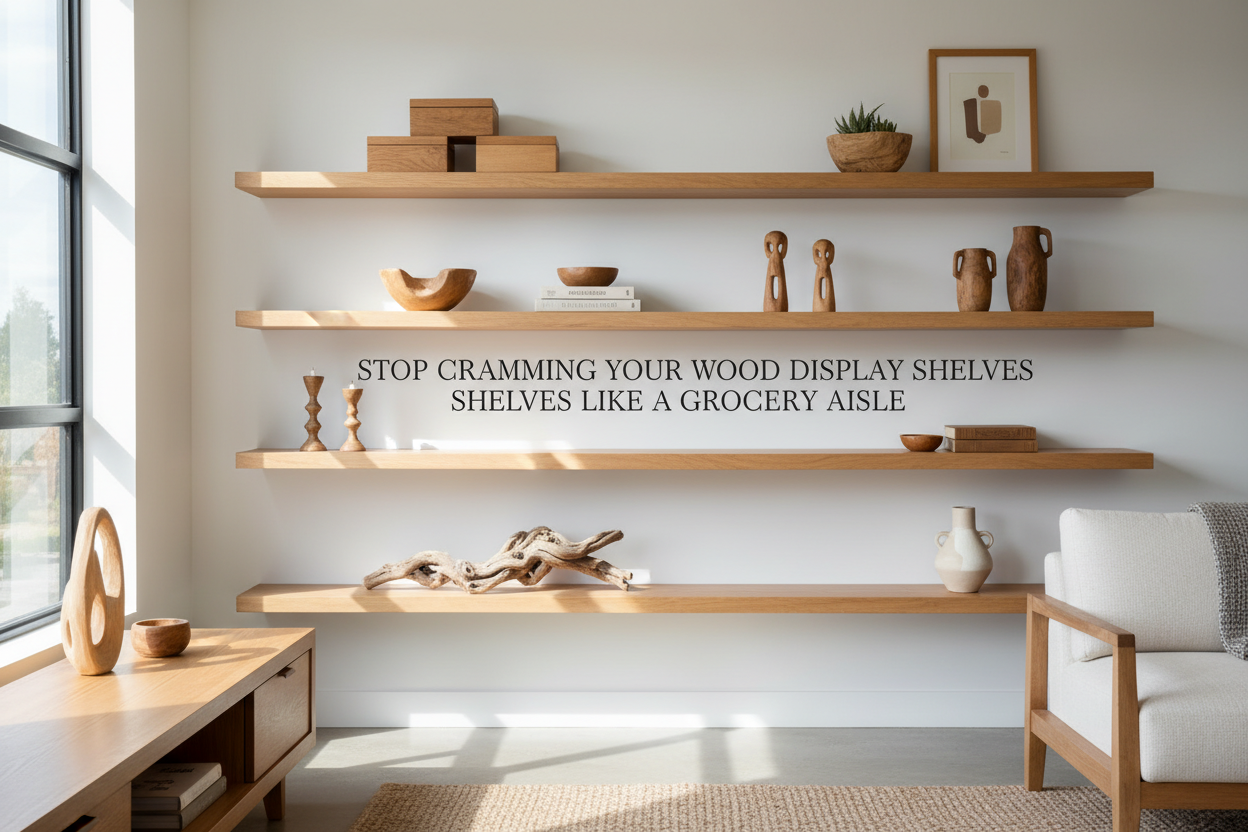
I remember staring at my first set of wood display shelves at 1 AM, surrounded by a mountain of ceramics, half-dead succulents, and every book I’d ever bought but never read. I’d spent a small fortune on a solid wood display shelves unit, expecting my living room to suddenly look like a spread from a high-end magazine. Instead, it looked like a chaotic wooden display rack at a yard sale where everything was priced at fifty cents.
It’s a common trap. We buy a beautiful wood display wall shelf and treat it like a storage unit rather than a stage. We feel this weird pressure to fill every square inch of a wooden display shelf, as if empty space is a waste of money. In reality, that ‘empty’ space is exactly what makes the objects you actually love look expensive.
Quick Takeaways
- Negative space is your best friend; if you can’t see the back of the shelf, you’ve failed.
- Use the ‘Triangle Rule’ to create visual balance without looking symmetrical.
- Mix hard and soft textures to prevent a wooden display stand for shop vibes from feeling too clinical.
- If you hate dusting, admit defeat and pivot to a unit with glass doors.
Why Your 'Curated' Shelf Looks Like a Yard Sale
The psychological difference between a well-styled wood retail display and a messy home shelf usually comes down to density. When you walk into a boutique, they aren't using their wooden shop shelves to store their entire backstock. They are using them to tell a story about three specific items. At home, we tend to treat our wood display wall shelves as a catch-all for everything that doesn't have a drawer.
When you overstuff a wooden display shelf for retail store impact, your eye doesn't know where to land. It’s visual noise. I’ve personally tested this with a heavy wood stand rack in my hallway. When I had twelve items on one shelf, it felt like a chore to even look at it. When I stripped it down to three—a vase, a stack of two books, and a small sculpture—the whole room felt ten degrees cooler. You want your wood display wall to breathe.
Overcrowding also hides the quality of the furniture itself. If you’ve invested in solid wood display shelves, you want to see the grain, the joinery, and the finish. Covering every inch of wood retail display racks with plastic knick-knacks is like buying a Ferrari and then covering it in bumper stickers. Let the wood be part of the display, not just the support system.
The 'Boutique Trick' to Styling a Wooden Display Shelf
High-end retail merchandising is all about the 'breathing room'—the intentional gaps that tell a customer, ‘This item is important.’ You can steal this for your home by treating your wooden display shelf for retail store vibes as a series of small, independent vignettes. Instead of lining books up like soldiers, stack three horizontally and place a small wooden display shelf object on top. This breaks the vertical line and creates a focal point.
One of the biggest mistakes I see is people trying to fit tall objects into short gaps. It looks cramped and awkward. This is why I always tell people that flexible adjustable shelf storage is a total game-changer for styling. It allows you to drop a shelf lower to accommodate a tall branch or a piece of art, which immediately makes the arrangement look custom and professionally designed. If your wood retail display shelves are fixed, you’re stuck playing Tetris with your own decor.
Think about the height. If every item on your wood store displays is the same height, it’s boring. You want your eyes to travel in a wave. Use small wood display shelf risers or even just thick coffee table books to vary the elevations. This is how pros make wooden shelves in a store look so much more appealing than the ones in our basements. They aren't just placing items; they are directing your gaze.
The Triangle Rule for Small Wood Display Shelves
If you're working with a small wood display shelf, the triangle rule is your secret weapon. Imagine a triangle on your shelf. You want to place your items so they hit the points of that triangle. For example, a tall vase on the back left, a medium stack of books in the center, and a small bowl on the front right. This creates depth and prevents the shelf from looking top-heavy or lopsided.
I used to struggle with a wooden wall display shelf in my kitchen. I kept putting everything in a straight line, and it looked like a grocery aisle. Once I started layering items—putting a small wooden product display piece slightly in front of a larger leaning platter—it finally clicked. It’s about creating layers that invite the eye to explore the space rather than just scanning it from left to right.
How to Mix Textures Without Losing the Plot
Wood is a warm, organic material. If you only put other wooden items on your wood shop shelving, the whole thing turns into a brown blur. You need contrast. I like to follow the 'rule of opposites.' If the shelf is a matte, dark oak, I’ll put something high-gloss or metallic on it. If it’s a light, natural birch wooden shop shelf, I’ll go for something heavy and dark, like cast iron or charcoal ceramics.
Texture isn't just about the objects, though; it's about the materials they represent. Matte paper books, glass jars, and leafy green plants all provide different visual 'weights' against the timber. If you're styling a larger piece, like a full wood retail display, you can even mix in some textile elements, like a small woven basket. If you want to dive deeper into this, you can learn how to style a wood display cabinet to master the balance of glass, wood, and light.
Don't be afraid of 'dead' materials either. A stone bookend or a brass tray can anchor a wooden stand wall arrangement that otherwise feels too floaty. The goal is to make the wooden racks for shop displays feel like they were curated over time, not bought in a single afternoon from a big-box store. Variety in texture is the fastest way to achieve that 'found' look.
When to Admit Open Shelving Isn't for You
I’m going to be honest with you: open wood retail fixtures are a lifestyle choice, and that lifestyle involves a lot of Swiffering. I once had an entire wall of wood store fixtures in a sun-drenched loft. It looked incredible for exactly three days. Then the dust settled, and every single object on those wooden store displays looked like it had been sitting in an attic for a decade.
If the thought of dusting thirty individual objects every week makes you want to move into a hotel, open shelving might not be your path. There is no shame in wanting the aesthetic of wood shelf for shop style without the maintenance. In that case, switching to a freestanding wood bookcase with glass doors is the smartest move you can make. You still get to see your beautiful wood shelves top view, but the glass keeps the grime out.
At the end of the day, your home shouldn't feel like a part-time job. Whether you choose cheap wooden display stands for a temporary fix or investment-grade wood retail store fixtures, the goal is the same: a space that reflects who you are without making you crazy. If you can’t keep it styled, hide it behind some beautiful glass and call it a day.
FAQ
How do I make my wood shelves look expensive?
Stop overfilling them. Use negative space and high-quality materials like ceramic, brass, and glass. Avoid plastic or mass-produced 'filler' decor. One large, beautiful vase always looks better than five tiny, cheap ones.
What is the best wood for display shelves?
I always recommend kiln-dried hardwoods like oak, walnut, or maple. They don't warp over time like cheap pine or particle board. If you're holding heavy books, you need that structural integrity so the shelves don't sag in the middle.
Should I organize my books by color?
Only if you want it to look like a staged home. If you actually read your books, organize them by genre or author. To keep it looking 'styled,' just make sure to mix vertical and horizontal stacks to create visual interest.

Dejar un comentario
Este sitio está protegido por hCaptcha y se aplican la Política de privacidad de hCaptcha y los Términos del servicio.