










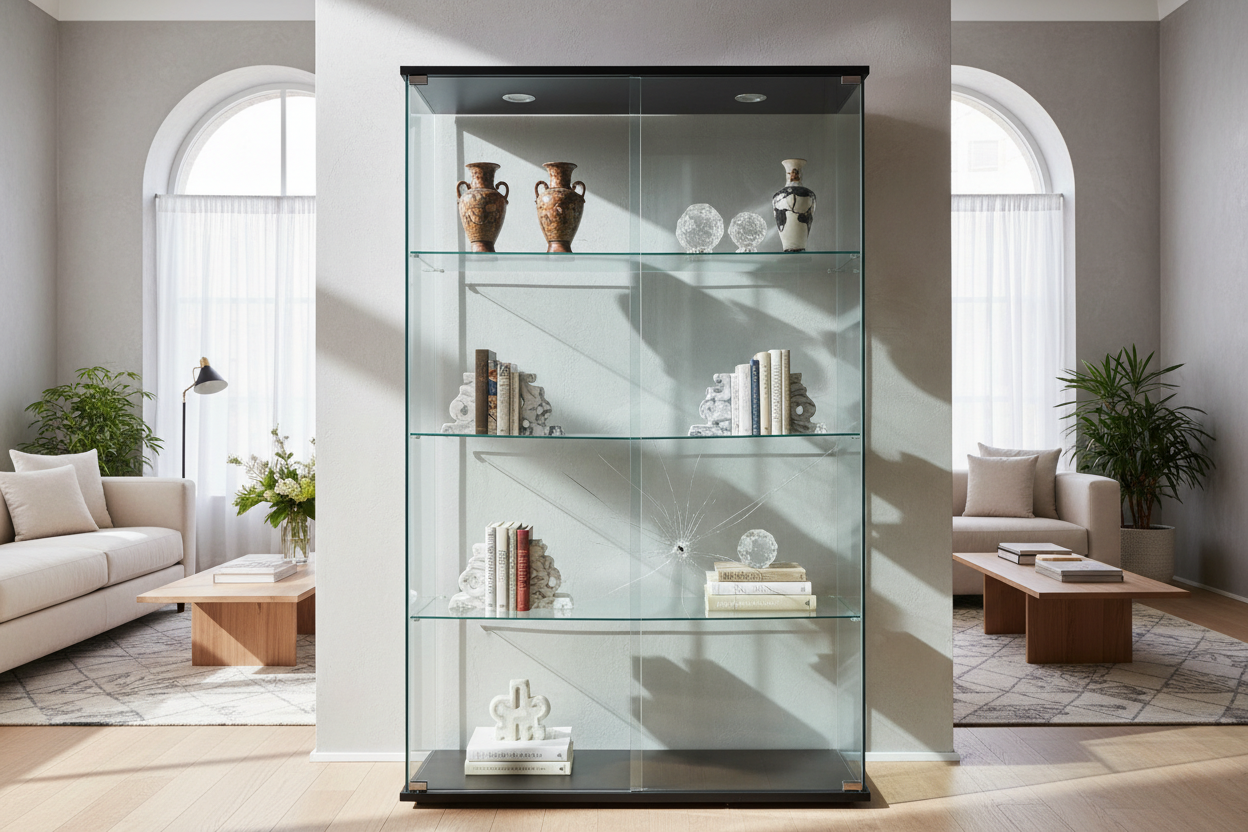
I spent three years convinced my grandmother’s heavy ceramic ginger jar was going to spontaneously combust my curio glass shelf. Every time the heater kicked on and the house creaked, I’d sit bolt upright in bed, waiting for the sound of a thousand tiny shards hitting the floor. It’s a specific kind of anxiety only collectors know—that nagging feeling that your most prized possessions are being held up by nothing more than a prayer and some 5mm silica.
The reality is that glass is much stronger than we give it credit for, provided it’s the right kind of glass. I’ve personally overloaded more than one cabinet in my time, and while I’ve had some close calls with sagging, I’ve learned that the midnight crash is usually avoidable with a little bit of physics and some honest assessment of your shelf’s limits. Most modern cabinets are surprisingly resilient, but they aren't invincible.
- Standard 3/16-inch (5mm) tempered glass usually holds 15–20 lbs if weight is distributed.
- Always check for the 'Tempered' stamp in the corner; if it's not there, proceed with extreme caution.
- The brackets (the little metal pegs) are often the first point of failure, not the glass itself.
- Keep heavy pottery and books on the solid wood base, not the glass tiers.
The Midnight Crash: My Irrational Fear of Shattered Shelving
We’ve all been there—staring at a beautiful, delicate display and wondering if that one extra crystal bowl is the straw that breaks the camel’s back. I remember waking up at 3 AM convinced I heard a hairline fracture. I ran to the living room with a flashlight, only to find my glass curio cabinet shelves sitting perfectly still, mocking my paranoia.
The truth is, tempered glass is engineered to be under internal tension. This makes it incredibly strong against direct pressure, though it’s vulnerable to sharp hits on the edges. I once dropped a heavy brass candlestick on a shelf while cleaning, and instead of a disaster, I just got a loud 'thunk' and a minor heart attack. The glass didn't even scratch. We underestimate the engineering here because it looks 'invisible,' but these shelves are workhorses in disguise.
So, How Much Can These Things Actually Hold?
Thickness is your best metric for safety. Most mass-market curio glass shelves use 3/16-inch (5mm) or 1/4-inch (6mm) glass. A standard 3/16-inch shelf that is about 12 inches deep can usually handle 15 pounds safely. If you’re pushing 25 pounds on a single thin pane, you’re entering the danger zone. I’ve seen people try to stack a full set of heavy stoneware on these, and that’s how you end up with a mess.
Tempered glass is a must. It’s four to five times stronger than standard glass. If your collection includes heavy iron statues or dense minerals, you need to be realistic. Mentioning how upgrading to a large display cabinet storage shelf eliminates the guesswork for heavier vintage collections is something I tell everyone who starts buying 'serious' antiques. Reinforced supports and thicker glass are worth the peace of mind.
The 'Tap Test' (And Other Ways to Check Your Glass)
Tempered glass has a specific ring to it. If you tap it gently with a fingernail, it sounds high and crisp, almost like a bell. More importantly, look at the edges. Tempered glass usually has smoothed, slightly rounded edges and a tiny sandblasted logo in a corner. If the edges are sharp or look like they were cut with a handheld tool, it’s likely annealed glass. Annealed glass breaks into long, lethal daggers. If that's what you have, keep the weight under 5 pounds or swap it out immediately.
The 'Heavy on the Bottom' Styling Rule
This is basic physics, but we often ignore it for 'the look.' Your heaviest items—think heavy art books, thick ceramic vases, or that cast-iron teapot—belong on the bottom. Most cabinets have a solid wood or MDF base. Use it. It’s the only part of the unit that isn't relying on four tiny metal pegs to stay upright.
When you're styling a black cabinet with glass doors, placing your lighter, translucent pieces at the top allows light to filter down. It creates a beautiful, airy glow against the dark frame while keeping the center of gravity low. This isn't just about safety; it’s about visual balance. A top-heavy cabinet looks anxious; a bottom-heavy one looks grounded and expensive.
When (And How) to Replace Your Factory Glass
If your factory glass shelf curio cabinet feels like plastic or flexes when you touch it, go to a local glazier. Ask for 1/4-inch or even 3/8-inch tempered glass with 'polished edges.' Take exact measurements—width and depth—and bring one of your current shelves so they can match the thickness for your brackets. It’s an affordable upgrade that turns a 'wobbly' cabinet into something that feels like a museum piece. I did this for an old thrift store find and it changed the whole vibe of the room.
A Stress-Free Layout That Actually Looks Good
Don't cluster everything in the center. That’s where the glass is weakest. Spread your items out toward the edges where the brackets are. Think of it like a bridge. I like to use a 'Z' pattern: a medium-weight item on the far left of the top shelf, the far right of the middle, and so on. This keeps the load balanced across the entire frame of the cabinet.
For readers who need more inspiration on arranging their newly secured shelves, check out this guide on transforming your room with a 3 shelf glass cabinet. A balanced display isn't just about weight; it's about negative space. Give your items room to breathe, and your shelves will thank you by not snapping in the middle of the night.
FAQ
Can I put books on a glass shelf?
Only if they are small paperbacks or a single decorative volume. A full row of hardcovers is far too heavy for standard 5mm glass and will almost certainly cause a failure over time.
How do I know if my shelf is sagging?
Hold a straightedge, like a level or a ruler, against the front edge of the glass. If you see a gap in the middle, the glass is bowing. Remove the weight immediately before it reaches its breaking point.
Are the metal pegs or the glass more likely to break?
Usually the pegs or the holes in the wood frame fail first. If the pegs are plastic, replace them with metal ones immediately. They are the unsung heroes of your display.



Dejar un comentario
Este sitio está protegido por hCaptcha y se aplican la Política de privacidad de hCaptcha y los Términos del servicio.